Low Likelihood of Leading to ICBM·SLBM Development
"Existing Strategic Weapon Operation Policies Likely Established"
Boosting Morale and Loyalty Through Military Personnel and Organizational Management
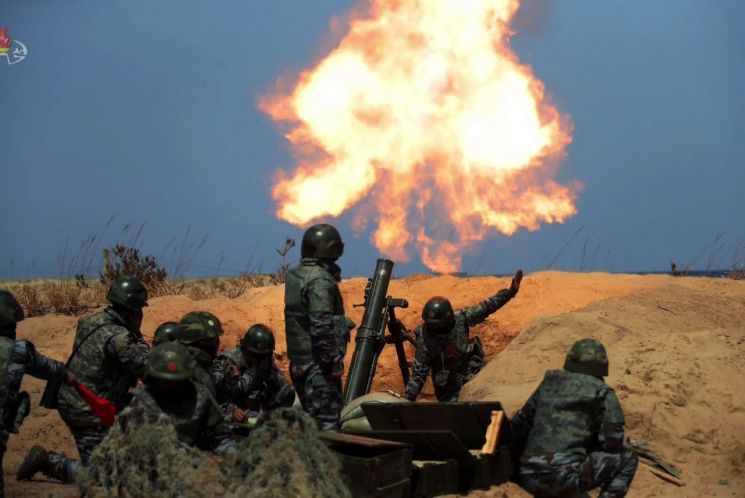
Chairman Kim Jong-un presided over the 4th Enlarged Meeting of the 7th Central Military Commission of the Workers' Party and discussed measures to strengthen nuclear war deterrence. Although the likelihood of actual nuclear-related activities continuing is considered low, concerns are rising that tensions on the Korean Peninsula could escalate as the term 'nuclear deterrence,' which had disappeared from North Korean media for some time, has reappeared.
On the 24th, North Korea's state media, Korean Central News Agency (KCNA), reported, "The 4th Enlarged Meeting of the 7th Central Military Commission of the Workers' Party was held," adding, "Comrade Kim Jong-un guided the meeting." The agency stated that at this meeting, "new policies were presented to further strengthen the country's nuclear war deterrence and to operate strategic forces in a highly dynamic state in accordance with the overall requirements for building and developing national military power," but did not specify the details.
Professor Yang Moo-jin of the University of North Korean Studies said, "It is concerning that the expression 'strengthening nuclear deterrence' has appeared again after two years," and analyzed, "The message is more about pressuring the U.S. than signaling imminent action." He explained, "North Korea's strategic forces include submarine-launched ballistic missiles (SLBM) and intercontinental ballistic missiles (ICBM), but it seems the focus is still on the deployment of the new four types of weapons system."
Hong Min, head of the North Korea Research Division at the Korea Institute for National Unification, said, "It is not easy to interpret this as a direct intention to newly develop or test strategic weapons such as ICBMs or SLBMs," and analyzed, "It seems more likely that policies related to the operation of existing strategic weapons have been established rather than new development or testing."
Professor Yang evaluated, "Since North Korea has not yet shown a policy decision to enter a dialogue phase, it is necessary to carefully analyze the impact of U.S.-China conflicts on our North Korea policy and to make continuous efforts to restore inter-Korean relations."
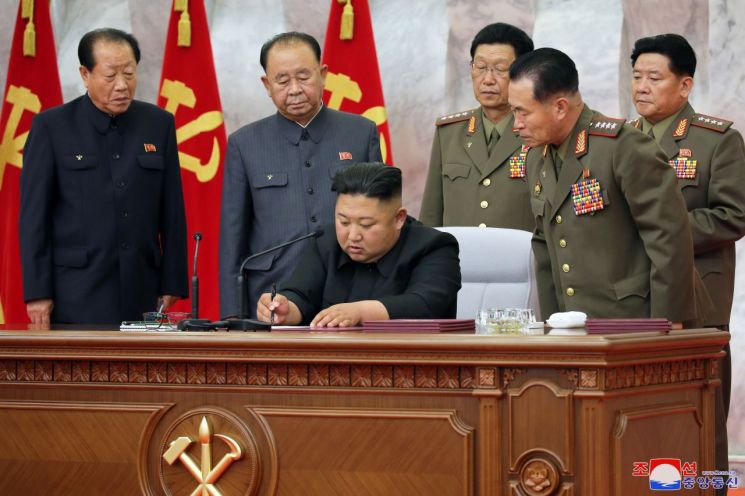 It was reported by the Korean Central News Agency on the 24th that the 4th Enlarged Meeting of the 7th Central Military Commission of the Workers' Party was held under the chairmanship of North Korean State Affairs Commission Chairman Kim Jong Un.
There is also analysis that North Korea has put newly developed weapons into operational use, increased loyalty through personnel appointments, and simultaneously strengthened organizational and political control over the military.
KCNA reported, "Significant measures have been taken to decisively enhance the firepower strike capability of the Korean People's Army artillery." Chairman Kim has expressed his determination to strengthen artillery forces by personally observing and directing artillery unit training several times since the beginning of the year.
KCNA stated that Kim signed seven orders in his own handwriting, including orders related to new military measures, organizational restructuring plans to enhance the responsibilities and roles of important military educational institutions, orders to reorganize the military command system according to the mission and duties of security agencies, and orders to promote the military ranks of commanding officers.
Personnel changes were also made to the Central Military Commission of the Party and the senior military leadership at this meeting. Ri Pyong-chol, a key figure in North Korea's missile development sector and Vice Chairman of the Workers' Party and Minister of the Military-Industrial Complex, was elected as Vice Chairman of the Central Military Commission, and Chief of the General Staff Pak Jong-chon was promoted to the rank of Chasu (a rank between Marshal and General). He is the only current military leader holding this rank.
Additionally, Pak Jong-chon, Chief of the General Staff, was the only current military leader to be rapidly promoted to the rank of Chasu (between Marshal and General). Pak, who previously served as Director of Artillery, was appointed Chief of the General Staff in September last year, equivalent to the Chairman of the Joint Chiefs of Staff in South Korea, and his rapid promotion to Chasu demonstrates Chairman Kim's trust.
Jong Kyong-taek, Minister of State Security, was promoted to General, which is interpreted as an intention to strengthen the role of the State Security Department, responsible for public security governance under North Korea's national blockade state.
At this meeting, under Chairman Kim's orders, personnel changes were also made for 7 Lieutenant Generals (three stars), 20 Major Generals (two stars), and 69 Brigadier Generals (one star).
Professor Lim Eul-chul of Kyungnam University's Institute for Far Eastern Studies analyzed, "During the COVID-19 situation, North Korea focused less on external messaging and more on strengthening internal military and organizational-political capabilities overall," adding, "The contents of the seven orders signed by Chairman Kim support this."
Professor Lim interpreted, "Although the meeting mentioned strengthening nuclear deterrence, these are things that have been repeatedly asserted before. The immediate intention seems to be to internally strengthen and reorganize the core of deterrence?nuclear, strategic weapons, and artillery firepower?while focusing on economic construction."
Hong Min said, "It is highly likely that the military's self-generated income and operations have faced various difficulties during the COVID-19 phase, which may have caused problems in the military's political life," and analyzed, "This meeting seems to be more about internal management and control of the military and the practical necessity of a new military organization rather than external messaging."
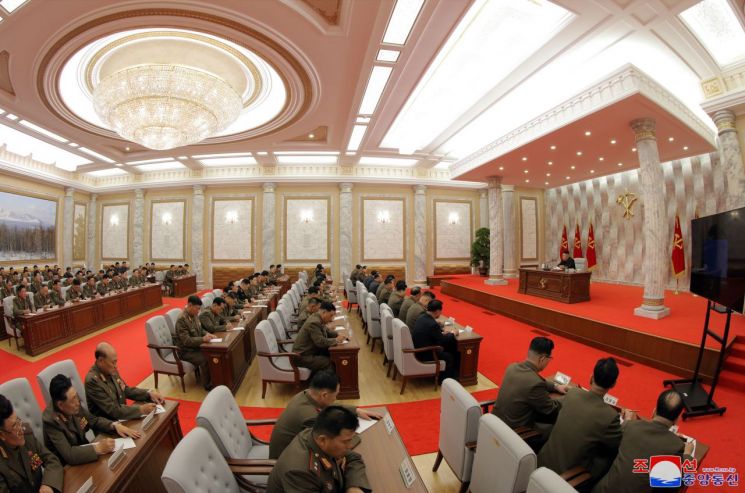 It was reported by the Korean Central News Agency on the 24th that the 4th Enlarged Meeting of the 7th Central Military Commission of the Workers' Party was held under the chairmanship of North Korean State Affairs Commission Chairman Kim Jong-un.
Meanwhile, photos released by North Korean state media show that not only Chairman Kim but all attendees did not wear masks despite being in an indoor meeting room. Professor Yang Moo-jin of the University of North Korean Studies analyzed, "This is meant to demonstrate the seriousness of military discussions and indirectly showcase Pyongyang as a COVID-19 clean area."
© The Asia Business Daily(www.asiae.co.kr). All rights reserved.
![Clutching a Stolen Dior Bag, Saying "I Hate Being Poor but Real"... The Grotesque Con of a "Human Knockoff" [Slate]](https://cwcontent.asiae.co.kr/asiaresize/183/2026021902243444107_1771435474.jpg)

















