Document Drafting and Case Analysis Done in 10 Seconds... Lowering Legal Service Prices
Legal and Ethical Issues Raised as AI Lawyers Catch Up with Human Lawyers
 With the development of an AI legal service that solves document drafting and case analysis in just 10 seconds, 'LegalTech' startups combining law and technology are emerging one after another. Photo by Gettyimage
# Two years ago, office worker Kim Hyun-ah (alias) lent a large sum of money to a junior colleague and suffered stress due to the junior delaying repayment. Following a friend's advice, she consulted with a 'non-face-to-face payment order service' company. Subsequently, she took legal action, and the processing fee was only in the 100,000 KRW range, about one-fifth of the amount she had previously known.
# Lee Young-hyun (alias), who sought a lawyer over a labor contract issue, recently found a solution to a long-standing problem in just 15 minutes. When the lawyer input Lee's labor contract into an automatic analysis program, the analysis results came out in less than a minute, providing a summary of key contract information, missing clauses, legal risks, relevant precedents, and countermeasures instantly. After receiving the results, Lee gained confidence and decided to file a lawsuit.
AI-based legal tech startups are increasing in the legal market, where accessibility was low due to consultation and retainer fee burdens. Legal tech startups leveraging AI technology are drastically lowering the cost and barriers of legal services, expanding their main customer base from marginalized groups to individual entrepreneurs and small and medium-sized enterprises. Experts also expect AI utilization to gradually increase in areas where legal information can be standardized and quantified.
Analysis completed in 10 seconds, services that replace document drafting
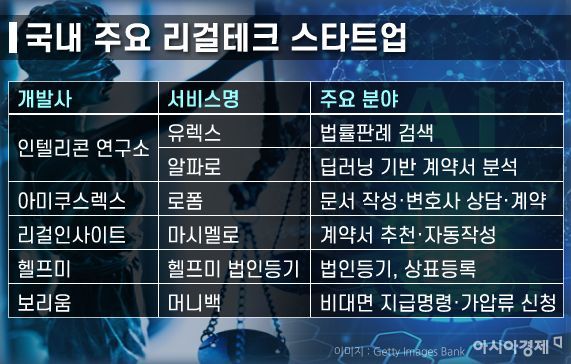
Intellicon Research Institute, which developed the AI legal analysis service 'Alpharo,' recently developed AlpharoF (Finance), a financial contract analysis machine based on the Alpharo algorithm, currently in the learning phase. Alpharo is a service that uses deep learning and machine reading technology to comprehend contracts input by users within 5 seconds. Last year, it achieved a decisive victory in a competition between human lawyers and AI lawyers. It extracts and analyzes legal issues, cautions, and confirmation points in contracts, identifies omissions and risks, and provides legal grounds and countermeasures. An Intellicon Research Institute official said, "Our goal is to introduce an all-purpose analysis system capable of reviewing contracts in all areas of daily life."
The automatic legal document drafting service 'Loform' is also gaining attention. Loform reviews and drafts documents such as certified notices and contracts. The document drafting fee starts from 10,000 KRW for individual users.
'Marshmallow,' which automatically recommends contracts tailored to user needs, analyzes the user's intent based on AI technology when the desired contract content is input. It offers over 250 contract templates, including consignment service contracts and loan agreements, enabling even those without legal knowledge to easily draft documents. User consultation content is converted into learning data and trained by AI algorithms. The developer, Legal Insight, provides Marshmallow free of charge to the public to address legal blind spots.
Long-delayed registrations and cumbersome payment orders now non-face-to-face
There are also services developed to drastically reduce the cost of legal services such as corporate registration. 'HelpMe' is a representative example. After entering information and uploading related documents, the system processes and submits the registration application within 72 hours. All tasks can be completed non-face-to-face with just a digital certificate. Following the positive response to the corporate registration service, HelpMe is currently developing and operating trademark registration and inheritance issue systems.
The payment order service 'MoneyBack,' which conveniently recovers owed money, is also conducted non-face-to-face. Payment orders issued by the court to the debtor without separate hearings upon the creditor's application become final if the debtor does not file an objection. This easily resolves matters that would otherwise take months in litigation. If supporting documents exist, users can photograph and send them via mobile phone, then input their name and signature; the AI deep learning system drafts a power of attorney within 5 minutes. The cost, which used to be around 1 million KRW when hiring a lawyer or judicial scrivener, has dropped sharply to the 100,000 KRW range. MoneyBack announced that the amount applied for through its payment order service reached 15 billion KRW last year.
'Urex,' which has learned over 3 million legal statutes, precedents, and ordinances using deep learning technology, is a search system accessible with everyday language rather than legal terms. For example, searching "responsibility of a student bullied at school and the principal" lists the Act on Prevention and Countermeasures against School Violence and related precedents. Searching "hit-and-run" provides related laws such as the Act on Aggravated Punishment of Specific Crimes and the Road Traffic Act, along with similar precedents. The engine 'Iris,' which reflects legal experts' thinking patterns and has a legal network knowledge structure, underpins Urex, implementing a visual navigation function that allows not only legal professionals but also the general public to easily check related content.
Engineer-turned-lawyer develops services directly
Lawyer Park Ui-jun, CEO of 'MoneyBack,' graduated from KAIST's Department of Electrical and Electronic Engineering and participated in service development alongside four developers. Having learned workflow automation design while serving alternative military service at Samsung Electronics Research Institute, Park said he developed the service with confidence that simple legal services could be automated through database learning with AI. Lawyer Lim Young-ik, CEO of Intellicon who developed 'Alpharo' and 'Urex,' has a unique background, having majored in life sciences at Seoul National University and taken the bar exam to develop AI programs. Lim encountered deep learning while studying neuroscience in the U.S., returned to Korea to develop legal AI, and passed the bar exam in 2009, believing law knowledge was essential. He founded Intellicon Research Institute in 2010 during his judicial training, began full-scale legal AI system development, and in 2015 released Korea's first AI legal system engine 'Iris,' demonstrating the potential of legal AI.
Under current law, AI drafting legal documents or handling legal affairs must be conducted under the supervision of a lawyer to avoid violations. In 2016, the Korean Bar Association filed complaints against four legal tech sites for violating the Attorney-at-Law Act, but all were dismissed due to insufficient evidence.
Professor Lee Byung-kyu of Myongji University's Department of Law said, "The development of AI-based legal tech is a natural and unstoppable trend, but since AI lacks the licensing required for lawyers, control and regulation are necessary. From a capital perspective, AI lawyers may be efficient, but introducing AI without restrictions in areas requiring human judgment threatens human dignity and value," he pointed out.
While AI legal services lowering barriers are becoming widespread, industry research and development have somewhat stalled. Professor Choi Kyung-jin of Gachon University's Department of Law and head of the AI and Big Data Policy Research Center analyzed, "Currently, Korea's legal tech industry has not reached a stage of creating independent added value. Along with deregulation of analysis data such as precedents and contracts, the development direction, which has been lawyer (supplier)-centered, should shift to user-centered to respond to demand in the future."
© The Asia Business Daily(www.asiae.co.kr). All rights reserved.
![Clutching a Stolen Dior Bag, Saying "I Hate Being Poor but Real"... The Grotesque Con of a "Human Knockoff" [Slate]](https://cwcontent.asiae.co.kr/asiaresize/183/2026021902243444107_1771435474.jpg)
















