Hotel Shilla Sales Down 30% Year-on-Year
Industry Reflects Full Impact of COVID-19 in Q2
Brokerages Lower Sales Targets
Hope for Performance Improvement as Cases Decline
[Asia Economy Reporter Cha Min-young] Hotel Shilla, the only domestic luxury hotel to announce quarterly earnings, has turned to a deficit as the risk of the novel coronavirus infection (COVID-19) materialized. In particular, the quarterly deficit in the hotel & leisure sector, which had been running losses for several years, increased by more than 10 billion KRW, and it is expected to worsen in the second quarter, highlighting the crisis faced by the hotel industry.
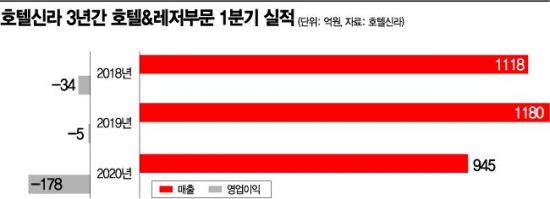
◆ Hotel Shilla, Hotel & Leisure -17.8 billion KRW = According to Hotel Shilla's earnings disclosure on the 27th, the operating loss in the first quarter was 67 billion KRW, turning to a deficit compared to the same period last year. Sales amounted to 943.7 billion KRW, down 30% from the previous year. This was due to simultaneous sluggishness in the duty-free business division (TR) and the hotel & leisure sector. Especially concerning is the operating profit of the hotel & leisure sector, which had shown clear signs of recovery. Hotel Shilla's hotel & leisure sector recorded an operating loss of 3.4 billion KRW in the first quarter of 2018 during the height of the Terminal High Altitude Area Defense (THAAD) crisis, but it quickly recovered to a loss of 0.5 billion KRW in the first quarter of 2019. However, due to the COVID-19 situation, the deficit increased again in the first quarter, reaching 17.8 billion KRW.
Domestic hotels such as Hotel Lotte and Westin Chosun, as well as major foreign hotels like Hyatt Hotel, are also unlisted companies and do not disclose their earnings, but are believed to have posted poor results. The listing schedule for Hotel Lotte has also stopped. Both the duty-free shop business and hotel business, which were the main drivers in the first quarter, suffered severe damage, causing the market value to be evaluated at about one-quarter of the initial expectations.
◆ The second quarter will be more difficult = Concerns have grown as the impact of COVID-19 is expected to continue through this summer. In fact, for Hotel Shilla, the COVID-19 impact is expected to be fully reflected in the second quarter of this year, with forecasts suggesting that the situation could worsen further rather than turning a profit. Hana Financial Investment projected an operating loss of 41 billion KRW, while Daishin Securities forecasted 76 billion KRW. Both duty-free sales and deficits in the hotel & leisure sector are expected to increase.
The hotel industry's downturn was anticipated since the outbreak and spread of COVID-19 in January this year. According to the Korea Hotel Association, the nationwide average hotel room occupancy rate (OCC) in March plummeted to 21.3%, with estimated damages approaching 580 billion KRW. The OCC was 61.7% in January before the COVID-19 outbreak, exceeding the previous year's 58%, raising expectations, but the situation changed after January. The OCC was 44.4% in February, 21.3% in March, and 25.3% in April, all below the normal operating range (60-70%). Especially, luxury hotels with high fixed costs such as property taxes and labor costs suffered greater damage. In March alone, the OCC was 18.5% for 5-star hotels, 19.2% for 4-star, 19.7% for 3-star, 25.3% for 2-star, and 35.6% for 1-star hotels. This means that tourist hotels rated 3 stars and above recorded occupancy rates in the 10% range.

◆ "Property tax and comprehensive real estate tax reductions needed" = Although the government has introduced additional support policies such as tax reductions, there are also calls for amendments to local government ordinances to translate these into actual support measures. This is because the comprehensive real estate tax corresponds to 'local taxes' paid to each local government. The financial independence ratio of local governments was only 51.4% on average nationwide in 2019. The burden of comprehensive real estate tax continues to increase. According to the Ministry of Land, Infrastructure and Transport's announcement in February this year, the nationwide standard official land price rose by 6.33% compared to a year earlier, with Seoul increasing by 7.89%. Since hotel occupancy rates have fallen to abnormal levels, follow-up measures related to this are necessary.
Professor Han Jin-su of Kyung Hee University's Department of Hotel Management pointed out, "2020 will be recorded as the worst year in the history of the domestic hotel industry," adding, "Since issues such as employee misconduct and wage problems within the lodging industry have overlapped, it is necessary to provide labor cost support to hotels to enhance long-term employment stability, and to implement short- and long-term support policies that can reduce burdens such as comprehensive real estate tax and traffic inducement charges."
A representative of the Korea Hotel Association said, "The policy to support leave pay, which provides up to 90% wage support, is a positive and fortunate aspect," but added, "However, as with the THAAD crisis in 2017, there is a lack of consultation between central government ministries and local governments with actual budget authority regarding tax benefits, so actual support has not been realized, which is regrettable."
A representative of a large hotel in Seoul said, "It would be good if there was a way for government support funds related to COVID-19 or locally issued currency to be used in hotels regardless of whether they are large or small businesses," and added, "It would be appreciated if the Korea Tourism Organization continues to explore ways to increase actual inbound visitors beyond simple national promotion."
© The Asia Business Daily(www.asiae.co.kr). All rights reserved.