[Asia Economy Reporter Junho Hwang] Domestic researchers have elucidated the principle by which shining light on the head enhances spatial memory ability.
The Institute for Basic Science (IBS) announced on the 23rd the research results of the team led by Invited Research Fellow Wondo Heo (Professor of Biological Sciences at KAIST) from the Social Brain Science Group of the Center for Cognition and Sociality.
The research team focused on the 'Fas receptor protein,' which is related to various brain diseases such as inflammatory brain diseases and degenerative neurological disorders, leading to these findings. It is known that the Fas receptor is involved in neural regeneration in the cerebral hippocampus (the area responsible for memory and learning), but the detailed mechanism of action has not been clarified.
The team developed the 'OptoFAS' technology, which induces the activation of the Fas protein by exposing it to blue light. This technology combines the gene of a photoreceptor protein, whose structure or activity changes in response to light, with the gene of the Fas receptor protein, allowing control of the Fas protein with light to activate signaling pathways within the brain.
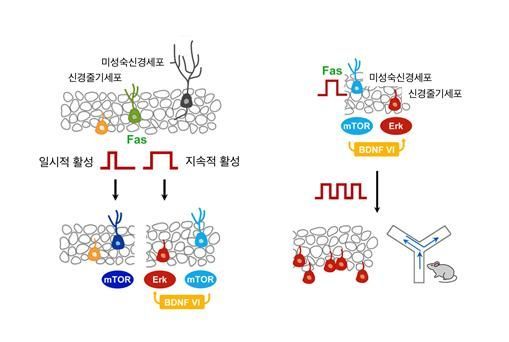
Using this technology, experiments were conducted by exposing the brains of living mice to light for various durations to spatiotemporally regulate the activity of the Fas protein.
The researchers activated OptoFAS in immature neurons located in the dentate gyrus of the hippocampus and observed that different downstream signaling pathways were activated in immature neurons and neural stem cells depending on the duration of light exposure. They also confirmed that a specific brain-derived neurotrophic factor is involved in this phenomenon. When light was repeatedly applied for a sufficient duration, adult neurogenesis was observed as neural stem cells in the hippocampal dentate gyrus proliferated, and the experimental mice showed a temporary improvement in spatial memory ability.
Professor Wondo Heo stated, "Using OptoFAS technology, it is possible to easily control protein activity and signaling pathways within neurons of living organisms using only light," adding, "We hope this technology will be widely applied in brain cognitive science research and future development of treatments for cerebral diseases."
The research results were published online on the 23rd at 3 a.m. (Korean time) in the international journal Science Advances.
© The Asia Business Daily(www.asiae.co.kr). All rights reserved.
![Clutching a Stolen Dior Bag, Saying "I Hate Being Poor but Real"... The Grotesque Con of a "Human Knockoff" [Slate]](https://cwcontent.asiae.co.kr/asiaresize/183/2026021902243444107_1771435474.jpg)















