Corporate Bond Demand Forecast Draws 740 Billion KRW on 13-14th
Focus on Bond Market Stabilization Fund Participation and Purchase Decisions
[Asia Economy Reporter Eunmo Koo] Amid the freeze in corporate bond issuance and trading due to the impact of the novel coronavirus disease (COVID-19), companies are set to conduct demand forecasting for corporate bond issuance worth 740 billion KRW next week. It is expected that the participation and purchase decisions of the Bond Market Stabilization Fund (Bond Stabilization Fund) in the demand forecasting will serve as a gauge for the stability of the corporate bond market.
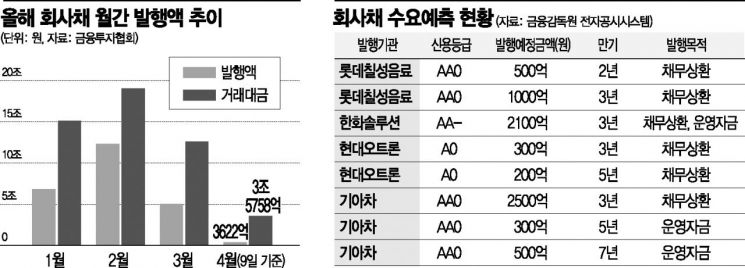
According to the Financial Supervisory Service's electronic disclosure system (DART) on the 10th, demand forecasting for unsecured corporate bond issuance totaling 740 billion KRW will be conducted on the 13th by Lotte Chilsung Beverage, Hanwha Solutions, Hyundai Autron, and on the 14th by Kia Motors.
By company, Kia Motors plans to issue 330 billion KRW, Hanwha Solutions 210 billion KRW, Lotte Chilsung Beverage 150 billion KRW, and Hyundai Autron 50 billion KRW. Kia Motors will issue 250 billion KRW with a 3-year maturity, 30 billion KRW with a 5-year maturity, and 50 billion KRW with a 7-year maturity. Hanwha Solutions will issue the entire 210 billion KRW as 3-year bonds, while Lotte Chilsung Beverage plans to issue 50 billion KRW in 2-year bonds and 100 billion KRW in 3-year bonds. Hyundai Autron plans to issue 30 billion KRW in 3-year bonds and 20 billion KRW in 5-year bonds.
Among these, the Bond Stabilization Fund is expected to participate in the demand forecasting for Kia Motors, Lotte Chilsung Beverage, and Hanwha Solutions. This is because Kia Motors and Lotte Chilsung Beverage have credit ratings of 'AA0', and Hanwha Solutions has 'AA-', which meet the Bond Stabilization Fund's purchase criteria of 'credit rating AA- or higher, bonds with maturities of 3 years or less.'
The Bond Stabilization Fund, planned to be established with a total of 20 trillion KRW to ease instability in the bond market and facilitate corporate financing, has currently raised 3 trillion KRW through its first capital call.
The results of this demand forecasting are expected to serve as an indicator of the corporate bond market's stability. If the Bond Stabilization Fund actively participates in purchasing corporate bonds and leads demand expansion, it could provide an opportunity for companies that had postponed or canceled demand forecasting due to deteriorating investor sentiment to return to the issuance market.
Researcher Sangman Kim of Hana Financial Investment explained, "As the Bond Stabilization Fund begins to actively purchase corporate bonds, corporate bond issuance will also resume in earnest. Once the issuance market restarts, concerns about corporate liquidity will ease, which is a positive factor for the credit market."
However, since the Bond Stabilization Fund cannot purchase all corporate bonds even if it participates in the market, some time will be needed before market stabilization is achieved. Researcher Kyungrok Lee of Mirae Asset Daewoo said, "Even if the Bond Stabilization Fund begins actual execution, not all corporate bonds will benefit. A thorough selection process will begin, and differentiation between high-quality and lower-quality corporate bonds will inevitably continue for a considerable period." Additionally, the fact that the Bond Stabilization Fund is unlikely to offer rates more favorable than the market reference rate (average market rate) due to its purpose is another factor slowing the market's shift to a bullish phase.
Previously, on the 6th, the Bond Stabilization Fund placed a purchase order for 30 billion KRW in the demand forecasting of Lotte Food's 3-year maturity corporate bonds, which have a credit rating of 'AA0'. This was the Bond Stabilization Fund's first corporate bond purchase decision. Lotte Food, which initially planned to raise 70 billion KRW, decided to issue 100 billion KRW after demand forecasting participation reached 140 billion KRW, twice the planned amount.
The corporate bond market has frozen as both issuance volume and trading value sharply declined last month. According to the Korea Financial Investment Association, corporate bond issuance in March was 5.552 trillion KRW, a decrease of about 7.3 trillion KRW compared to the previous month (12.3375 trillion KRW), and trading value was 12.591 trillion KRW, down about 6.5 trillion KRW from the previous month (19.0526 trillion KRW).
The yield on 3-year maturity 'AA-' rated corporate bonds, which serve as a benchmark in the corporate bond market, fell from the 2% range in mid-January to 1.644% in early March, then surged again to maintain the 2% range.
© The Asia Business Daily(www.asiae.co.kr). All rights reserved.
![Clutching a Stolen Dior Bag, Saying "I Hate Being Poor but Real"... The Grotesque Con of a "Human Knockoff" [Slate]](https://cwcontent.asiae.co.kr/asiaresize/183/2026021902243444107_1771435474.jpg)















