Highest opposition rate at 43% for 감사 선임안건
Ban on long-term pensions for outside directors... opposition rate drops to 15%
[Asia Economy Reporter Minji Lee] The Korea Corporate Governance Service (hereinafter KCGS) revealed that the rate of recommending votes against proposals at this year's regular shareholders' meetings reached 15%.
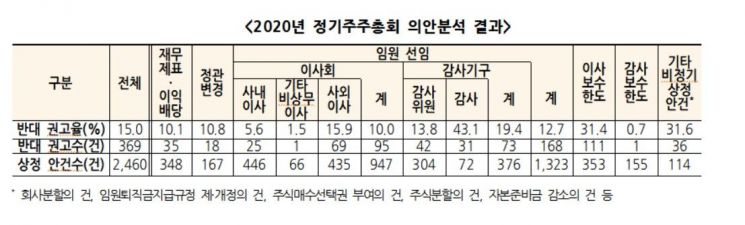
According to the '2020 Q1 Regular Shareholders' Meeting Proposal Analysis Results' released by KCGS on the 9th, out of 2,460 proposals submitted by 353 companies, KCGS recommended voting against 369 proposals (15%). This figure is similar to last year's rate (15.9%). Among the 353 companies, 206 companies, accounting for 58.4%, had at least one proposal with a recommended vote against.
By proposal type, the opposition recommendation rate for auditor appointments was the highest at 43% (31 cases). Although the Enforcement Decree of the Commercial Act only prohibits long-term reappointment of outside directors, KCGS judged that auditor candidates reappointed for more than seven years also have compromised independence.
The opposition recommendation rate for director remuneration limit approval proposals increased to 31.4% compared to 27.1% last year. KCGS recommended voting against director remuneration limit proposals in 111 companies where there was no confirmed correlation between the level of director remuneration paid and business performance, and where the actual payment level was lower than the proposed remuneration limit.
For director appointment proposals, KCGS recommended voting against 168 out of 1,323 cases (12.7%). Among these, the opposition recommendation rate for outside directors was 15.9%, significantly decreasing from 23.7% the previous year.
KCGS explained, "The main reason for the decrease in opposition cases against outside directors is that companies resolved long-term reappointments to meet legal requirements following the amendment of the Enforcement Decree of the Commercial Act," adding, "We recommended opposition against some cases where individuals continuously served as outside directors or where former other non-executive directors were appointed as outside directors."
In fact, proposals opposed due to long-term reappointment numbered 4, much fewer than last year's 39. Also, among the newly appointed outside director proposals submitted this year, 258 out of 435 (59.3%) were new appointments.
However, the number of outside directors opposed due to reasons such as damage to corporate value, inappropriate concurrent positions, and administrative or judicial sanctions increased compared to last year. KCGS stated, "There was a noticeable tendency to appoint individuals as outside directors who have direct or indirect relationships with controlling shareholders through various channels beyond explicit business transactions with the company."
Regarding financial statements and profit distribution, among 348 proposals submitted, KCGS recommended voting against 35 companies (10%) due to insufficient dividends, a significant increase from 21 cases (6.8%) last year. Companies recommended for opposition showed characteristics such as inefficient capital allocation, excessive inflow of surplus cash flow, and poor investment activities and plans, indicating a lack of active shareholder returns compared to peers.
Additionally, regarding amendments to articles of incorporation, 142 companies submitted proposals, and KCGS recommended voting against 185 proposals. The opposition rate for executive retirement pay payment proposals was 11 cases, accounting for 30.6%. Regarding company splits, 9 companies submitted split proposals, about three times more than last year's 3 companies.
KCGS commented, "The amendment of the Enforcement Decree of the Commercial Act significantly reduced long-term reappointments of outside directors, and disclosures regarding delinquency status, management of insolvent companies, and legal disqualifications have created an environment where more abundant information can be obtained than before," adding, "Regarding the qualitative aspect of disclosures, since the reasons for director recommendations are uniform, thorough disclosures are necessary."
© The Asia Business Daily(www.asiae.co.kr). All rights reserved.
![Clutching a Stolen Dior Bag, Saying "I Hate Being Poor but Real"... The Grotesque Con of a "Human Knockoff" [Slate]](https://cwcontent.asiae.co.kr/asiaresize/183/2026021902243444107_1771435474.jpg)















