3-Month Deferral for Small Business Owners and Vulnerable Groups
Aligned with Government Support Measures
94% of Revenue from Electricity Sales
Concerns Over Management Burden and Three Consecutive Years of Deficits
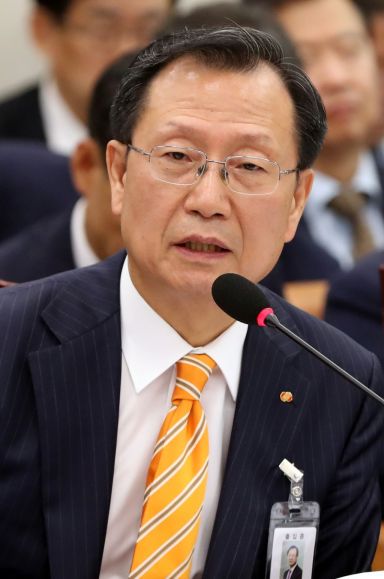
[Asia Economy Reporter Moon Chaeseok] Korea Electric Power Corporation (KEPCO) announced that, in accordance with government policy, it will accept applications for a three-month extension of the electricity bill payment deadline from small business owners and vulnerable groups affected by the novel coronavirus disease (COVID-19). Although there were expectations that raising electricity rates, which account for 94% of revenue, would help overcome the management crisis, concerns are growing as plans have been disrupted due to government policy.
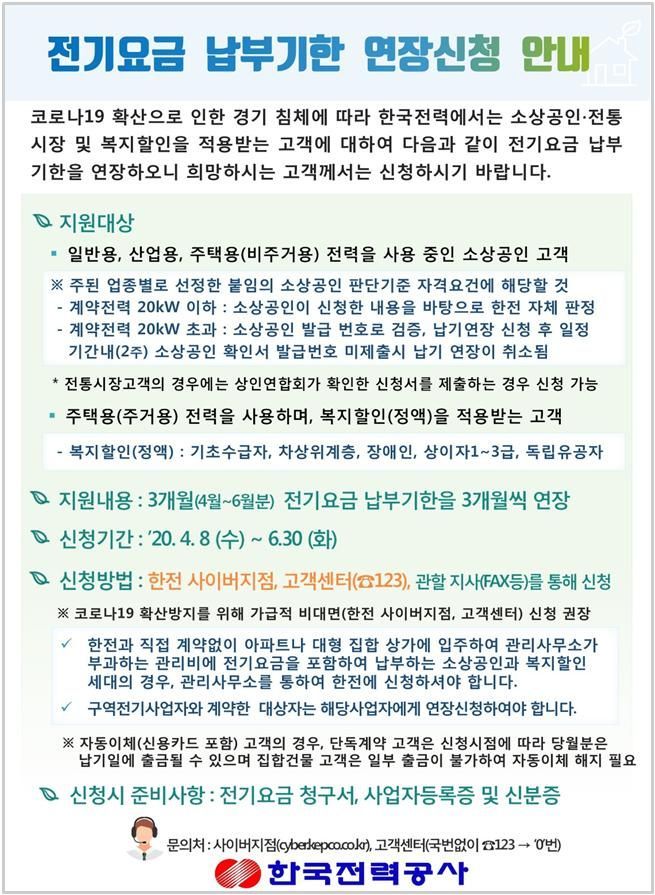
KEPCO stated that starting from the 8th, it will accept applications for the extension of electricity bill payment deadlines for small business owners and vulnerable groups through its website and call center. Earlier, the government decided, under the 'Measures to Alleviate Social Insurance and Electricity Bill Burdens,' to defer electricity bills for April to June by three months for small business owners and vulnerable groups struggling due to COVID-19. No late fees will be charged during the extended payment period. The support targets include small business owners nationwide using residential (non-residential), industrial, and general electricity, as well as households receiving fixed welfare discounts from KEPCO. KEPCO expects this support to provide practical assistance to small business owners affected by COVID-19 and contribute to economic revitalization.
Regardless of the policy's intent, concerns have been raised that it will burden KEPCO's management. Initially, there was a strong expectation that KEPCO would raise electricity rates after the general election, but this was withdrawn following President Moon Jae-in's announcement of the electricity bill deferral. Because of this, the energy industry fears that KEPCO may not be able to adjust electricity rates this year either. According to KEPCO's 2018 consolidated audit report, electricity sales revenue accounts for as much as 93.8% of total revenue.
The demand for electricity sales, KEPCO's cash cow, is steadily decreasing, and due to the government's nuclear phase-out (energy transition) policy, nuclear power plant utilization rates have fallen to the 70% range. This is why there are concerns that KEPCO will inevitably record losses for the third consecutive year if it faces adverse factors such as rising international oil prices. It is also problematic that while the cash flow is drying up, expenses are increasing. On the 3rd, the Ministry of Education finalized the establishment of the Korea Electric Power University (KEPU) school corporation, which is expected to cost over 1 trillion won, adding another financial burden.
KEPCO recorded a net loss of 1.3566 trillion won last year, plunging into its worst financial crisis in 11 years since the 2008 global financial crisis, which saw an operating loss of 2.7981 trillion won, marking the worst performance in KEPCO's history.
Some argue that KEPCO has a golden opportunity to introduce a fuel cost linkage system amid falling oil prices. KEPCO believes that by linking international fuel prices with electricity rates and periodically reflecting changes in generation costs (power wholesale prices) such as crude oil, coal, and gas in retail electricity prices, it can manage operations more stably. Fuel costs account for 50-60% of KEPCO's expenses.
However, there are criticisms that even this is not a fundamental solution. Under this structure, electricity rates could skyrocket uncontrollably during periods of sharp international oil price hikes. Oil prices can rebound at any time depending on political agreements among oil-producing countries. If oil prices rise, they could stimulate inflation, making it likely that the government will be reluctant to adopt the fuel cost linkage system.
© The Asia Business Daily(www.asiae.co.kr). All rights reserved.
![Clutching a Stolen Dior Bag, Saying "I Hate Being Poor but Real"... The Grotesque Con of a "Human Knockoff" [Slate]](https://cwcontent.asiae.co.kr/asiaresize/183/2026021902243444107_1771435474.jpg)
















