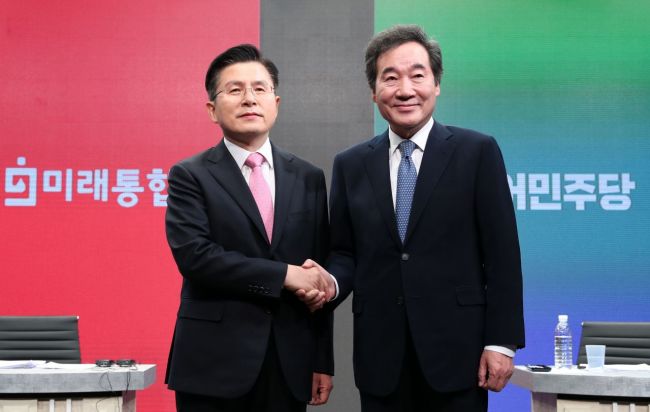
 In the April 15 general election, Lee Nak-yeon, co-chairman of the Democratic Party of Korea (right), who ran in Jongno-gu, Seoul, and Hwang Kyo-ahn, leader of the United Future Party, met and shook hands at a debate hosted by the Jongno-gu Election Broadcasting Debate Committee held on the 6th at the T-Broad Broadcasting Gangseo Production Center in Gangseo-gu, Seoul. Photo by the National Assembly Press Photographers Group
[Asia Economy Reporter Park Cheol-eung] "Voters in the Yeongnam and Honam regions, especially in this 21st general election, have already decided which party to vote for. Ultimately, the battleground will be the Seoul metropolitan area and the PK region."
This was said by Seong Dong-gyu, head of the Yeouido Institute, the think tank of the United Future Party, during an appearance on MBC Radio's 'Kim Jong-bae's Focus' earlier this month. According to a Gallup Korea poll conducted from the 31st of last month to the 2nd of this month, the Democratic Party holds 65% support in the Gwangju and Jeolla regions, while the United Future Party has only 1%.
On the other hand, in the Daegu and Gyeongbuk (TK) region, the United Future Party leads with 38%, far ahead of the Democratic Party's 19%. In the Busan, Ulsan, and Gyeongnam (PK) region, the Democratic Party has 37% support, and the United Future Party 32%, making it a close race. (The survey included 15% landline calls conducted by telephone interviewers, with a margin of error of ±3.1 percentage points at a 95% confidence level, and a response rate of 14%. For more details, refer to the Central Election Poll Deliberation Commission website.)
The PK region accounts for 40 seats. Since former President Kim Young-sam's 1990 'Three-Party Merger,' it has been a stronghold of conservatism, but due to the Democratic Party's strong performance four years ago, it now holds 10 seats. Two years ago, in the local elections, the Democratic Party caused an upset by sweeping major local government heads.
The Democratic Party is eager to secure additional seats, while the United Future Party is desperate to reclaim them. Following Democratic Party leader Lee Hae-chan's visit to Busan the day before, the 'Latte Campaign Team,' composed of retiring senior lawmakers, will tour the Gyeongnam region on the 7th. Earlier, Yang Jeong-cheol, head of the Democratic Party's think tank, the Democratic Research Institute, visited Busan on the 3rd and appealed for support, saying, "The Democratic Party must win in Busan to win overall."
The Democratic Party is placing its hopes on candidates such as Bae Jae-jung, who is competing against United Future Party candidate Jang Je-won in Sasang District; Choi Ji-eun, running against Kim Do-eup in Buk-gu and Gangseo-gu Eul; and Kim Bi-o, who is running in Jung-gu and Yeongdo-gu, where United Future Party lawmaker Kim Moo-sung has announced he will not run.
Judging by the poll results alone, the Democratic Party seems capable of securing additional seats. However, looking at individual constituencies, the situation is truly 'clock zero.' In the representative battleground of Busanjin Gap, Democratic candidate Kim Young-choon and United Future Party candidate Seo Byung-soo are so close that the outcome varies by poll. Other districts such as Nam-gu Eul (Democratic Park Jae-ho vs. United Future Party Lee Eon-ju), Haeundae Eul (Democratic Yoon Jun-ho vs. United Future Party Kim Mi-ae), and Saha Gap (Democratic Choi In-ho vs. United Future Party Kim Cheok-su) are also engaged in tight races within the margin of error. Kim Du-gwan, the Democratic candidate in Yangsan Eul, who is leading the PK election front, is showing a close support rate with United Future Party candidate Na Dong-yeon.
The United Future Party is in a more urgent situation as public sentiment in the largest region, the Seoul metropolitan area, worsens. According to Gallup Korea, in Seoul, the Democratic Party's support rate is 45%, while the United Future Party's is only 19%. In Gyeonggi and Incheon, the gap is similarly overwhelming at 43% and 21%, respectively.
Inappropriate remarks by United Future Party leader Hwang Kyo-ahn and others seem to be a contributing factor. It is reported that there are calls within the party for urgent countermeasures. Jisang-wook, a candidate running in Seoul Jung-gu and Seongdong Eul, said, "Even if candidates work hard from dawn to night, if inappropriate remarks come from the party leadership, our efforts will be in vain, so even if the same expressions are used, please use appropriate ones."
Kim Jong-in, the United Future Party's overall election committee chairman, undertook a grueling schedule on the 6th, visiting 14 constituencies in Seoul, and on the 7th, co-chairman Park Hyung-joon will campaign in Songpa Byeong, Gwangjin Gap, and Gangdong Eul to support candidates.
Kim also mentioned that the election could be overturned based on 'feelings' rather than poll results. On the same day, appearing on CBS's 'Kim Hyun-jung's News Show,' he emphasized, "It will definitely be overturned. Eight days are enough. It's easier to chase than to defend." Regarding Hwang Kyo-ahn, who is running in Jongno, Seoul, he said, "Initially, there was a gap of over 20%. That has really narrowed to about 10%, so Hwang Kyo-ahn's election is also expected."
Meanwhile, from the 9th, the publication and reporting of election-related poll results will be banned. This marks the start of the so-called 'blind election,' and depending on the public sentiment over the six days, there is a possibility that the voting patterns could differ significantly from the poll results so far.
© The Asia Business Daily(www.asiae.co.kr). All rights reserved.
![Clutching a Stolen Dior Bag, Saying "I Hate Being Poor but Real"... The Grotesque Con of a "Human Knockoff" [Slate]](https://cwcontent.asiae.co.kr/asiaresize/183/2026021902243444107_1771435474.jpg)















