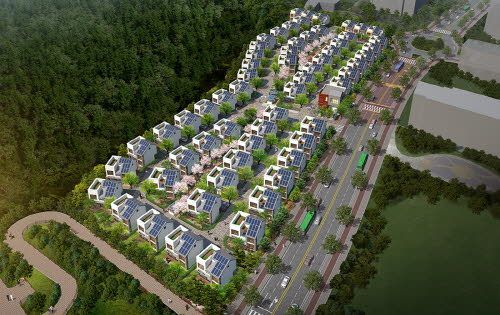
 ▲ Sejong Loren House exterior (Provided by Ministry of Land, Infrastructure and Transport)
[Asia Economy Reporter Chunhee Lee] For the first time, a detached house has received certification as a 'Zero Energy Building.' The protagonist is Sejong Loren House, developed as part of the Zero Energy Building pilot project.
The Ministry of Land, Infrastructure and Transport announced on the 29th that Sejong Loren House, a rental-type zero energy detached house (60 households), has obtained the Level 2 main certification for zero energy buildings, the first among detached houses. Loren House is a housing complex named by combining 'RO' from 'Zero Energy' and 'REN' from 'Rental House' to form 'LOREN,' designed from the start to have energy usage close to zero.
Zero energy buildings optimize energy performance and efficiency by reducing energy consumption through 'Passive' technologies such as high insulation and high airtight windows, while producing energy using advanced energy management systems with 'Active' technologies and new and renewable energy sources like solar panels. Currently, the Ministry has selected a total of 878 households, including Loren House, Osan Segyo (118 households), and Gimpo Hangang (120 households), as pilot project complexes since 2014 to expand the spread of zero energy buildings. In 2017, a certification system was introduced, dividing grades into five levels based on energy self-sufficiency rates.
After being selected for the pilot project, Loren House obtained the Building Energy Efficiency Grade certification (1+++) in 2018 and successfully acquired the main certification by meeting the Level 2 energy self-sufficiency standard, which applies to buildings producing 80% or more but less than 100% of primary energy consumption per unit area.
Loren House produces more than 80% of the energy used for heating, cooling, and lighting by installing solar panels and heat recovery ventilation systems. It produces over 83% of the total consumed energy on its own. Additionally, by adopting various high-efficiency equipment systems, energy costs per household are almost negligible except during extreme heat or cold periods. As a result, the average monthly electricity bill per household at Loren House is about 7,000 KRW.
As of March, including Loren House, a total of 13 buildings have obtained the main certification for zero energy buildings. With the mandatory implementation of zero energy buildings for public buildings this year, the spread of zero energy buildings is expected to expand significantly. Although about 69% of the main certifications so far have remained at Level 5, Loren House's achievement of Level 2 certification confirms that high-level zero energy buildings can be realized in detached houses without significant additional costs.
Kim Sang-moon, Director of Building Policy at the Ministry of Land, Infrastructure and Transport, stated, "Zero energy buildings are a key means to reduce greenhouse gases for realizing a healthy living environment and can also contribute to housing welfare by reducing heating and cooling costs. We will further develop our zero energy building technology level, accelerate its spread, and lead overseas expansion of related industries and job creation."
© The Asia Business Daily(www.asiae.co.kr). All rights reserved.