Asia Economy & Seoul City Joint Project [Work-Life Balance 2.0 Era]
Work-Life Balance Leading SME 'Hanguk Gisul Gyeongyeong Yeonguwon'
Corporate Management Diagnosis & Training Services
Voluntary Remote Work
Paid Continuous Service Leave
No Forced Overtime
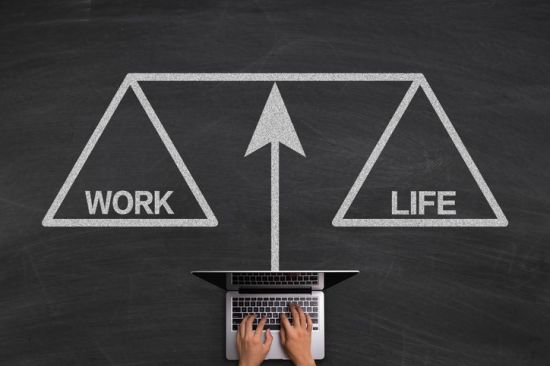 [Image source=Getty Images]
[Asia Economy Reporter Hyunju Lee] As the novel coronavirus infection (COVID-19) spread, the government and local governments proposed a "pause" as part of social distancing measures. One method was the introduction of telecommuting, working from home. However, there was a clear polarization among companies regarding whether to implement telecommuting. Large corporations that had prepared related systems adapted smoothly, but many small and medium-sized enterprises (SMEs) did not even attempt it. Only after a mass infection outbreak occurred at a call center located in Guro-gu, Seoul, did the Ministry of Employment and Labor announce a policy to support SMEs with up to 20 million won for infrastructure setup costs if they adopt telecommuting.
Is work-life balance (work and life balance) only someone else's concern for SMEs? There is a company that broke the prejudice that flexible work such as telecommuting is impossible for SMEs. The Korea Institute of Technology Management, located in Eunpyeong-gu, Seoul, has only 10 employees including the CEO, but it has created and practices a work-life balance system tailored to the company's circumstances. This company provides educational services to other companies and also offers consulting to help obtain ISO certification.
The Korea Institute of Technology Management considers its small number of employees an advantage. As COVID-19 showed signs of prolonging, they accepted telecommuting applicants. Except for employees who found it difficult to work at home due to having children, half of the staff started telecommuting from the 5th of last month. They enabled remote server access and transferred internal phone lines to each individual's personal mobile phone. Seo Yeo-jung (29), who has been with the company for three years, said, "I applied for telecommuting because my commute was long," adding, "It was advantageous to save commuting time and work in comfortable clothing."
On the 12th, a week after implementing telecommuting, all employees gathered at the company. It was a meeting to discuss the pros and cons experienced firsthand and to devise improvements. As a result, they agreed on a policy to implement telecommuting voluntarily and to notify internally through the intranet only one day in advance. Since there was an opinion that it would be good to meet face-to-face about once a week for weekly reports, they decided to come to the office only on Fridays. Park Tae-hyun, head of the Management Planning Office, said, "We are implementing telecommuting according to each person's circumstances, such as working one day at the office and one day from home."
No pressure to leave early when work ends
One cultural day per month
No complaints about overtime when urgent work arises
The stereotype that SMEs have long working hours and frequent overtime does not apply here. The Korea Institute of Technology Management’s weekly working hours are 35 hours. Official working hours are from 9:30 a.m. to 5:30 p.m. There are almost no employees working overtime. Kim Ha-kyung (29), who has been with the company for eight months, said, "I can freely invest time in self-development activities such as family meals, meeting friends, exercise, studying, and club activities." Seo Seon-jin (47), who experienced a career break of about seven years raising children, said, "I am satisfied with the commuting hours, and no one pressures me when I leave after finishing work." She also mentioned that when urgent work arises, she works overtime without complaints, thanks to the company's consideration.
Another work-life balance system at the Korea Institute of Technology Management is granting at least 15 days of paid leave, including weekends, at 3, 5, 7, and 10 years of continuous service. This is additional to annual leave and can be used separately. They also plan to actively utilize flexible working hours in the future. Park said, "Employee demand is the top priority, so we are conducting surveys related to implementation," adding, "On the monthly 'Culture Day,' work ends at 2 p.m., and employees go together to watch movies or go bowling."
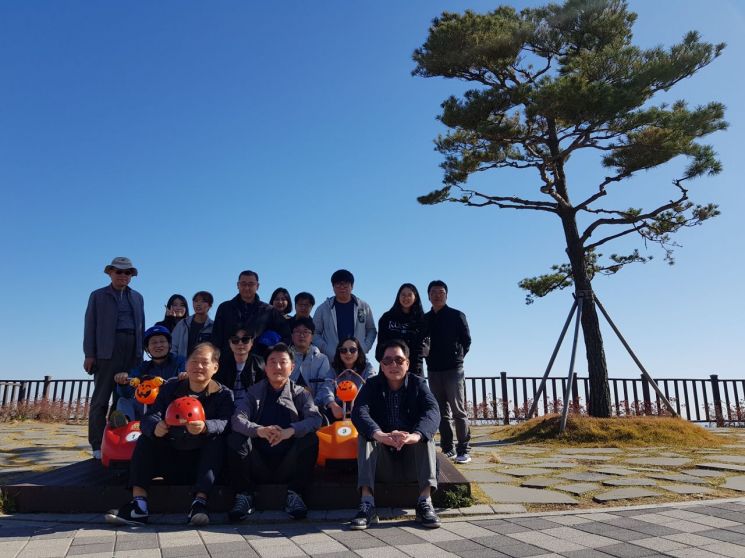 Members of the Korea Technology Management Institute (Provided by Korea Technology Management Institute)
The strong will of CEO Ju Seong-jong, who founded the company in 2015, was a major factor in actively adopting the work-life balance system. CEO Ju said, "I have worked at various companies and often felt like I was just being exploited," adding, "When I became a leader, I often thought I shouldn't do that, and I wanted to apply it when I started my own company." He also laughed and questioned, "In my previous workplaces, they emphasized having a sense of ownership a lot, but how many companies actually treat employees as owners?"
CEO Ju established the Korea Institute of Technology Management after working as a professional manager in venture companies, marketing team leader in a media company’s business division, contract public official, and university professor. Starting from a 5-pyeong (approx. 16.5 sqm) office in Hongje-dong, Seoul, he moved to a newly built office in Nokbeon-dong two years ago. CEO Ju said, "I believe there is no need to hold on to work that can be finished in 2-3 hours until the end of the workday," emphasizing, "Rather than telling the younger generation to blindly follow us, we should wisely pass on the good experiences from our time so they can use them well."

© The Asia Business Daily(www.asiae.co.kr). All rights reserved.
![Clutching a Stolen Dior Bag, Saying "I Hate Being Poor but Real"... The Grotesque Con of a "Human Knockoff" [Slate]](https://cwcontent.asiae.co.kr/asiaresize/183/2026021902243444107_1771435474.jpg)
















