Economic Downturn Triggered by COVID-19... Concerns Over Falling House Prices
Possibility of 'Kkangtong Jeonse' Spreading in Areas with High Jeonse-to-Price Ratios
Late Rush to Subscribe to Jeonse Deposit Insurance Amid Growing Anxiety
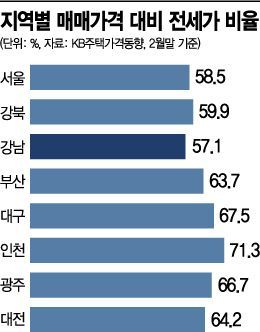
[Asia Economy Reporter Moon Jiwon] As signs of a decline in housing prices appear in some areas, concerns are emerging that 'Kkangtong Jeonse' (underwater Jeonse) could spread, especially in regions where the Jeonse price is higher than the sale price. In fact, some Jeonse tenants are hastening to subscribe to Jeonse deposit insurance to prepare for potential risks. Experts warn that if the real economy downturn begins to seriously affect the real estate market, the repercussions could be significant.
According to industry sources on the 18th, despite the Bank of Korea's interest rate cuts, voices expressing concern over falling housing prices are growing due to the real economy downturn caused by the COVID-19 pandemic. The government's tightening of regulations, such as expanding the scope of investigations into the sources of real estate purchase funds, is also interpreted as dampening sales demand.
Experts say that if the economic downturn prolongs, the ability of landlords who made so-called gap investments?buying homes with Jeonse deposits?to repay Jeonse deposits may decline, leading to a significant increase in tenants suffering losses. Park Wongap, Senior Real Estate Specialist at KB Kookmin Bank, explained, "If domestic and international economic uncertainties become extremely severe, domestic real estate sale prices could fall. In that case, the phenomenon of Kkangtong Jeonse, where tenants in apartments with a high Jeonse-to-sale price ratio suffer losses, is highly likely to emerge."
In fact, during past real estate downturns, there were cases where sale prices fell below Jeonse deposits, causing Jeonse tenants to be unable to recover their deposits. Tenants' anxiety is also increasing. A man in his 30s living in an officetel in Dangsan-dong, Yeongdeungpo-gu, Seoul, is currently considering subscribing to Jeonse deposit insurance. When he renewed his Jeonse contract at the end of last year, he did not plan to subscribe due to the cost of fees, but he has since changed his mind. He said, "Although the contract period is still ongoing, I feel uneasy because the landlord made a gap investment. I plan to visit a bank soon for consultation."
Online, more tenants are expressing their concerns. One netizen living in Jeonse said, "The landlord put the house up for a quick sale last week, and the buyer signed the sales contract under the condition of Jeonse succession without even seeing the house. I bought Jeonse deposit insurance recently because I was anxious, but I still feel uneasy because I don't know the new landlord's financial situation."
Experts point out that if the housing price decline accelerates, areas that have experienced rapid short-term price increases or where the Jeonse-to-sale price ratio is high could be at risk. Ham Youngjin, Head of the Zigbang Big Data Lab, said, "It is still difficult to say that the reverse Jeonse crisis will become a nationwide phenomenon. However, places where the Jeonse price accounts for more than 80% of the sale price, areas with excessive supply, or regions where assets are overvalued and sale prices may fall could face problems." Park added, "Compared to Seoul, Kkangtong Jeonse is more concerning in regions with housing price declines such as Gangwon and Jeju."
However, some argue that it is still too early to worry about a housing price crash or a reverse Jeonse crisis. Although there are some quick-sale listings in the Gangnam area, it is difficult to say the overall real estate market is in decline, and if the COVID-19 situation ends early, the low-interest-driven housing price rise may continue.
Kim Deokrye, Director of Housing Policy at the Korea Research Institute for Human Settlements, said, "It is difficult to discuss the housing market beneath the macroeconomy when we have no idea how the economic downturn will spread in the US, Europe, and domestically. However, since the situation is clearly uncertain, it is advisable to subscribe to Jeonse deposit insurance as a precaution."
© The Asia Business Daily(www.asiae.co.kr). All rights reserved.
![Clutching a Stolen Dior Bag, Saying "I Hate Being Poor but Real"... The Grotesque Con of a "Human Knockoff" [Slate]](https://cwcontent.asiae.co.kr/asiaresize/183/2026021902243444107_1771435474.jpg)














