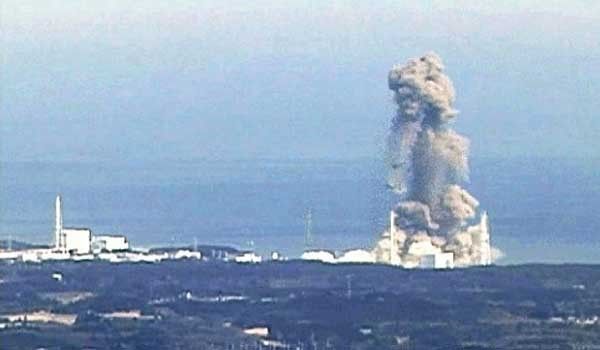
 Explosion scene of Fukushima Nuclear Power Plant Unit 4 immediately after the Great East Japan Earthquake in 2011 [Image source=Yonhap News]
[Asia Economy Reporter Hyunwoo Lee] The international environmental organization Greenpeace announced that the radioactive materials in the Fukushima Prefecture area of Japan, where the baseball and softball events of the Tokyo Olympics scheduled for July will be held, exceed 1,700 times the levels before the Fukushima nuclear power plant accident. As radiation issues arise alongside the novel coronavirus infection (COVID-19), controversy over the possibility of holding the Tokyo Olympics is expected to intensify.
On the morning of the 9th, Greenpeace held a press conference in Tokyo, Japan, and announced the results of radiation measurements conducted from October 16 to November 5 last year in the Fukushima Prefecture area. They reported that the surface radiation levels around the Tokyo Olympic facilities were approximately 1,775 times higher than before the nuclear accident. According to Greenpeace, after Typhoon Hagibis (Typhoon No. 19) in October last year caused some radioactive waste to be washed away by heavy rain and floods, investigations in the Fukushima area identified numerous so-called "hotspot" regions where radiation levels were several times higher than the surrounding average.
In particular, around a closed elementary school in Namie-machi, Fukushima Prefecture, where evacuation orders have been lifted, many places along the roads were covered with mud-stained leaves and branches, which Greenpeace assessed as hotspots. Greenpeace explained, "It appears that mud containing radioactive substances was transported from the forest attached to leaves and branches due to heavy rain."
Especially, radiation levels near the Tokyo Olympic-related facilities scheduled for July this year were found to be very high. At the J-Village area, about 20 km south of the Fukushima Daiichi Nuclear Power Plant, which is the starting point of the Tokyo Olympic torch relay, surface radiation levels reached 71 microsieverts (μSv). The background radiation level, which indicates radiation levels in Fukushima Prefecture before the nuclear accident, was 0.04 μSv. Greenpeace stated that it is difficult to definitively assess the impact of this level of radiation on the human body and said, "We cannot say the risk is zero."
© The Asia Business Daily(www.asiae.co.kr). All rights reserved.
![Clutching a Stolen Dior Bag, Saying "I Hate Being Poor but Real"... The Grotesque Con of a "Human Knockoff" [Slate]](https://cwcontent.asiae.co.kr/asiaresize/183/2026021902243444107_1771435474.jpg)















