End of Diagnostic Fee Increase Competition
Starting This Month, Efforts to Manage Loss Ratio Begin
[Asia Economy Reporter Oh Hyung-gil] The reduction of coverage limits in the non-life insurance industry is becoming more pronounced. From this month, the diagnosis benefit for carcinoma in situ has been reduced to 10 million KRW at most non-life insurers. Compared to just a year ago, when insurers offered coverage up to 50 million KRW, sparking a surge in carcinoma in situ subscriptions, the situation has changed drastically. This reflects an urgent need to strictly manage loss ratios, even if it means lowering coverage limits.
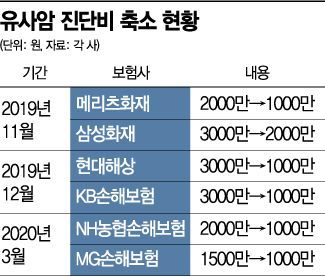
According to the non-life insurance industry on the 3rd, NH Nonghyup Insurance has reduced the carcinoma in situ diagnosis benefit from 20 million KRW to 10 million KRW starting this month. MG Non-life Insurance also lowered the maximum carcinoma in situ diagnosis benefit from 15 million KRW to 10 million KRW. Samsung Fire & Marine Insurance, which currently offers coverage up to 20 million KRW, is also expected to reduce its limit soon.
An industry insider said, "Customers who wanted to subscribe with a carcinoma in situ coverage limit of 20 million KRW completed their applications by the 28th of last month," adding, "From this month, not only is the reduction of carcinoma in situ coverage being announced, but there are also talks about cuts in vascular diagnosis benefits."
Carcinoma in situ refers to thyroid cancer, other skin cancers, borderline tumors, and carcinoma in situ. Compared to general cancers, it has a higher incidence rate, so the coverage amount tends to be lower. Thyroid cancer is the most common cancer among women in Korea, but its survival rate is nearly 100%, indicating excellent treatment outcomes.
Last year, non-life insurers raised the coverage amounts for carcinoma in situ, making it a key item in the competition for long-term insurance sales. In the second half of last year, products guaranteeing up to 50 million KRW for carcinoma in situ diagnosis benefits for seniors aged 60 and over appeared, leading to overheating in the market.
Financial authorities, concerned about excessive competition among companies, recommended reducing coverage limits. Consequently, from the second half of last year, major non-life insurers began significantly lowering carcinoma in situ coverage.
Meritz Fire & Marine Insurance reduced the carcinoma in situ diagnosis benefit from 20 million KRW to 10 million KRW starting November last year.
Hyundai Marine & Fire Insurance and KB Insurance also reduced the carcinoma in situ diagnosis benefit to 10 million KRW around the end of last year. Some insurers have even lowered the cumulative industry subscription limits, refusing additional subscriptions for carcinoma in situ diagnosis benefits from consumers who already have coverage with other insurers.
Reducing carcinoma in situ diagnosis benefits is expected to directly impact future long-term insurance sales. It is interpreted as an intention to strengthen loss ratio management and reduce losses, even if it means lowering sales. While loss ratios have been surging in auto insurance and indemnity insurance, which were relatively stable, management is now being tightened even in long-term insurance.
An insurance industry official explained, "The competition to raise diagnosis benefits, which had overheated as companies focused on protection insurance products, is ending, and the mood is shifting to loss ratio management," adding, "From the consumer's perspective, since coverage details have been reduced compared to the past, if they want to maintain high coverage limits, the insurance premium burden will inevitably increase."
© The Asia Business Daily(www.asiae.co.kr). All rights reserved.
![Clutching a Stolen Dior Bag, Saying "I Hate Being Poor but Real"... The Grotesque Con of a "Human Knockoff" [Slate]](https://cwcontent.asiae.co.kr/asiaresize/183/2026021902243444107_1771435474.jpg)















