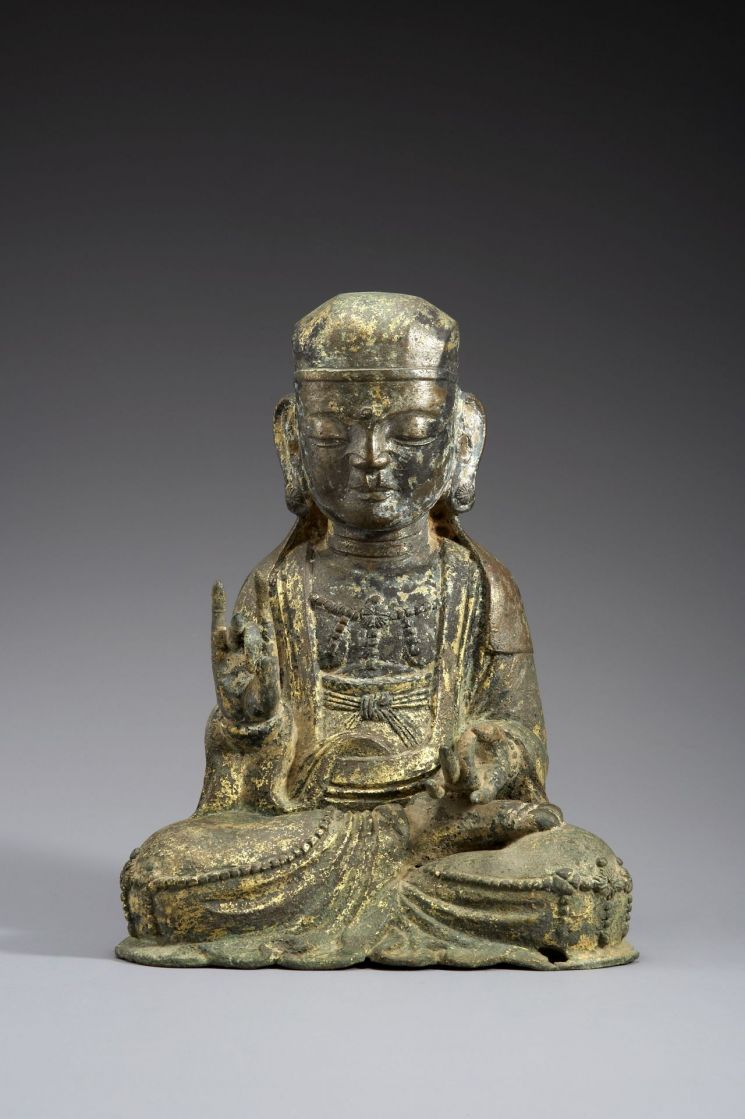
 Batch of Gilt-Bronze Buddha Statues Excavated from the Five-Story Stone Pagoda at Muryangsa Temple, Buyeo_Gilt-Bronze Seated Jizang Bosal Statue
[Asia Economy Reporter Lee Jong-gil] Four Buddhist statues discovered during the dismantling of the five-story stone pagoda at Muryangsa Temple in Buyeo (Treasure No. 185) have been designated as treasures. These include one Goryeo gilt-bronze Bodhisattva seated statue and three Joseon gilt-bronze Amitabha Triad seated statues.
The Cultural Heritage Administration announced on the 27th that the "Batch of Gilt-Bronze Buddhist Statues Excavated from the Five-Story Stone Pagoda at Muryangsa Temple in Buyeo," the "Earthenware Turtle-Decorated Cylindrical Stand and Short-Necked Jar Excavated from Tomb No. 11 in Bokcheon-dong, Busan," and the "Gwanbuk Yeojido" have each been designated as nationally designated cultural treasures.
The five-story stone pagoda in front of the Geungnakjeon Hall at Muryangsa Temple is an early Goryeo period pagoda that inherits the Baekje and Unified Silla stone pagoda styles. During dismantling and repair work in August 1971, a gilt-bronze Amitabha Triad seated statue consisting of Amitabha Buddha, Avalokitesvara Bodhisattva, and Ksitigarbha Bodhisattva was found on the first story of the pagoda body. The composition and iconography are intact and exhibit distinct stylistic features of the period. The gilt-bronze Bodhisattva seated statue excavated from the second story is highly valued for its clear discovery location and production period, contributing to its historical, academic, and artistic significance. The Cultural Heritage Administration explained, "Although there is no inscription revealing the background of its creation, the condition is good and the carving technique is excellent."
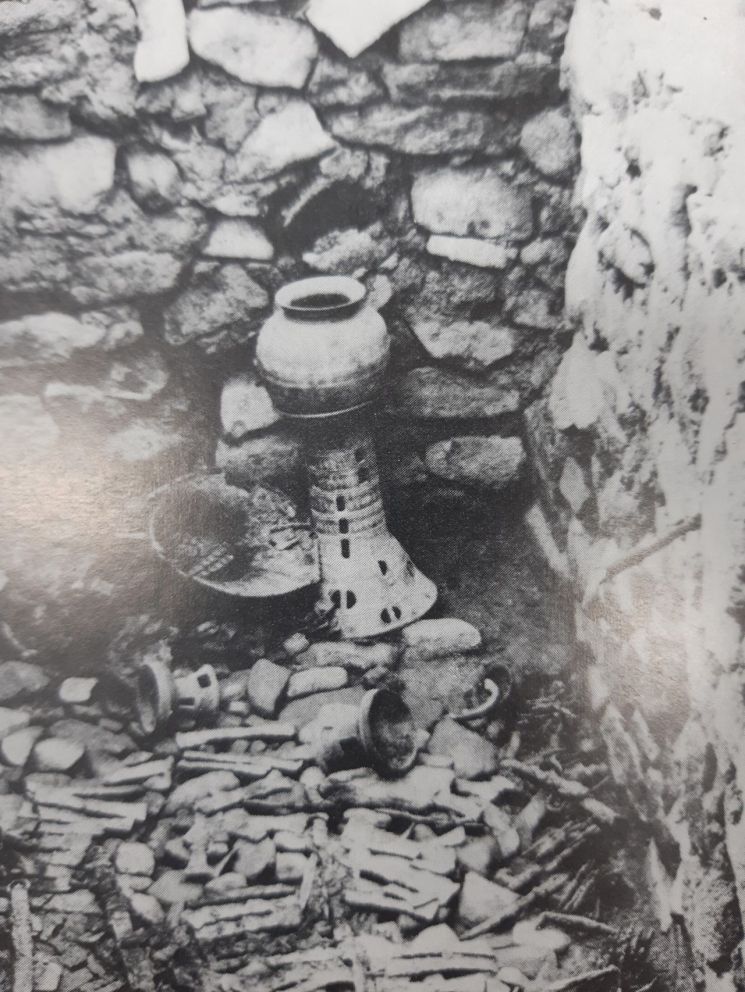 Appearance of pottery turtle-decorated cylindrical vessel and short-necked vessel excavated from Tomb No. 11 in Boksan-dong, Busan
The earthenware from Tomb No. 11 in Bokcheon-dong, Busan, housed at the National Gimhae Museum, consists of a cylindrical stand called gidae (器臺) and a short-necked jar called dangyeongho (短頸壺). Tomb No. 11 in Bokcheon-dong was excavated by the Busan National University Museum in the 1980s and is presumed to be the burial site of a regional leader from the 5th century. The earthenware was excavated from the southwest side of the tomb chamber. Unlike many earthenwares from that time which were heavily damaged, these have almost no broken parts. A turtle-shaped clay figurine was attached to the center of the gidae. The Cultural Heritage Administration stated, "This is the only known example among Three Kingdoms period earthenware." They added, "The holes called tochang (透窓) pierced in the base are made in various shapes, and the patterns are engraved in a zigzag design. The surface is evenly coated with glaze, and the form is stable, which are also distinctive features."
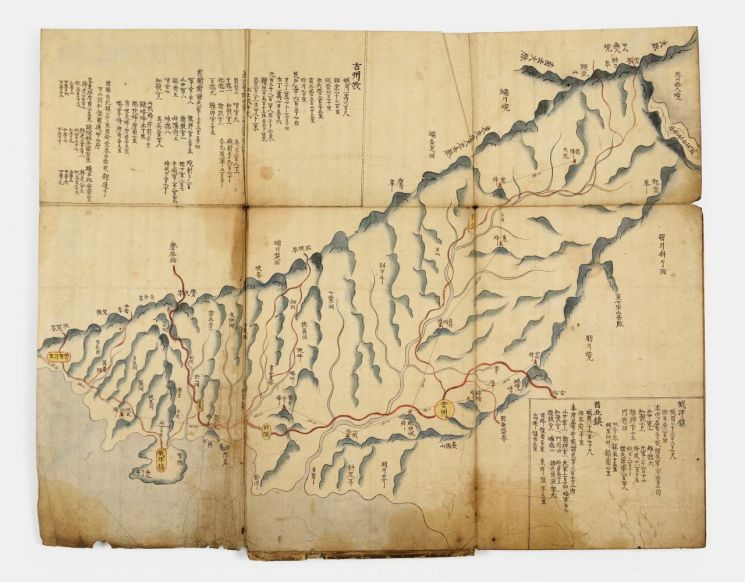
The "Gwanbuk Yeojido (關北輿地圖)" held by Dong-A University in Busan is an 18th-century atlas depicting villages and strategic points in the Gwanbuk region of Hamgyeong Province during the Joseon Dynasty. Among the eight extant Dongmyeong maps in Korea and abroad, it is regarded as having the most excellent production technique. The estimated production period is during King Yeongjo's reign from 1738 to 1753. It was produced as a successor to the atlas commissioned in 1719 by Lee Sam (1677?1735), a late Joseon military official who served as the commander of Hamgyeong Province. The Cultural Heritage Administration noted, "This reflects the heightened interest in Hamgyeong Province following the border agreement between Joseon and Qing in 1712." They further explained, "The atlas includes information by region such as distances to Hanyang (Seoul), population counts, military numbers, and details of yeogwan (驛院), a type of inn. Communication routes between beacon fire stations are indicated with solid lines. The application of painterly techniques to the map is also a distinctive feature."
© The Asia Business Daily(www.asiae.co.kr). All rights reserved.
![Clutching a Stolen Dior Bag, Saying "I Hate Being Poor but Real"... The Grotesque Con of a "Human Knockoff" [Slate]](https://cwcontent.asiae.co.kr/asiaresize/183/2026021902243444107_1771435474.jpg)

















