Industry: "Shutdown Just Beginning... Government Must Urgently Prepare Measures"
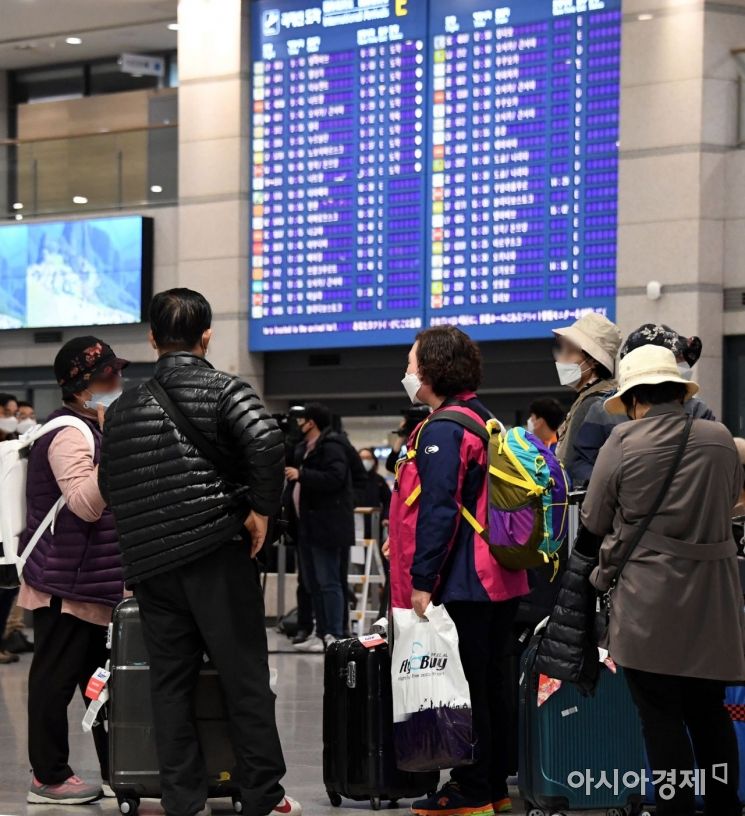 Korean tourists who arrived on the first charter flight arranged by the Israeli government gathered at Terminal 1 arrival hall of Incheon International Airport on the 25th. / Yeongjongdo - Photo by Kim Hyun-min kimhyun81@
[Asia Economy Reporter Yu Je-hoon] As the novel coronavirus disease (COVID-19) outbreak that started in Daegu spreads nationwide, the number of flights and passengers operated by Korean national airlines at Incheon International Airport have decreased by 8% and 15%, respectively, in just one week. This is due to various countries rapidly restricting air traffic with Korea to prevent the spread of COVID-19. Industry insiders express concerns that the "skyway shutdown" is only beginning, as entry restrictions to Korea are still in the early stages and airlines plan to intensify flight suspensions from later this week.
◆ Already down 30%, then another 8% drop in 7 days = According to Incheon International Airport Corporation on the 27th, as of the 25th, the total number of flights operated by eight Korean national airlines departing from Incheon Airport was 515. This represents a 7.87% decrease in flights within just seven days since the first confirmed patient in Daegu, who was the 31st confirmed case in Korea, was identified. Passenger numbers also dropped by 15.14% to 58,303.
During the same period, the total number of flights departing Incheon, including foreign airlines, was 772. Since the first confirmed case appeared on January 20th, flights had already decreased by 28.05% by the 18th, and then dropped an additional 6.54% in just one week. Compared to a year ago, the total number of flights departing Incheon by Korean national airlines decreased by 29.36%, and including foreign airlines, the total flights dropped by 30.89%.
The decline in passenger numbers is even greater than the drop in flights. The number of passengers departing Incheon Airport, which was 199,547 on January 21st, fell by 50.18% to 99,457 on the 18th, and then further decreased by 12.88% to 86,646 on the 25th. Compared to a year ago, when the figure was 214,760, this is a sharp decline of 59.65%.
The regions leading the flight reductions over the past week were Northeast Asia (excluding China and Japan) and Southeast Asia routes. Flights to these regions decreased from 365 on the 18th to 297 on the 25th, a reduction of about 18%. While flights to China had been the most heavily reduced region since the first confirmed case (from 272 flights on January 21st to 70 on the 18th), the impact is now spreading to neighboring regions. This is attributed to Taiwan, Hong Kong, and Mongolia imposing de facto entry bans on Koreans starting this week.
◆ "Shutdown is just beginning" = Industry insiders expect this skyway shutdown to intensify going forward. This week, many countries have begun to enforce entry restrictions on Korea in earnest. Among major countries, the United States and France have raised their travel advisories for Korea to Level 3 (refrain from non-essential travel), and Russia has significantly reduced flights to Korea.
Korean national airlines are also set to begin full-scale flight suspensions from the end of this month and early next month. For example, Air Seoul will sequentially suspend 10 international routes starting from the 28th, which accounts for about 90% of the 11 international routes it previously operated.
There are already cases of international routes being shut down at regional airports. At Cheongju Airport, low-cost carriers (LCCs) have largely suspended operations, resulting in a complete halt of international flights since the 24th. It is also expected that international flights at Daegu Airport, where COVID-19 is spreading intensively, will be suspended starting March.
A senior official from a Korean national airline stated, "So far, very few countries have completely banned entry of Koreans, but the level of control appears to be gradually increasing. If this situation continues for one to two months, some airlines may not survive and go bankrupt, so the authorities need to take more proactive support measures."
© The Asia Business Daily(www.asiae.co.kr). All rights reserved.
![Clutching a Stolen Dior Bag, Saying "I Hate Being Poor but Real"... The Grotesque Con of a "Human Knockoff" [Slate]](https://cwcontent.asiae.co.kr/asiaresize/183/2026021902243444107_1771435474.jpg)















