Kakao Stock Rises 20% This Year... Holding Up Well Amid KOSPI Decline
Cash Equivalents Steadily Increasing Despite New Business Investments
Subsidiaries Issue New Shares to Raise Funds... Strong Financial Structure
[Asia Economy Reporter Hyungsoo Park] As the number of patients infected with the novel coronavirus disease (COVID-19) rapidly increases, concerns about a domestic economic recession are growing. The domestic stock market is also retreating, reflecting fears of an economic downturn, but Kakao's stock price continues to show a steady trend. Newly launched businesses such as mobility and Kakao Pay have entered a growth trajectory, leading to increasing profits.
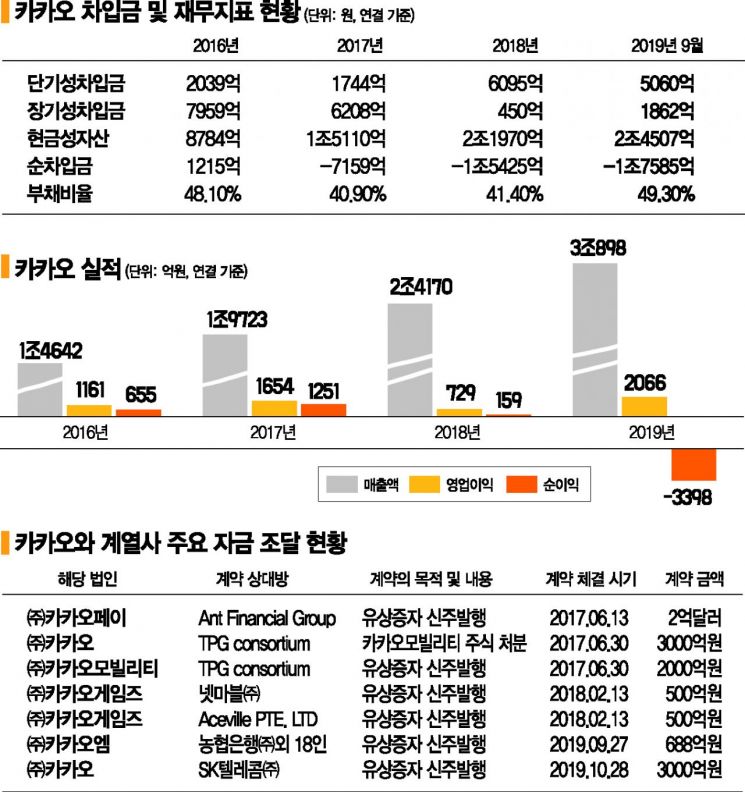
Kakao recorded consolidated sales of 3.0898 trillion KRW and operating profit of 206.6 billion KRW last year. Sales increased by 27.8% compared to the previous year, and operating profit surged by 183.2%. Kakao's stock price has risen more than 20% since the beginning of this year. During the same period, the KOSPI fell by 3.9%.
◆ Blossoming New Businesses = The Talk Biz business has been sailing smoothly, leading to improved performance. The Talk Biz division, based on the mobile messenger KakaoTalk, recorded sales of 650 billion KRW last year, an increase of more than 50% from 421 billion KRW the previous year. In December last year, the average daily sales of Talk Biz Board exceeded 500 million KRW. Kakao offers advertising products that expose various types of materials or deliver messages according to advertisers' purposes based on the mobile messenger 'KakaoTalk.' Talk Biz Board is a service that displays ads in the chat list most frequently used by mobile messenger users. The ad space on Talk Biz Board has high user attention, making it popular among advertisers. More than 3,000 advertisers use Talk Board. Kakao expects the growth rate to accelerate further as the number of advertisers increases, which also raises advertising prices.
Kakao provides convenient mobility services such as taxi, Black (premium taxi), designated driver, parking, and bike through the KakaoT app. It quickly connects users and service providers and earns platform commission revenue accordingly. As of the end of September last year, the number of users registered on the KakaoT app reached 24 million, and members who registered credit cards exceeded 8.7 million. Sales have rapidly increased in proportion to the growing number of members, nearly doubling from 49 billion KRW in 2018 to 90 billion KRW last year.
Legal regulations remain a challenge for Kakao to expand its mobility business. However, optimistic prospects have emerged as the Seoul Central District Court acquitted Lee Jae-woong, CEO of Socar, and Park Jae-wook, CEO of VCNC, among others, in the first trial ruling on the 'Tada illegality' case on the 19th. The court viewed the ride-hailing service Tada as an ultra-short-term rental car service, suggesting that new mobility services beyond existing transportation businesses will emerge.
Jaemin Ahn, a researcher at NH Investment & Securities, explained, "The court ruling is expected to positively impact not only the activation of Tada's service but also internet companies launching new services," adding, "We anticipate that Kakao, which is as active as Tada in the mobility business, will benefit."
Following its acquisition of the largest shareholder status in Kakao Bank last year, Kakao also acquired Baro Investment & Securities. It launched Kakao Pay Securities and is expanding financial services into various fields such as account issuance, investment product brokerage, and personal portfolio management. Euljeong Yoon, a researcher at Shin Young Securities, analyzed, "Kakao Pay's transaction volume is rapidly increasing," and "It is beginning to generate profits in new business sectors including financial platforms, so we expect performance improvement and market dominance expansion."
◆ Investment Attraction Secured by New Business Growth Potential = Kakao is investing a considerable amount of funds to nurture new businesses. It spends about 5% of sales on marketing activities to increase users of new platforms such as Kakao Pay and Kakao Mobility. It also actively recruits talent for new business initiatives, maintaining personnel expenses at around 23% of sales consistently.
In March 2016, Kakao acquired a 76.4% stake in Loen Entertainment for 1.8743 trillion KRW. To raise acquisition funds, it raised 754.4 billion KRW through a third-party allotment capital increase and borrowed 800 billion KRW. Financial structure deterioration was inevitable. Total borrowings increased from 221.8 billion KRW in 2015 to 999.9 billion KRW in 2016. During the same period, the debt ratio jumped from 23.3% to 48.1%.
Kakao sought to improve its financial structure by securing funds backed by the growth potential of new businesses. Since 2017, Kakao has raised funds by issuing new shares of affiliates promoting new businesses.
In 2017, Kakao attracted a $200 million (approximately 230 billion KRW) investment from Ant Financial Services Group for its subsidiary Kakao Pay and established a strategic partnership. Ant Financial is the parent company of Alipay.
Kakao Mobility formed a strategic partnership with the global private equity firm Texas Pacific Group (TPG) in 2017 and received a total investment of 500 billion KRW. It secured 300 billion KRW by selling Kakao Mobility shares and raised 200 billion KRW by issuing new shares. In January 2018, it issued overseas depositary receipts worth 1 trillion KRW.
As of the end of the third quarter last year, consolidated net borrowings were negative 1.76 trillion KRW, restoring abundant liquidity. This ample liquidity has become a fountain of investment. In November last year, Kakao used 378 billion KRW to additionally purchase shares of Korea Kakao Bank. Its shareholding ratio increased to 34%. Since it reached the maximum shareholding ratio under the Internet Banking Special Act, the possibility of further share purchases has decreased.
Korea Ratings forecast that Kakao will cover new business-related cost burdens through various forms of capital expansion and maintain an excellent financial structure. However, in the long term, as competition intensifies in the mobile service market, investment burdens in the form of equity investments to maintain business competitiveness are expected to continue. Since the possibility of large-scale mergers and acquisitions (M&A) remains open, it advised monitoring cash outflows, resulting financial structure changes, and whether a solid financial structure is maintained.
© The Asia Business Daily(www.asiae.co.kr). All rights reserved.
![Clutching a Stolen Dior Bag, Saying "I Hate Being Poor but Real"... The Grotesque Con of a "Human Knockoff" [Slate]](https://cwcontent.asiae.co.kr/asiaresize/183/2026021902243444107_1771435474.jpg)















