LH, SH, and Other Public Sector Entities to Mandate Electronic Contracts for Sales and Purchases
[Asia Economy Reporter Onyu Lim] South Korea, an ICT powerhouse where people buy luxury bags worth 10 million won through overseas direct purchase and pay electricity bills via SNS messengers, still lags behind in digitalization in one particular area: real estate contracts. Although the government invested 17.3 billion won to develop an electronic contract system that enhances convenience and security, the usage rate remains only about 1% due to the closed nature of real estate culture and system flaws. Ultimately, the Ministry of Land, Infrastructure and Transport (MOLIT) plans to promote the activation of real estate electronic contracts by proposing a bill mandating its use in the public sector starting in September.
According to the government on the 22nd, MOLIT intends to submit a bill or legal amendment mandating electronic real estate contracts in the upcoming regular National Assembly session in September. The bill will require electronic contracts for sales and leasing conducted by public entities such as Korea Land and Housing Corporation (LH) and Seoul Housing Corporation (SH). A MOLIT official explained, "To promote electronic real estate contracts, we are preparing to first mandate it for LH and SH, then gradually expand it to local public corporations. We are currently reviewing which specific laws it will apply to."
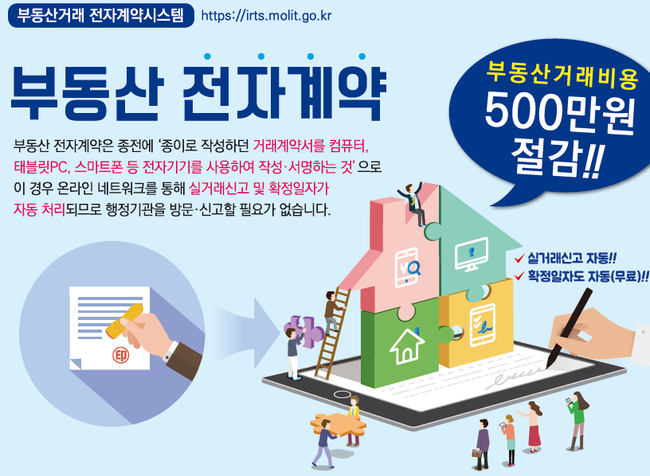
Real estate electronic contracts are a system that allows signing real estate sales and lease contracts online using PCs, tablets, or mobile devices. MOLIT and the Korea Appraisal Board invested 17.3 billion won to implement this nationwide in August 2017 to ensure transaction transparency and convenience.
The electronic contract system requires only a certified digital signature, eliminating the need for paper contracts or seals, thereby reducing various transaction costs in real estate deals. Additionally, it automatically assigns a fixed date and simplifies registration applications, making administrative procedures more convenient. It also strengthens safe transactions by blocking unregistered or unqualified parties from conducting transactions. Economic benefits include a 0.1% additional interest rate reduction when using the Didimdol and Buteemok loans.
However, after four years, the usage rate remains low at around 1%. According to the Korea Appraisal Board, the usage rates were 0.28% in 2017, 0.77% in 2018, and 1.64% from January to September 2019. Of these, 85% are in the public sector and 90% are leases, indicating significant concentration. This issue is repeatedly pointed out during annual government audits.
The biggest reasons cited are the entrenched practice of paper contracts and vague concerns about tax exposure. Especially sellers tend to worry that electronic contracts might lead to tax investigations. A certified real estate agent at S Brokerage in Gangnam-gu said, "I have never received a request for an electronic contract, so I have not used it since the training 10 months ago," adding, "Within the entire corporation, only one client requested it due to the loan interest rate reduction."
Furthermore, it is pointed out that there are no significant advantages for real estate agents or sellers. On the 17th, Han Suk-ryeol, head of the Real Estate Market Management Division at the Korea Appraisal Board, explained at the 'Public Sector Real Estate Electronic Contract Activation Forum' held at the National Assembly, "Buyers benefit from automatic fixed date registration and preferential loan interest rates, but sellers do not receive benefits, making practical expansion difficult."
Nevertheless, many experts view electronic contracts as essential given the system's advantages and the social trend toward the popularization of 'PropTech,' which combines real estate and ICT.
Accordingly, MOLIT is promoting activation in the public sector to establish the real estate electronic contract system. Park Sun-ho, 1st Vice Minister of MOLIT, stated, "We need to first activate it in the public sector where introducing standard contracts is relatively easy to create model cases," and added, "Then, it is necessary to expand this to the private sector and share efforts for technological changes and innovations underway in the real estate field."
However, some argue that the real estate electronic transaction system falls short of achieving the fundamental goal of transaction transparency. Jang Jae-hyun, head of RealToday, pointed out, "Even if the electronic transaction system is used, it cannot prevent practices like under-the-table contracts," and added, "To achieve this goal, mandating card payments for real estate transactions would be more appropriate."
© The Asia Business Daily(www.asiae.co.kr). All rights reserved.
![Clutching a Stolen Dior Bag, Saying "I Hate Being Poor but Real"... The Grotesque Con of a "Human Knockoff" [Slate]](https://cwcontent.asiae.co.kr/asiaresize/183/2026021902243444107_1771435474.jpg)















