Narrowing Rise in Sales and Jeonse Prices Ahead of Lunar New Year Holiday
High-Intensity Regulations, Weakened Buying Sentiment "Market Stabilization Expected After Lunar New Year"
[Asia Economy Reporter Yuri Kim] Ahead of the Lunar New Year holiday, the Seoul apartment market has somewhat contracted. This is due to increased market uncertainty following the government's announcement of additional regulations, combined with the off-season effect before the holiday. This trend is similar to the slowdown in the apartment market before the Chuseok holiday after the September 13, 2018 measures. In non-Gangnam areas of Seoul, inquiries for low-priced listings continued sporadically, but in the Gangnam area, where high-priced apartment loan regulations and strengthened transaction verification have dampened buyer sentiment, buyers remained cautious.
According to Real Estate 114 on the 23rd, the weekly change rate of Seoul apartment prices recorded 0.06%. Reconstruction apartments, which had declined for two consecutive weeks, rose by 0.02%, but general apartments increased by only 0.07%, reducing the overall increase compared to the previous week (0.09%). New towns rose by 0.03%, and Gyeonggi/Incheon by 0.02%.
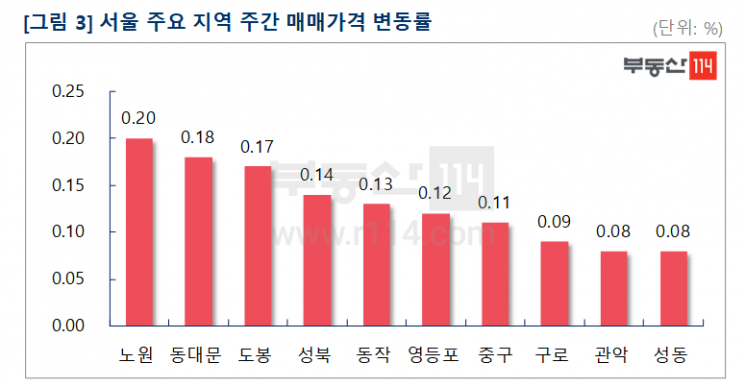
Seoul's price increase was centered on non-Gangnam areas. By region, the increases were as follows: Nowon (0.20%), Dongdaemun (0.18%), Dobong (0.17%), Seongbuk (0.14%), Dongjak (0.13%), Yeongdeungpo (0.12%), Jung-gu (0.11%). In Nowon, demand continued due to the development of the Dongbuk Line light rail and Gwangwoon University station area, with Wolgye-dong's Kkumui Sup SK View, as well as Sanggye-dong's Bulam Donga and Byeoksan, rising by 5 to 20 million KRW. In Dongdaemun, after low-priced listings were exhausted, Dapsimni-dong's Dapsimni Raemian Weave and Jangan-dong's Jangan 1st Hyundai Hometown rose by 5 to 10 million KRW. Dobong saw rises of 5 to 20 million KRW in Chang-dong's Sanggye Jugong 18 and 19 complexes and Jugong 3 complex. Seongbuk's Ha Wolgok-dong Raemian Wolgok 1st and Wolgok Doosan We’ve increased by 2.5 to 10 million KRW. Dongjak's Daebang-dong Daelim, Sadang-dong Geukdong, and Raemian Roy Park rose by 5 to 20 million KRW.
New towns increased in the order of Pyeongchon (0.07%), Sanbon (0.06%), Bundang (0.05%), Gwanggyo (0.03%), Jungdong (0.02%), Dongtan (0.02%). In Pyeongchon, due to undervaluation perception, demand flowed mainly for small units such as Pyeongchon-dong Choweon Booyoung and Choweon Seongwon, rising by 5 to 10 million KRW. Sanbon's small units like Sanbon-dong Maehwa Jugong 14 complex and Gaya 5th Jugong 1st complex rose by 5 to 10 million KRW. Bundang's sporadically traded Gumi-dong Mujigae 3rd Shinhan, Geonyeong, and Yatap-dong Tap Jugong 8 complex rose by 5 million KRW. Gwanggyo's Woncheon-dong Gwanggyo Doosan We’ve and Iui-dong Gwanggyo e-Pyeonhan Sesang increased by 5 to 10 million KRW. Jungdong's Sangdong Hanarum Dongsung and Jungdong Green Town Kumho Hanyang rose by 5 to 10 million KRW.
Gyeonggi/Incheon showed an upward trend mainly in the southern Gyeonggi region. By region, the increases were: Yongin (0.06%), Seongnam (0.05%), Gwangmyeong (0.04%), Bucheon (0.04%), Ansan (0.03%), Anyang (0.03%). In Yongin, areas with good metropolitan transportation conditions such as Singbong Station on the Shinbundang Line saw Seongbok-dong Seongbok Station Lotte Castle Gold Town and Sinbong-dong Sinbong Village LG Village 5th rise by 10 to 20 million KRW, mainly in medium to large units. Seongnam's Dandae-dong Jinro and Geumgwang-dong Hwangsong Village rose by 5 million KRW. Gwangmyeong's small units like Cheolsan-dong Jugong 12 complex, Haan-dong Jugong 8 and 12 complexes rose by 2.5 to 5 million KRW. Bucheon's Sangdong Summit Ville and Dajeonghan Maeul Samsung rose by 5 to 10 million KRW. Ansan's Gojan-dong Jugong 5 complex and Sadong Ansan Gojan 7th Prugio rose by 5 to 10 million KRW.
The jeonse (long-term lease) market saw inquiries and transactions slow down ahead of the holiday. Seoul apartment jeonse prices rose by 0.03%, a smaller increase compared to the previous week (0.10%). New towns and Gyeonggi/Incheon rose by 0.02% and 0.01%, respectively, showing a similar trend to the previous week.
In Seoul, demand flowed into large apartment complexes with over 1,000 households, driving the upward trend. By region, the increases were: Gangdong (0.14%), Seongbuk (0.08%), Gangbuk (0.07%), Dongjak (0.07%), Gangnam (0.05%), Dongdaemun (0.05%), Yeongdeungpo (0.05%). In Gangdong, Amsa-dong Seonsa Hyundai rose by 10 to 20 million KRW. Seongbuk's Ha Wolgok-dong Raemian Wolgok 1st and Wolgok Doosan We’ve rose by 5 to 10 million KRW, mainly in medium to large units. Gangbuk's Mia-dong Byeoksan Live Park and Suyu-dong Byeoksan rose by 2.5 to 10 million KRW. Dongjak's Daebang-dong Daelim, Sadang-dong Raemian Roy Park, and Isu Station area rose by 5 to 10 million KRW.
New towns rose in the order of Pyeongchon (0.10%), Sanbon (0.08%), Gwanggyo (0.03%), Bundang (0.01%), Ilsan (0.01%), Jungdong (0.01%). Pyeongchon saw Pyeongchon-dong Choweon Booyoung and Hogye-dong Mugunghwa Hyosung rise by 5 to 10 million KRW. Sanbon's Sanbon-dong Sinan Moran and Myohyang Lotte rose by 5 to 10 million KRW. Gwanggyo's large-sized Iui-dong Gwanggyo e-Pyeonhan Sesang rose by 5 million KRW.
Gyeonggi/Incheon rose in the order of Gwangmyeong (0.04%), Gunpo (0.03%), Namyangju (0.02%), Bucheon (0.02%), Suwon (0.02%). Gwangmyeong's Cheolsan-dong Cheolsan Raemian Xi, Haan-dong Gwangmyeong Doosan We’ve Treziom, and Gwangmyeong-dong Hyunjin Everbill rose by 5 to 10 million KRW. Gunpo's scarce listings in Sanbon-dong Sanbon 2nd e-Pyeonhan Sesang rose by 5 to 10 million KRW. Namyangju's listings were exhausted, with Wabu-eup Deokso I-Park and Jindo rising by 5 million KRW each. Bucheon's Sangdong Hyosung Central Town and Dajeonghan Maeul Ssangyong rose by 5 million KRW.
Due to high-intensity regulations coinciding with the Lunar New Year holiday, transactions appear to have slowed. Kyunghee Yeo, senior researcher at Real Estate 114, analyzed, "Considering that after the September 13, 2018 measures, Seoul housing prices began a full decline after the Chuseok holiday, there is a possibility that market contraction will appear around this Lunar New Year holiday. While the burden of property taxes is increasing, leading more multi-homeowners to consider selling after the holiday, buyers are maintaining a wait-and-see stance, so sluggish transactions are expected to continue for the time being."
In the jeonse market, demand for jeonse instead of purchase is increasing, and after the holiday, moving demand in school districts and areas close to workplaces is expected to be active. As a result, jeonse shortages are expected to worsen, and demand for semi-jeonse options is also anticipated to increase.
© The Asia Business Daily(www.asiae.co.kr). All rights reserved.
![Clutching a Stolen Dior Bag, Saying "I Hate Being Poor but Real"... The Grotesque Con of a "Human Knockoff" [Slate]](https://cwcontent.asiae.co.kr/asiaresize/183/2026021902243444107_1771435474.jpg)















