2.01% Last Year... Lowest in 10 Years
Private Consumption 1.9%, Facility Investment -8.1%, etc.
Weakness in All Sectors Except Government Consumption
Government GDP Contribution Three Times That of Private Sector
Fiscal Concentrated Investment in Q4
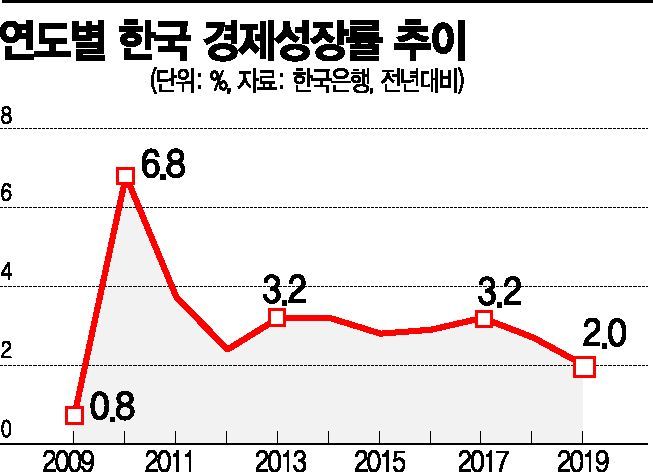
[Asia Economy Reporters Sim Nayoung, Kim Eunbyeol, Kim Minyoung] Last year, South Korea's real Gross Domestic Product (GDP) growth rate recorded 2.0%, marking the lowest level in a decade. This was due to the simultaneous contraction of investment, consumption, and exports caused by the US-China trade dispute and the semiconductor market downturn. Although the government significantly loosened fiscal policy at the end of the year, raising the fourth-quarter growth rate to 1.2% and preventing the annual growth rate from falling into the 1% range, there were limitations.
According to the preliminary real GDP figures for the fourth quarter and the entire year of 2019 released by the Bank of Korea on the 22nd, last year's real GDP increased by 2.01% compared to the previous year. It barely exceeded 2.0%, but it was the lowest since 2009 (0.8%) right after the global financial crisis, and cannot be considered a good performance. It also falls significantly short of South Korea's potential growth rate (2.5~2.6%).
The government's last-minute fiscal stimulus played a role in South Korea barely achieving a 2% growth rate. While the private sector still showed weak performance, the government raised the growth rate by implementing expansionary fiscal policies. There are also forecasts that the nominal growth rate, which reflects price changes, will remain in the 1% range.
Looking at the annual growth rates by category, all sectors except government consumption were sluggish. Private consumption fell to 1.9%, the lowest in six years (1.7% in 2013). Facility investment dropped by -8.1%, the lowest since -8.1% in 2009. Construction investment improved slightly from -4.3% in 2018 to -3.3%, but remained in negative territory. Exports recorded 1.5%, the lowest in four years since 0.2% in 2015. On the other hand, government consumption rose to 6.5%, the highest since 6.7% in 2009. Park Yangsoo, head of the Economic Statistics Bureau at the Bank of Korea, explained, "Exports became considerably difficult as the semiconductor cycles of both DRAM and flash memory worsened simultaneously, significantly reducing the growth momentum of the private sector."
When isolating the fourth-quarter growth rate (compared to the previous quarter) of 1.2%, it becomes even clearer that the government led growth by loosening fiscal policy. Initially, the Bank of Korea and others expected the fourth-quarter growth rate to be around 0.9%, but the government increased consumption, resulting in a surprising performance. Government consumption in the fourth quarter was 2.6%, much higher than 0.4% in the first quarter, 2.2% in the second quarter, and 1.4% in the third quarter. In particular, government welfare and goods expenditures increased significantly. As the government increased social overhead capital (SOC) investment, construction investment also surged from -6.0% in the third quarter to 6.3% in the fourth quarter.
Professor Kim Sangbong of the Department of Economics at Hansung University evaluated, "While the private sector struggled at the bottom last year, the government consumption growth rate increased over time," calling it "'tax-led growth'."
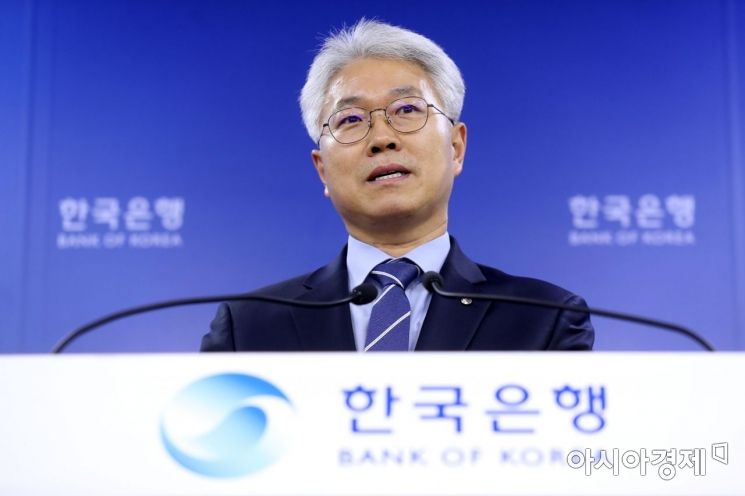 Park Yang-su, Director of the Economic Statistics Bureau at the Bank of Korea, is briefing at the press conference on the preliminary real Gross Domestic Product (GDP) for the 4th quarter and the annual results of 2019, held on the 22nd at the Bank of Korea in Jung-gu, Seoul. Photo by Moon Ho-nam munonam@
◆ Growth Rate Raised by the Government = According to the Bank of Korea on the 22nd, of the 2.0% annual GDP growth rate last year, the government's contribution was 1.5 percentage points. The private sector's contribution was only 0.5 percentage points. This means the government accounted for 75% of the total GDP growth, covering about three times the growth from the private sector through government spending. In 2018, the growth rate was 2.7%, with the private sector contributing 1.8 percentage points and the government 0.9 percentage points. The government's contribution ratio, which was about 33%, surged sharply within a year. The government's GDP contribution was also the highest since the financial crisis period when the private sector's contribution was negative (2009, 2.3 percentage points). Especially, the government significantly increased fiscal spending in the fourth quarter last year. Of the 1.2% growth rate in the fourth quarter, the government's contribution was 1.0 percentage point, and the private sector's was 0.2 percentage points, making the government's share 83%.
According to the Ministry of Economy and Finance, as of the end of December last year, central government fiscal spending was executed at over 97% of the initially set target. Although local government fiscal execution fell short of the 90% target, it was recorded at 86.87%, higher than 84.2% in 2018, indicating increased spending. The supplementary budget (5.8 trillion KRW) was executed at over 98%. Considering that as of the end of November last year, central government spending execution was 90.3% and local government spending was 77.1%, fiscal execution rates increased by more than 6 percentage points for the central government and nearly 10 percentage points for local governments in December alone. Although the execution rate itself only rose by about 2-3 percentage points compared to a year ago, the amount spent had a compensatory effect on the economy, such as the supplementary budget. Even a 1% increase in the central government budget (470 trillion KRW) amounts to about 4.7 trillion KRW. A Ministry of Economy and Finance official estimated, "Although it is difficult to say that the budgets executed by the central and local governments directly contributed to GDP, the reduction in budget carryover and non-execution means more spending, which contributed to raising the growth rate," adding, "The government's efforts to improve fiscal execution rates had a compensatory effect on the economy beyond the supplementary budget."
However, Director Park positively evaluated that the private sector's GDP contribution remained positive on a quarterly basis. He said, "The private sector is continuing to improve," and added, "Although exports decreased, consumption and investment improved, so these aspects should be considered simultaneously."
◆ Nominal GDP Growth Rate Expected to Remain at 1% = The nominal GDP growth rate for last year, to be announced in March, is estimated to be in the 1% range, leading to assessments that the economy has effectively entered deflation. While economic growth rates use real GDP growth applying base year prices, nominal GDP reflects market prices of the current year, thus more closely representing the felt economic conditions.
Director Park said, "The GDP deflator has continuously shown negative values, so the nominal growth rate is expected to be lower than the real growth rate," adding, "Since the nominal growth rate was about 1% up to the third quarter last year, this trend is likely to continue." South Korea's nominal GDP growth rate has never fallen below 3% since recording -1.1% in 1998, the year following the International Monetary Fund (IMF) crisis.
The GDP deflator rate of change (year-on-year), which is nominal GDP divided by real GDP, is also showing an increasing decline. It dropped from -0.1% in the fourth quarter of 2018 to -0.5% in the first quarter, -0.7% in the second quarter, and -1.6% in the third quarter of 2019. Unlike the Consumer Price Index, which measures prices closely related to consumers, the GDP deflator shows the overall price level of the national economy.
Professor Sung Tae-yoon of Yonsei University said, "Nominal GDP is inevitably much lower than current real GDP," and added, "There is no choice but to see deflation concerns." He also said, "Although the real growth rate achieved 2%, the downward trend is strong, and economic downturn is intensifying," and predicted, "The preliminary GDP figures are unlikely to reach 2% growth." Meanwhile, last year's Gross National Income (GNI) is expected to be lower than the 33,346 USD level in 2018. Director Park said, "Due to the exchange rate falling by about 4-5% last year, GNI is expected to be around 32,000 USD."
© The Asia Business Daily(www.asiae.co.kr). All rights reserved.
![Clutching a Stolen Dior Bag, Saying "I Hate Being Poor but Real"... The Grotesque Con of a "Human Knockoff" [Slate]](https://cwcontent.asiae.co.kr/asiaresize/183/2026021902243444107_1771435474.jpg)
















