Bank of Korea Announces 2019 Economic Growth Rate
Private Investment, Consumption, and Exports Contract Simultaneously
Only Government Consumption Increased as a Short-term Measure... No Help for Long-term Recovery
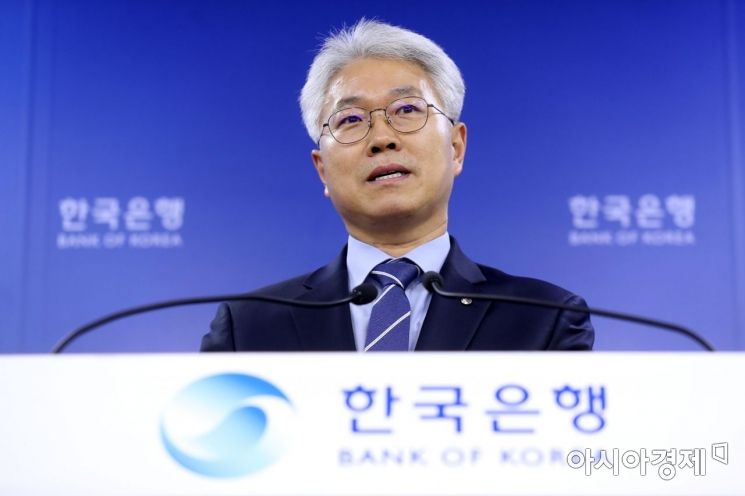 Park Yang-su, Director of the Economic Statistics Bureau at the Bank of Korea, is briefing at the press conference on the preliminary real Gross Domestic Product (GDP) for the 4th quarter and the annual results of 2019, held on the 22nd at the Bank of Korea in Jung-gu, Seoul. Photo by Moon Ho-nam munonam@
[Asia Economy Reporters Sim Nayoung, Kim Eunbyeol] Last year, South Korea's real Gross Domestic Product (GDP) growth rate recorded 2.0%, marking the lowest level in 10 years. The cause was the simultaneous contraction of private sector investment, consumption, and exports due to the US-China trade dispute, semiconductor market downturn, and government policies increasing labor costs. In the final stage, the government significantly loosened taxes, raising the fourth-quarter growth rate to 1.2%, preventing the annual growth rate from falling into the 1% range, but there were limitations.
On the 22nd, the Bank of Korea announced the last year's economic growth rate (year-on-year) of 2.01% through the '2019 4th Quarter and Annual Real GDP (Preliminary)'. Initially, the dominant forecast was that the growth rate would barely reach 2.0%, hovering in the high 1.9% range, but the actual figure was higher than expected. Looking at the numbers alone, this is the lowest since 0.8% in 2009, right after the global financial crisis. Professor Kim Sangbong of Hansung University’s Department of Economics evaluated, "Last year, the private sector struggled at the bottom, but the government consumption growth rate increased over time," adding, "It was a case of 'tax-driven growth.'"
Examining the annual growth rates by sector, all areas except government consumption were sluggish. Private consumption fell to 1.9%, the lowest in six years (1.7% in 2013). Facility investment dropped by -8.1%, the lowest since -8.1% in 2009. Construction investment improved slightly from -4.3% in 2018 to -3.3%, but remained in negative territory. Exports recorded 1.5%, the lowest in four years since 0.2% in 2015. Imports also fell by -0.6%, the lowest level in 10 years since -7.2% in 2009.
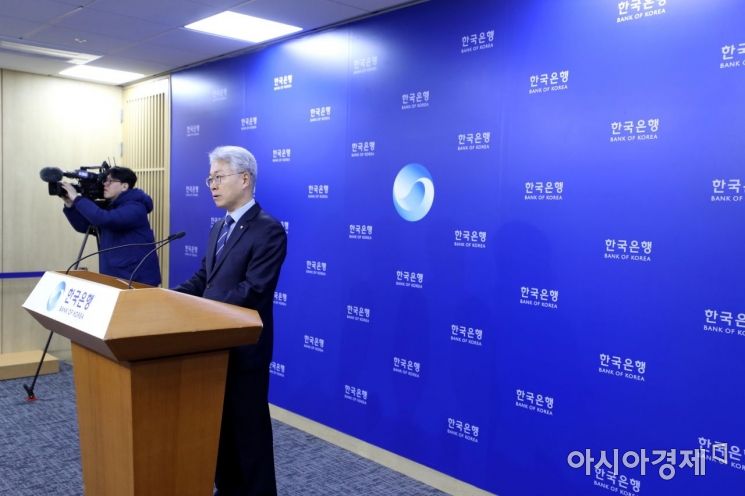 Park Yang-su, Director of the Economic Statistics Bureau at the Bank of Korea, is briefing at the press conference on the preliminary real Gross Domestic Product (GDP) for the 4th quarter and the annual results of 2019, held on the 22nd at the Bank of Korea in Jung-gu, Seoul. Photo by Moon Ho-nam munonam@
On the other hand, government consumption rose to 6.5%, the highest since 6.7% in 2009. Park Yangsoo, Director of the Economic Statistics Bureau at the Bank of Korea, explained, "Exports became considerably difficult as the semiconductor cycles of both DRAM and flash memory deteriorated simultaneously, significantly reducing growth momentum in the private sector," adding, "The government had no choice but to operate fiscal policy expansively to stabilize the economy."
Looking at the fourth-quarter growth rate (quarter-on-quarter) of 1.2%, it becomes even clearer that the government led growth by loosening taxes. Originally, inside and outside the Bank of Korea, the fourth-quarter growth rate was expected to be around a maximum of 0.9%, but the government stepped in to increase consumption, achieving a surprising result. Government consumption in the fourth quarter was 2.6%, much higher than 0.4% in the first quarter, 2.2% in the second quarter, and 1.4% in the third quarter. In particular, government welfare and goods expenditures increased significantly. The government also increased social overhead capital (SOC) investment, causing construction investment to jump sharply from -6.0% in the third quarter to 6.3% in the fourth quarter.
Joo Won, Head of Economic Research at Hyundai Research Institute, commented on the increase in government consumption, saying, "How the taxes were used is also important," and evaluated, "Supporting the growth rate with government consumption like last year is only a temporary short-term remedy and does not help economic recovery in the long term."
Meanwhile, last year's real Gross Domestic Income (GDI) decreased by 0.4% year-on-year, the lowest in 21 years since -7.0% in 1998. This was affected by worsening terms of trade due to the decline in semiconductor prices.
© The Asia Business Daily(www.asiae.co.kr). All rights reserved.
![Clutching a Stolen Dior Bag, Saying "I Hate Being Poor but Real"... The Grotesque Con of a "Human Knockoff" [Slate]](https://cwcontent.asiae.co.kr/asiaresize/183/2026021902243444107_1771435474.jpg)
















