Doubled in 3 Years to 1.2 Trillion
Government: "Rapid Aging Progress... Strengthening Social Safety Net"
Experts: "Limits to Fiscal Investment"
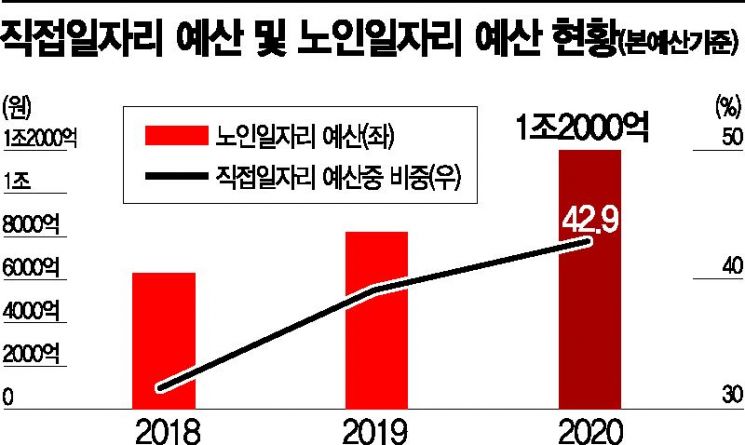
[Asia Economy Reporter Jang Sehee] The budget for senior citizen job projects within the government's direct employment budget has nearly doubled over the past three years. As a result, the proportion of the senior job budget (based on the main budget) exceeded 40% for the first time this year. While the government maintains that this is inevitable due to the rapid aging of the population, experts point out that there are limits to increasing senior jobs through fiscal input.
According to the Ministry of Economy and Finance and the Ministry of Employment and Labor on the 23rd, the senior job project budget within the direct employment budget (based on the main budget) surged from 630 billion KRW in 2018 to 822 billion KRW in 2019 (920 billion KRW including supplementary budget), and 1.2 trillion KRW this year. This represents an increase of nearly double (90.5%) in three years. During the same period, the proportion of the senior job project budget also rose from 31.5% to 42.9%. Nearly half of the job project budget is being invested in senior job projects. This is more than three times the combined amount of 200 billion KRW (7.1%) for the region-led youth job support project and 140 billion KRW (5.1%) for the disabled job support project this year.
The increase in the senior job budget played a major role in driving employment growth last year. The number of employed people aged 60 and over last year was 377,000, exceeding the total employment increase of 301,000. The senior jobs created by government tax input contributed most significantly to the improvement of employment indicators. On the other hand, the number of employed people in their 30s and 40s decreased by 53,000 and 162,000 respectively.
◆Budget for Job Placement and Vocational Training Projects Actually Decreased= With limited resources, concentrating the budget on senior jobs has reduced or stagnated funds for other areas. This year, the startup support project budget decreased by 100 billion KRW compared to the previous year. The employment service (job placement) project budget increased by only 200 billion KRW. Although the vocational training project budget increased by 200 billion KRW, this was due to the restructuring of the Tomorrow Learning Card, with no new projects added. Despite the ongoing employment chill among the economically active 30s and 40s, there is little budget allocated to address this.
To create stable jobs, support should be directed toward projects that contribute to reemployment or private sector job creation, such as vocational training, but taxes are being poured only into senior job projects, which have low wages and instability.
The bigger problem is that under the current government policy direction, the senior job budget could snowball in the future following the aging trend. According to the Statistics Korea's future population projection (based on 2017), the elderly population aged 65 and over will rapidly increase from 8.13 million this year to 10.51 million in 2025 and 19.57 million in 2065. The government insists on strengthening support for the elderly, a vulnerable group facing difficulties entering the labor market.
Na Youngdon, Director of Policy at the Ministry of Employment and Labor, said, "Because the social safety net for the elderly is weak, a large budget for direct job projects that also provide income support is inevitable," adding, "Especially with the rapid progress of aging, there is a need to continuously expand senior jobs."
◆Strengthening Support for Vocational Training and the Third Sector= However, experts point out that the current fiscal input policy has inherent limits amid the rapidly increasing elderly population. Support should be focused only on elderly people with low income or no assets. They also emphasized that since jobs created with tax money are not sustainable, budgets should be spent on projects that create stable and quality jobs.
Professor Sung Tae-yoon of Yonsei University's Department of Economics said, "The elderly population is increasing, but it is impossible to solve this solely through fiscal input," adding, "From a long-term perspective, more budget should be invested in projects that help build human capital, such as vocational training."
Professor Jung Se-eun of Chungnam University's Department of Economics emphasized, "Since the elderly tend to have relatively low productivity, it will be difficult for the private sector to create jobs for them," and added, "Support for the third sector, such as social enterprises and cooperatives that pursue purposes beyond profit, should be strengthened like in advanced countries."
© The Asia Business Daily(www.asiae.co.kr). All rights reserved.
![Clutching a Stolen Dior Bag, Saying "I Hate Being Poor but Real"... The Grotesque Con of a "Human Knockoff" [Slate]](https://cwcontent.asiae.co.kr/asiaresize/183/2026021902243444107_1771435474.jpg)
















