Impact of Rising Coal and Petroleum Product Prices Due to Oil Price Increase
Also Affected by Decreased Shipment of Some Agricultural Products and Poor Fishery Yields
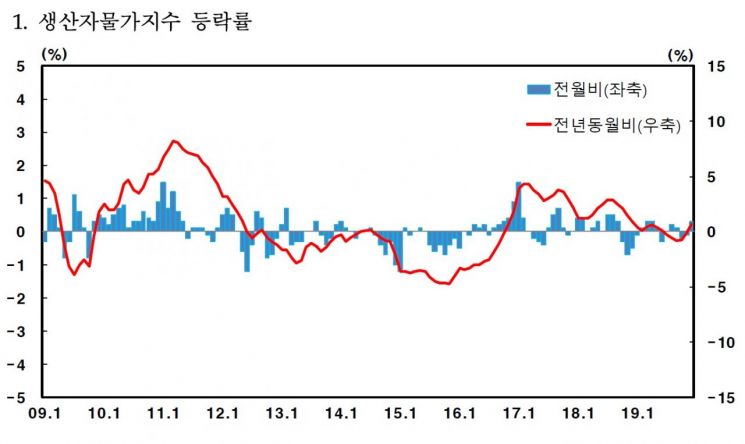
[Asia Economy Reporter Eunbyeol Kim] The Producer Price Index (PPI) in December turned to an increase compared to the same month last year for the first time in six months. It also turned to an increase compared to the previous month for the first time in three months. The rise in oil prices in December compared to the same month last year significantly influenced the increase in coal and petroleum product prices. Additionally, the prices of agricultural, forestry, and fishery products rose due to a decrease in the shipment volume of some agricultural products and poor fish catches.
According to the 'December 2019 Producer Price Index' announced by the Bank of Korea on the 21st, the December PPI was recorded at 103.71, marking a 0.7% increase compared to the same month last year. The PPI had been declining for five consecutive months since June last year, when it rose by 0.1% year-on-year.
Compared to the previous month, the PPI also rose by 0.3%, marking an increase for the first time in three months since a 0.1% rise in September last year.
The first reason for the rise in producer prices in December was the increase in prices of agricultural and fishery products. The price of agricultural products rose by 7.4% month-on-month due to a decrease in radish shipments, and fishery product prices increased by 4.6% due to poor squid catches. In the case of agricultural products, prices of radish (30.7%), pumpkin (49.3%), and onion (30.2%) all rose month-on-month due to autumn monsoon rains and abnormal temperatures. Radish prices surged by 247.8% compared to the same month last year. Among fishery products, squid catches were poor, largely due to illegal fishing by Chinese vessels along the East Coast.
Additionally, coal and petroleum product prices rose by 2.3% due to the increase in oil prices. Computer, electronic, and optical equipment prices rose slightly by 0.1%. Semiconductor prices entered an upward trend but the increase was modest at 0.4%. Song Jae-chang, head of the price statistics team at the Bank of Korea, stated, "Semiconductors, including DRAM, are mainly contracted on a quarterly basis, so prices tend to rise at the beginning of the quarter," adding, "We need to observe the situation in January."
In the service sector, due to the winter off-season, chartered bus prices fell by 8.7% month-on-month, and toll road operation prices decreased by 1.9% as some private roads lowered toll fees. However, restaurant and accommodation services (0.2%) and real estate services (0.2%) rose, resulting in a stable trend compared to the previous month.
The annual Producer Price Index for 2019 showed a flat trend (0.0%) compared to the previous year. Although it rose for two consecutive years from 2017, it leveled off last year. After recording increases of 3.5% in 2017 and 1.9% in 2018, the growth rate significantly shrank in 2019.
The Domestic Supply Price Index, which adds import prices to the PPI, showed an upward trend centered on final goods (0.5%), rising 0.3% year-on-year and month-on-month respectively. The Total Output Price Index, which adds export prices to the PPI, rose 0.4% month-on-month mainly due to industrial products. However, it still fell 0.3% year-on-year due to the influence of semiconductor prices. The annual Total Output Price Index for 2019 also declined by 0.6% compared to the previous year, affected by the overall decline in export prices last year.
© The Asia Business Daily(www.asiae.co.kr). All rights reserved.
![Clutching a Stolen Dior Bag, Saying "I Hate Being Poor but Real"... The Grotesque Con of a "Human Knockoff" [Slate]](https://cwcontent.asiae.co.kr/asiaresize/183/2026021902243444107_1771435474.jpg)















