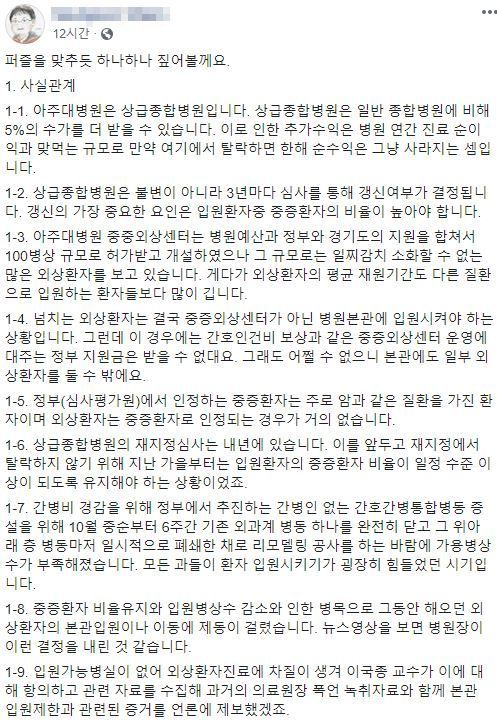
 Professor Shin Mo from Ajou University posted on his Facebook / Photo by Professor Shin Mo, Facebook capture
[Asia Economy Intern Reporter Kim Sung-yeol] As Yoo Hee-seok, director of Ajou University Medical Center, and Professor Lee Guk-jong, head of the Ajou University Hospital Gyeonggi Southern Regional Trauma Center, are in conflict, other professors at the hospital have come forward to explain the facts. According to the professors' claims, the shortage of trauma center beds asserted by Professor Lee varies depending on the situation. Some professors strongly opposed the hospital being labeled as a "money-driven hospital" due to this controversy.
Professor Shin, who works at Ajou University College of Medicine, wrote on his Facebook on the 16th, "I will go through it one by one like putting together a puzzle," and claimed, "It is not that only one side's claims (between Professor Lee and Director Yoo) are entirely correct and the other's are all wrong."
Professor Shin explained, "The Ajou University Hospital Severe Trauma Center was authorized and established with a scale of 100 beds by combining the hospital budget and support from the government and Gyeonggi Province, but it has long been unable to handle the large number of trauma patients at that scale," adding, "Moreover, the average length of stay for trauma patients is much longer than for patients admitted for other diseases."
He stated, "Excess trauma patients must be admitted to the hospital's main building rather than the Severe Trauma Center, but in this case, government support funds for operating the Severe Trauma Center, such as nursing labor cost compensation, cannot be received," and "The government (Health Insurance Review & Assessment Service) mainly recognizes severe patients as those with diseases like cancer, and trauma patients are rarely recognized as severe patients."
He continued, "Ajou University Hospital has a re-designation review for a tertiary general hospital next year, so since last fall, it has been necessary to maintain the proportion of severe patients among inpatients above a certain level," and explained, "In addition, to expand the integrated nursing care ward without caregivers, from mid-October last year, one existing surgical ward was completely closed for six weeks, and even the wards on the floors above and below were temporarily closed for remodeling, resulting in a shortage of available beds, making it very difficult for all departments to admit patients."
Professor Shin said, "Due to maintaining the proportion of severe patients and the bottleneck caused by the reduction in inpatient beds, the admission or transfer of trauma patients to the main building was restricted. From the news footage, it seems the hospital director made this decision," and added, "In this situation, when Professor Lee's medical care was disrupted, he appears to have collected related materials and leaked evidence related to the restriction of admission to the main building along with past recordings of verbal abuse by the medical center director to the media."
Regarding the claim of "150 empty beds," he pointed out that it is difficult to fully accept. Professor Shin explained, "It is impossible to leave that many beds empty. At that time, each department was in chaos because they could not admit patients. Some special wards or wards where trauma patients cannot be admitted also exist."
He also said, "Conversely, it is also difficult to fully accept the hospital's claim that the temporary decrease in the number of beds due to remodeling was the cause of the inability to accommodate trauma patients," explaining, "If you look only at the number of beds in the ward under construction for six weeks, it is about 50 beds, much less than 150 beds. Of course, the wards above and below were closed for about a week each during construction, but three wards were not closed simultaneously, so at most about 100 beds."
Professor Shin summarized the claims of Professor Lee and the medical center, saying, "Ultimately, the temporary shortage of beds due to construction and the policy restricting trauma patients' admission to the main building to maintain tertiary general hospital status both intervened, resulting in the paralysis of trauma patient admission to the main building for a while."
He explained, "Considering both Professor Lee's and the hospital authorities' claims, it is not that only one side is entirely correct and the other entirely wrong," and added, "If admitting trauma patients to the main building leads to reduced financial support or they are not recognized as severe patients, causing disadvantages in the next tertiary general hospital re-designation, such incidents will inevitably continue."
He concluded his post by saying, "No matter who takes the position of Severe Trauma Center director or hospital director in the future, the same situation will occur."
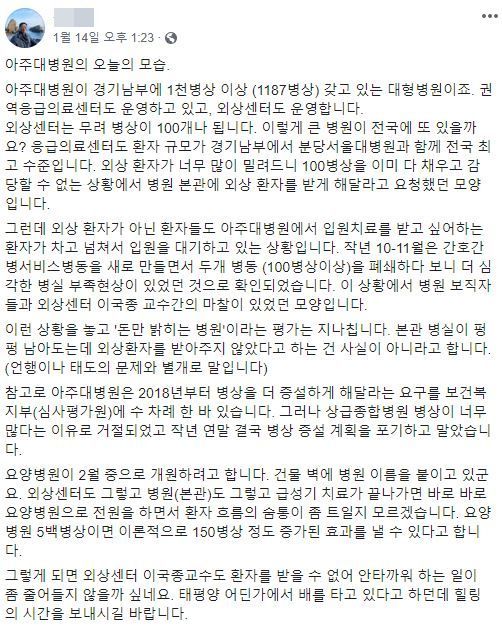 Professor Kim of Ajou University posted on his Facebook / Photo by Professor Kim on Facebook capture
Earlier, on the 14th, another current professor at Ajou University College of Medicine, Professor Kim, posted on his Facebook, stating, "It is not true that trauma patients were not accepted despite the main building having plenty of empty rooms."
He explained, "There are so many patients who want to be admitted and treated at Ajou University Hospital, not just trauma patients, that they are waiting for admission," and added, "In October to November last year, while creating new nursing care service wards, two wards (over 100 beds) were closed, which caused a more severe shortage of rooms."
He continued, "It seems there was friction between hospital officials and Professor Lee of the trauma center in this situation," and argued, "The evaluation of the hospital as 'money-driven' is excessive."
Professor Kim revealed internal circumstances, saying, "Since 2018, Ajou University Hospital repeatedly requested the Ministry of Health and Welfare (Health Insurance Review & Assessment Service) to increase beds, but the requests were rejected because there were already too many beds in tertiary general hospitals, and at the end of last year, the plan to increase beds was ultimately abandoned."
He also said, "A nursing hospital is scheduled to open in February," and expressed hope for improvement in the hospital environment, stating, "With 500 beds in the nursing hospital, it can theoretically have the effect of increasing about 150 beds, which will ease patient flow."
© The Asia Business Daily(www.asiae.co.kr). All rights reserved.
![Clutching a Stolen Dior Bag, Saying "I Hate Being Poor but Real"... The Grotesque Con of a "Human Knockoff" [Slate]](https://cwcontent.asiae.co.kr/asiaresize/183/2026021902243444107_1771435474.jpg)
















