Revision of 82 Laws on Investment Attraction and Job Creation
Workers: "Violation of Basic Rights and Threat to Employment Stability"
Foreign Companies Expect Improvement in Business Environment
[Asia Economy Jakarta Correspondent Sujin Choi] Indonesia is in turmoil over the so-called 'Omnibus Law' that bundles job creation and taxation issues together. President Joko Widodo, who was re-elected last October, is ambitiously pushing the law to attract investment, but it has met resistance from domestic workers.
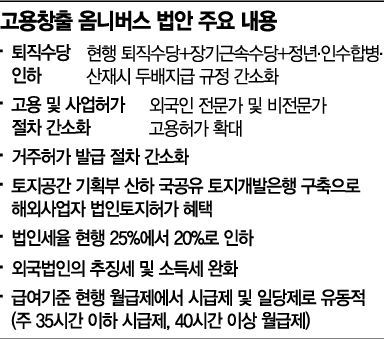
According to local media reports on the 14th, the Jokowi administration plans to push the Omnibus Law, which includes pro-business measures such as job creation and corporate tax rate cuts, through the parliament within this month. The 'Omnibus Law' is a law that combines multiple bills into one, characterized by simplifying the amendment and implementation procedures. To achieve the top priorities of investment attraction and job creation in President Jokowi's second term, 1,194 provisions across 82 related laws will be amended.
Domestic reactions to the Omnibus Law vary. Indonesian labor unions strongly oppose the revised labor law, citing significant disadvantages for domestic workers, while foreign investors and foreign companies are hopeful for improvements in the business environment.
Jumi, spokesperson for the Jakarta Labor Movement (GBJ), which is leading protests at Tanjung Priok, a major logistics port in North Jakarta, strongly opposes the Omnibus Law, stating it infringes on workers' basic rights by reducing severance pay and shifting to hourly wages. He particularly pointed out that expanding outsourcing of foreign workers beyond current regulations threatens the employment stability of domestic workers. He explained that increasing employment of foreign workers under the pretext of attracting foreign investment would lead to a decrease in jobs for domestic workers.
Despite such opposition, the Jokowi administration is rushing to amend the Omnibus Law, including labor laws, to foster a pro-business atmosphere. At the end of last year, the World Bank released the 'Ease of Doing Business Index' by country, ranking Indonesia 73rd. Strict employment conditions and minimum wage regulations were identified as the main factors lowering 'ease of doing business.' Indonesian labor law is also considered to offer some of the most generous severance pay worldwide. Workers with less than one year of service receive one month's salary, those with less than two years receive three months, less than four years five months, and those with 10 to 20 years of service receive a total of nine months' salary as severance pay. Long-term service bonuses occur every three years: two months' salary for over three years, three months for over six years, and up to ten months' salary for a maximum of 24 years of service. In 2018, Korean apparel company Hozen Industrial paid $4,000 in severance pay to each of 2,000 employees when closing its factory in West Java, Indonesia.
Notably, Indonesia has raised the minimum wage by 58% over the past five years, and the World Bank announced that "a 10 percentage point increase in the minimum wage in Indonesia results in a 0.8% decrease in employment."
The Indonesian government expects that if the job creation Omnibus Law is amended, it will be useful in attracting unicorn startups worth over $1 billion. The Indonesian E-commerce Association points out that only 5% of foreign companies have entered the domestic market. They emphasize that the passage of laws easing the employment of foreign workers is urgent, especially for Indonesian startups to recruit talent in advanced fields such as artificial intelligence (AI) from overseas.
© The Asia Business Daily(www.asiae.co.kr). All rights reserved.
![Clutching a Stolen Dior Bag, Saying "I Hate Being Poor but Real"... The Grotesque Con of a "Human Knockoff" [Slate]](https://cwcontent.asiae.co.kr/asiaresize/183/2026021902243444107_1771435474.jpg)















