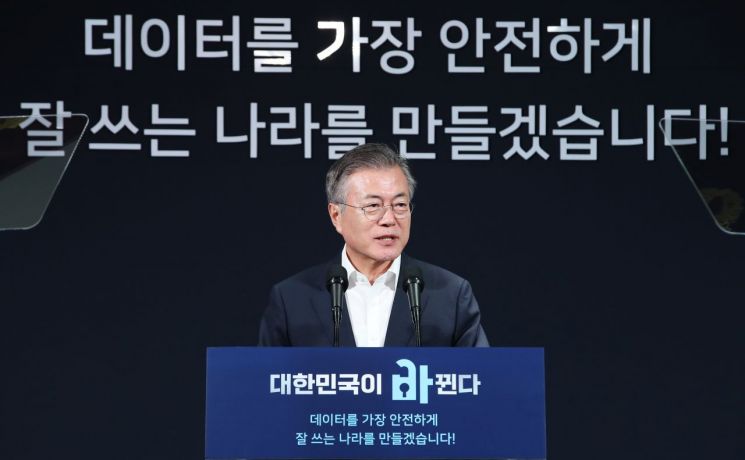
 President Moon Jae-in is delivering a speech at the Data Regulation Innovation On-site Visit event held in August 2018 at the Startup Campus in Pangyo, Seongnam, Gyeonggi Province.
 [Asia Economy Reporter Choi Dae-yeol] The Presidential Committee on the Fourth Industrial Revolution, directly under the president, approved the 'Data Industry Revitalization Strategy' in June 2018. As major advanced countries identified data as a key factor determining future industrial competitiveness and actively fostered it, the strategy emphasized the need for South Korea to build a data economy as well. About a month earlier, in May of the same year, the National Assembly's Special Committee on the Fourth Industrial Revolution concluded its activities by issuing a recommendation to revise related regulations to actively utilize personal information.
The government prepared improvement measures for the Personal Information Protection Act through multiple discussions with related industries and civic groups. In November 2018, In Jae-geun, a member of the Democratic Party of Korea and then-chairman of the National Assembly's Public Administration and Security Committee, introduced a revision bill as the main proposer. The bill categorized concepts related to personal information into personal information, pseudonymous information, and anonymous information, and included provisions allowing separate specialized institutions to combine or export data held by different companies. It also contained measures to strengthen personal information protection functions.
On the same day, a revision bill for the Act on Promotion of Information and Communications Network Utilization and Information Protection was introduced by Roh Woong-rae, also from the Democratic Party and chairman of the National Assembly's Science, Technology, Information and Communications Committee. The bill transferred matters related to personal information protection stipulated in the Information and Communications Network Act to the Personal Information Protection Act and designated the Personal Information Protection Commission as the supervisory body. A revision bill for the Credit Information Act, introduced by Kim Byung-wook of the Democratic Party, was also submitted that day. It introduced the concept of pseudonymous information, which cannot identify specific individuals, and allowed the use or provision of such information without the consent of the credit information subject for statistical compilation, research, or public interest record preservation.
Except for some members of the National Assembly, there was little disagreement between the ruling and opposition parties, and the government actively participated, but discussions were slow. This was because deliberations were not properly conducted due to parliamentary deadlock and political strife. Each revision bill faced prolonged discussions without easy conclusions even within standing committees. President Moon Jae-in urged urgent processing in his National Assembly policy speech in October last year, and Park Yong-man, chairman of the Korea Chamber of Commerce and Industry, also emphasized the need to pass the revision bills the following month, stating, "The data industry is the crude oil of future industries."
Civic groups viewed the concept of pseudonymous information skeptically, believing that the disadvantages would outweigh the benefits if the revision bills were passed. They judged that allowing provision and utilization without the consent of the information subject would enable companies to arbitrarily interpret the law, undermining the foundation of the Personal Information Protection Act system. The right to self-determination regarding personal information is a fundamental right recognized by the Constitution, and concerns have been consistently raised that the revision bills could lead to constitutional controversies. Kim Jong-dae and Chu Hye-seon of the Justice Party appeared as debaters before the vote on these revision bills at the plenary session held that afternoon, urging members to "cast a dissenting vote."
© The Asia Business Daily(www.asiae.co.kr). All rights reserved.
![Clutching a Stolen Dior Bag, Saying "I Hate Being Poor but Real"... The Grotesque Con of a "Human Knockoff" [Slate]](https://cwcontent.asiae.co.kr/asiaresize/183/2026021902243444107_1771435474.jpg)















