FBI Requests Unlocking of iPhone Belonging to Suspect Who Killed 3 Sailors at Naval Base
Apple Maintains Stance: "Cannot Provide Backdoor Access to Customer Information"
Also Refused in 2015 and 2017 Gun Terror Cases Citing Privacy Concerns
[Asia Economy Reporter Kwon Jaehee] National security or personal privacy.
The long-standing debate between the U.S. Federal Bureau of Investigation (FBI) and tech giant Apple is expected to reignite. The FBI requested Apple to unlock the iPhone of a suspect involved in a shooting incident at a Florida naval base last month, but Apple refused.
According to the Associated Press on the 8th (local time), the FBI recently asked Apple to unlock two iPhones belonging to a Saudi-born suspect who killed three sailors at the Florida naval base last month, but Apple declined. Dana Boente, FBI legal counsel, said, "We obtained a search warrant but were denied by Apple," adding, "This case is a national security issue and should be prioritized above all else."
Apple stated, "We can provide publicly available information, including data synchronized with iCloud, but we cannot accept requests to open a 'backdoor' to customer information," maintaining its existing position. "We respect law enforcement and will cooperate sincerely with investigations."
Apple provides users' backup data stored on its cloud storage service iCloud when ordered by a court, but the company cannot access this data if the user-set device password is not unlocked. Therefore, investigative authorities like the FBI have demanded the provision of an 'iOS backdoor' to bypass this. Apple has refused, citing privacy infringement concerns.
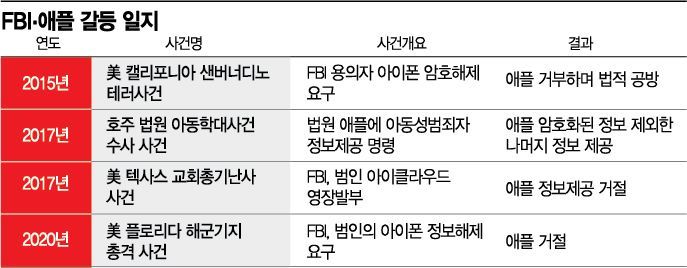
This confrontation between the FBI and Apple is not the first. The debate over 'national security vs. personal privacy' dates back to 2015. When a shooting terror incident in San Bernardino, California, resulted in 14 deaths, the FBI requested Apple to disable the security features of the terrorist's iPhone. However, Apple refused, citing privacy violations, sparking the controversy. The FBI argued that under the All Writs Act of 1789, it had legitimate authority as a government agency and could issue cooperation orders. Apple countered that this violated freedom of expression and the right to be free from unreasonable intrusion. The dispute escalated to legal battles, with U.S. federal courts divided between those ordering the iPhone to be unlocked (California court) and those ruling there was no obligation to do so (New York court). Ultimately, the FBI withdrew the lawsuit, claiming it found a way to unlock the encryption without Apple's cooperation, and the case was settled.
In 2017, an Australian court ordered Apple to provide information on a child sex offender, and after a church shooting terror incident in Texas the same year, U.S. authorities again requested Apple's cooperation to unlock the suspect's iPhone. However, Apple never allowed a 'backdoor' even once.
Instead, Apple has strengthened user privacy protection with 'ironclad security,' adding features such as blocking data transfer or access after one hour of device lock through operating system updates.
Apple's strong 'privacy protection' policy stands out as different from Google and Facebook, which generate advertising revenue based on customer information. This is the philosophy of Apple's co-founder, the late Steve Jobs, and has become a defining identity of Apple.
Apple CEO Tim Cook criticized Google and Facebook directly in an interview with the media, saying, "Extensive profile collection infringes on privacy."
© The Asia Business Daily(www.asiae.co.kr). All rights reserved.
![Clutching a Stolen Dior Bag, Saying "I Hate Being Poor but Real"... The Grotesque Con of a "Human Knockoff" [Slate]](https://cwcontent.asiae.co.kr/asiaresize/183/2026021902243444107_1771435474.jpg)















