FSS Imposes Total of 27 Sanctions on Commercial Banks Last Year
Fines Approaching 10 Billion KRW... Sixfold Increase from Previous Year
KEB Hana Bank Faces Highest Institutional Fine of 3.16 Billion KRW
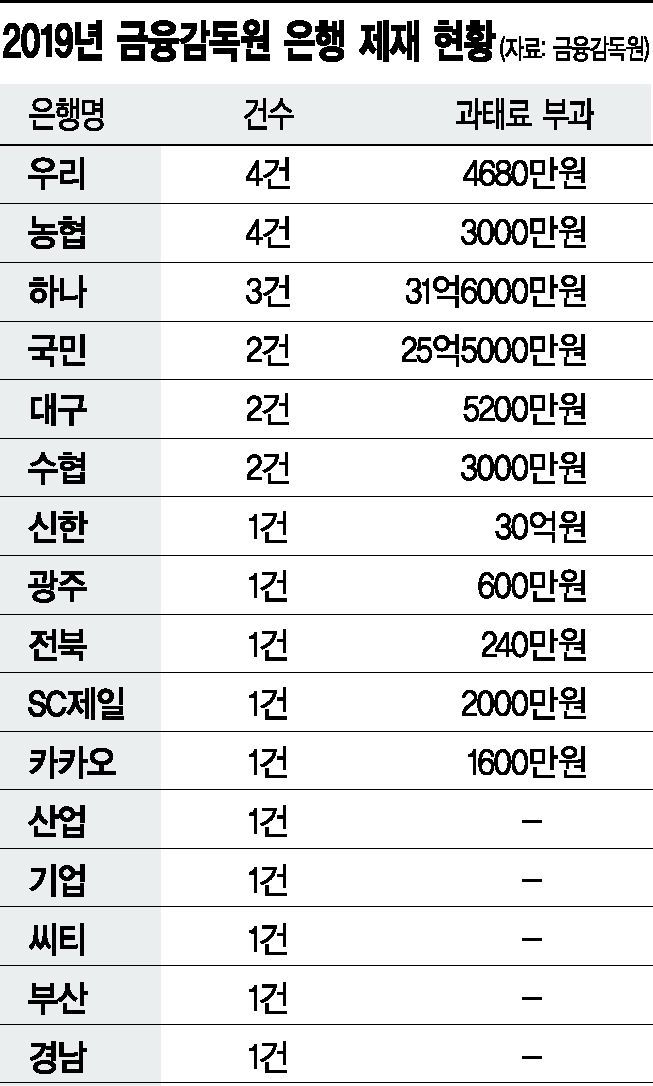
[Asia Economy Reporter Jo Gang-wook] Commercial banks, which faced heavy criticism for incomplete sales, paid fines approaching 10 billion KRW last year. This represents nearly a sixfold increase compared to the previous year. In particular, with recent intensified sanctions following the overseas interest rate-linked derivative-linked funds (DLF) and the large-scale redemption suspension incident of Lime Asset Management's private equity funds, there are even forecasts that a fine bomb may be imposed this year.
According to the Financial Supervisory Service (FSS) on the 9th, the total number of sanctions imposed on major domestic banks by the FSS last year was 27 cases. Including those under review by the Financial Intelligence Unit under the Financial Services Commission, the amount of fines imposed is estimated to reach 10 billion KRW. This is about six times higher than the 1.7 billion KRW of the previous year. Notably, fines alone in December last year amounted to as much as 9 billion KRW.
Among commercial banks, KEB Hana Bank received the highest institutional fine. Hana Bank was fined 3.16 billion KRW and received an institutional warning last month for incomplete sales of trust-type short straddle exchange-traded notes (ETNs). Two related executives were given reprimands.
According to the sanction disclosure, 140 branches including the Mia Sageori branch of Hana Bank solicited investments from 354 general investors for a specific short straddle ETN product worth 35.9 billion KRW from November 2017 to September 2018. During the solicitation and sales process, the investor suitability analysis was conducted again, and general investors initially classified as 'aggressive investor or below' were ultimately classified as 'aggressive investor.' Furthermore, the investor information serving as the basis was not confirmed or maintained through signatures or seals.
The FSS also pointed out that Hana Bank produced and distributed asset management explanatory documents that did not include explanations of the main contents, structure, and characteristics of the short straddle ETNs. Additionally, employees who were not derivative investment advisory personnel recommended investments in equity-linked securities (ELS) trust contracts, which are derivative products, raising further issues.
In the same month, KB Kookmin Bank and Shinhan Bank were fined 2.5 billion KRW and 3 billion KRW respectively. Kookmin Bank was caught promoting specific money trust products via text messages to over 100 customers at four branches from 2016 to last year. It was also revealed that from June 2016 for two years, some branches had employees without derivative investment advisory qualifications recommending investments in ELS and exchange-traded funds (ETFs) trusts. There was also a case of incomplete sales violating the suitability principle during the sale of ELS trusts to investors in February 2018.
Shinhan Bank violated regulations by promoting trust products via text messages to about 10,000 customers from May 2016 to June last year. At five branches, unqualified personnel for derivative investment solicitation were caught recommending investments in ELS trust contracts.
In the market, concerns are growing that the financial authorities may impose a fine bomb this year as they tighten controls on incomplete sales due to the KIKO, Lime, and DLF incidents.
A financial industry official said, "Public opinion sees this as a disaster caused by the incomplete sales practices of private equity funds, and the financial authorities' pressure emphasizing consumer protection will intensify further," adding, "For banks, which urgently need to improve management efficiency due to deteriorating profitability, this will inevitably cause headaches."
© The Asia Business Daily(www.asiae.co.kr). All rights reserved.
![Clutching a Stolen Dior Bag, Saying "I Hate Being Poor but Real"... The Grotesque Con of a "Human Knockoff" [Slate]](https://cwcontent.asiae.co.kr/asiaresize/183/2026021902243444107_1771435474.jpg)















