[Asia Economy Reporter Inho Yoo]
A wealthy individual, Mr. A, who owns three apartments in Gangnam, Seoul, put two of them on the market after the government announced the December 16 real estate measures last year. This was due to the burden of comprehensive real estate tax and the atmosphere of a downturn in housing prices in the Gangnam area.
Instead, Mr. A decided to invest in small commercial buildings (so-called 'Kkoma Buildings') using his cash holdings and funds from selling the houses. He judged that income-generating real estate, which can avoid residential real estate regulations and provide monthly cash flow, was a better option.
He said, "In a situation where the government is intensively regulating Gangnam, it has become difficult to own more than two properties. I believe non-residential investments that can generate stable long-term income are better, so I decided to invest in Kkoma Buildings."
Due to the increased tax burden from the government's December 16 real estate measures and various high-intensity housing regulations, wealthy investors have recently shown growing interest in Kkoma Buildings. Kkoma Buildings refer to small-scale commercial buildings with a total floor area of around 1,000㎡ and about five floors.
Since the end of last year, inquiries about related investments have increased at specialized brokerage offices, especially in areas with high foot traffic in Gangnam and Seongdong-gu. Among wealthy investors, the real estate investment formula of "selling residential properties and buying commercial ones" is gaining popularity. This is interpreted as a balloon effect caused by the government's high-intensity real estate measures.
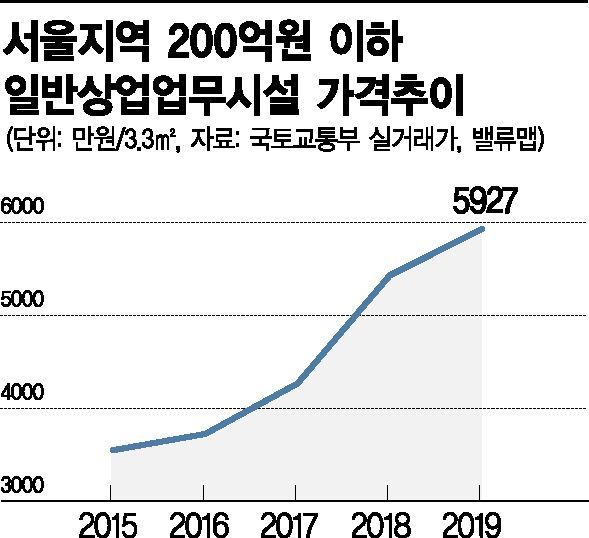
According to the KB Financial Group Management Research Institute on the 7th, the transaction price of buildings in Seoul with a total floor area between 100㎡ and 1,000㎡, which was around 4 million KRW per 1㎡ in 2014, rose to 10 million KRW in the third quarter of last year. The price increased 2.5 times in five years.
Park Hapsu, Senior Real Estate Specialist at KB Kookmin Bank, said, "Kkoma Buildings are increasingly preferred as they are excluded from heavy taxation on property holding and capital gains tax. Under the low-interest rate environment and strengthened regulations on the residential real estate market, Kkoma Buildings will stand out more as an alternative product."
Last year, the most active area for Kkoma Building transactions in Seoul was Gangnam-gu, with 154 transactions up to the third quarter, the highest number. This was followed by Jung-gu with 88 transactions and Jongno-gu with 71. In particular, the transaction prices of Kkoma Buildings in the three Gangnam districts?Gangnam, Seocho, and Songpa?are on the rise. The average sale price per 3.3㎡ last year was 82.7 million KRW, up 17.7% from 70.26 million KRW in 2018 and 31.4% from 62.96 million KRW two years ago.
For example, a five-story building in Nonhyeon-dong, Gangnam-gu, which was traded at the end of last year, increased by 1.02 billion KRW (11.6%) in about a year. A 300㎡ building in Yeoksam-dong was sold for 7 billion KRW in June 2017 and was resold for 8.27 billion KRW at the end of last year, generating a profit of 1.27 billion KRW in about two years.
The reason Kkoma Buildings are attracting attention as investment destinations is that, due to the government's ultra-high-intensity housing market regulations, wealthy investors hope to switch to commercial real estate that can avoid tax burdens and generate stable income. Unlike apartment sales, building sales are less regulated and can provide stable rental yields. In particular, Kkoma Buildings have the advantage of being accessible with relatively small capital.
On the other hand, the housing rental business, which was preferred by wealthy investors, has lost its appeal due to strengthened government regulations. Previously, housing rental income under 20 million KRW per year was tax-exempt, but from the 2019 tax year, income under 20 million KRW is also subject to income tax.
Additionally, the possibility of interest rate cuts has played a role. The real estate industry expects that if the base interest rate is further lowered in the first quarter or at the latest in the first half of this year, the popularity of income-generating real estate such as Kkoma Buildings will increase even more.
However, some experts advise caution against indiscriminate investment in Kkoma Buildings. This is because the government changed tax laws in 2019 to apply appraisal values instead of standard market prices for inheritance and gift taxes on general buildings excluding houses, officetels, and commercial buildings.
Kkoma Buildings have so far been assessed at standard market prices below 60% of their market value. An industry insider said, "Although Kkoma Buildings are a stable source of income for wealthy investors, they are unlikely to continue to be favored as a tax-saving investment for inheritance and gifts."
© The Asia Business Daily(www.asiae.co.kr). All rights reserved.
![Clutching a Stolen Dior Bag, Saying "I Hate Being Poor but Real"... The Grotesque Con of a "Human Knockoff" [Slate]](https://cwcontent.asiae.co.kr/asiaresize/183/2026021902243444107_1771435474.jpg)















