Manuscripts Preserved by University Boarding House Family
Early Work Believed Written at Age 20
Actively Spoke Out on Korean Historical Issues
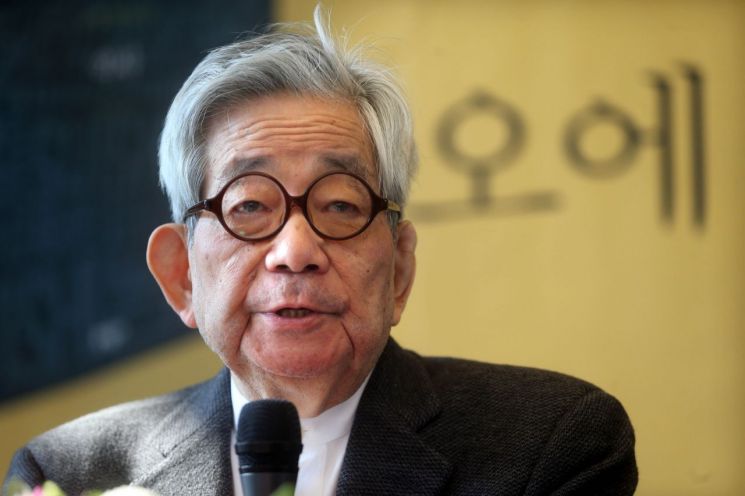
Kenzaburo Oe (1935-2023), a Nobel Literature Laureate and a leading figure in modern Japanese literature, has had two previously unpublished novels believed to have been written during his university years newly discovered.
On March 3, Yonhap News reported, citing Japanese media such as the Yomiuri Shimbun and the Asahi Shimbun, that the Faculty of Letters at the University of Tokyo has confirmed the existence of two handwritten short novel manuscripts written by Oe before his literary debut.
The newly discovered works are titled "Journey from a Dark Room" and "Attempt at a Journey." "Journey from a Dark Room," believed to have been written when Oe was 20 years old, is an early work structured in three parts. The story begins with the protagonist, a sophomore in college, receiving an invitation from an archaeology professor. The date "May 19, 1955" is written in Japanese at the end of the manuscript, suggesting that Oe wrote it at age 20. The Asahi Shimbun reported that apart from works submitted to literary contests and known only by title, this is the oldest extant novel by Oe. Notably, this work is characterized by a strong romantic element, which is relatively rare in Oe’s literature.
The other work, "Attempt at a Journey," centers on a boy with a physical disability. The date "May 1957" is written at the end of the manuscript. The Asahi Shimbun analyzed that this work shares similar settings and themes with a story Oe published in the literary magazine "Shincho" in August of the same year. Oe made his literary debut in 1957 with "Elitism of the Dead," and the following year, he won Japan's most prestigious literary award, the Akutagawa Prize, for "The Catch," catapulting him into the spotlight.
Interestingly, Oe had previously stated that he discarded most of his university-era drafts during his lifetime. However, these manuscripts were kept by the landlady of the boarding house where Oe lived as a student. In November of last year, her grandson informed the University of Tokyo about their existence, bringing them to public attention. After an investigation, the university confirmed that the manuscripts are indeed works by Oe.
The two newly discovered early novels are being regarded as important materials that shed light on the issues and creative process shaping Oe's literary world during his youth. Kenichi Abe, a professor at the University of Tokyo, commented, "I never imagined I would be able to read new works by Oe. As a reader, it feels like a gift from heaven." The Asahi Shimbun also evaluated these works as "valuable materials that show the formation process of Oe's literature, as recurring motifs and themes from his later works already appear here."
Kenzaburo Oe is recognized as a prominent intellectual writer who consistently addressed social anxiety and political issues within Japanese society. His major themes include criticism of militarism, peace and coexistence, and his life with his disabled eldest son. He was also outspoken on issues such as Japan's historical awareness and the peace constitution. In 1994, Oe was awarded the Nobel Prize in Literature. The Swedish Academy praised his literary world as "poetically expressing the bewildering situation of modern humanity with mythic imagination." However, shortly after winning the Nobel Prize, he made headlines by declining the Order of Culture awarded by the Japanese government, stating, "I am a postwar democrat, and a decoration from the state does not suit me," and, "I consider the Nobel Prize to be an award from the citizens of Sweden."
Oe was also vocal about historical issues related to Korea. He visited Korea numerous times and repeatedly emphasized the need for Japan to reflect on its past aggression in Asia. He criticized issues such as Japanese history textbooks and the comfort women issue. In 2010, the centennial of Japan's forced annexation of Korea, Oe participated in a joint statement by Korean and Japanese intellectuals declaring, "The annexation of Korea was invalid from the beginning."
© The Asia Business Daily(www.asiae.co.kr). All rights reserved.