Analysis of New Seoul Survey Questions
Mainly Used AI Service: "Conversational"
Top Future Safety Concern: "Personal Information"
54% of Citizens Support "Four-and-a-Half-Day Workweek"
More than 8 out of 10 Seoul residents have used artificial intelligence (AI) services, and nearly 70% of those aged 60 and older have also had experience using them.
On March 4, the Seoul Metropolitan Government released the results of its analysis of new questions included in the "2025 Seoul Survey."
The Seoul Survey is an annual statistical survey conducted since 2003 to monitor changes in the quality of life, values, and social perceptions of citizens, and to utilize these findings in city governance. After previously releasing key indicators, the city has now published results from questions introduced for the first time this year.
According to the survey, 86.3% of citizens reported having experience using AI services. By age group, the usage rates were 98.8% for those in their 20s or younger, 97.0% for those in their 30s, 93.9% for those in their 40s, 86.0% for those in their 50s, and 68.7% for those aged 60 and over.
The most frequently used AI services were "conversational AI" (60.0%), followed by "AI translators" (48.2%), and "services that automatically recommend content or products" (45.0%).
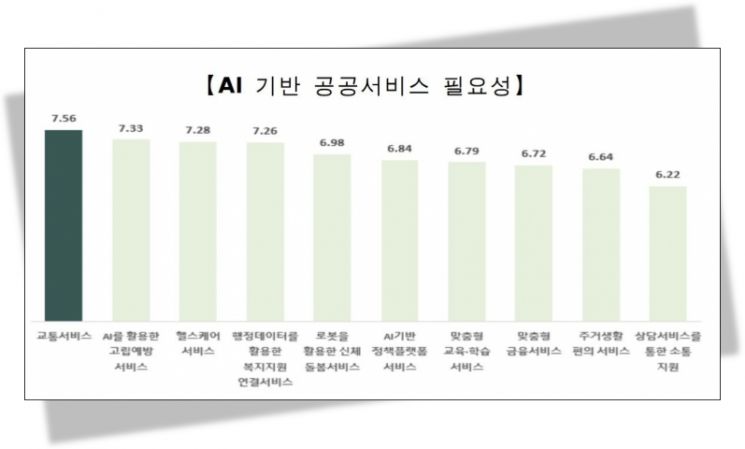
When asked to rate, on a 10-point scale, how necessary they believe AI services are in various sectors, transportation services received the highest score (7.56), followed by isolation prevention services (7.33) and healthcare services (7.28).
Regarding concerns about advanced technologies threatening social safety in the future, the most common response was "leakage and misuse of personal information" (75.8%). This was followed by "spread of false information and manipulation" (71.8%) and "cyberattacks" (50.3%).
This survey also marked the first time citizens’ views on a four-day and a four-and-a-half-day workweek were assessed. Support for introducing a four-and-a-half-day workweek stood at 54.5%, 5.5 percentage points higher than the 49% who supported a four-day workweek. Support for the four-and-a-half-day workweek was relatively higher among citizens in their 20s to 40s, those with a college degree or higher, and white-collar workers.
Citizens cited "increased time for leisure and hobbies" (60.8%), "improved work-life balance" (53.8%), and "better mental and physical health" (49.2%) as expected benefits of adopting a four-and-a-half-day workweek.
Kang Okhyun, Director General of the Digital City Bureau at the Seoul Metropolitan Government, stated, "Through the analysis of these new questions, we were able to gain insight into citizens' perspectives on structural changes such as labor, digitalization, and a super-aged society. We will reflect these shifting perceptions in the policy design process to operate city governance in a way that provides tangible benefits to citizens' lives."
© The Asia Business Daily(www.asiae.co.kr). All rights reserved.