Expansion of Transportation Networks and Active Redevelopment Achievements
Gangdong District in Seoul (Mayor Soohee Lee) announced on March 4 that, as of February 27, its registered population has surpassed 500,000. This makes it the fourth district among Seoul’s 25 autonomous districts to reach this milestone, following Songpa, Gangnam, and Gangseo Districts.
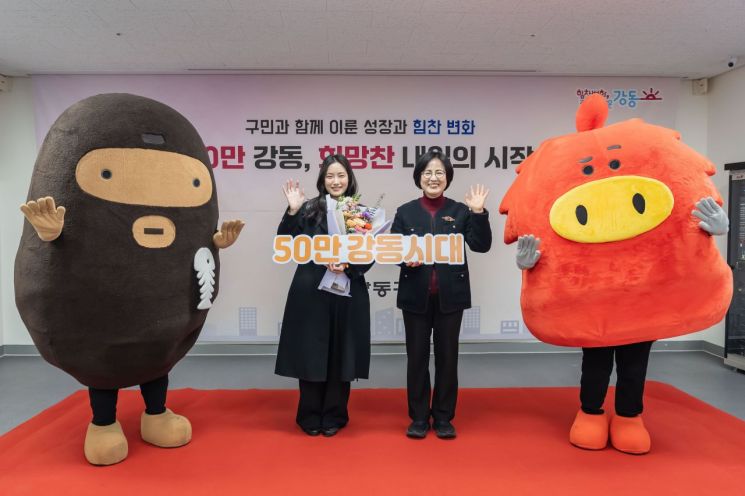 At the event celebrating the population reaching 500,000, Soohee Lee, Mayor of Gangdong District (right), and Noeul Kang are taking a commemorative photo. Provided by Gangdong District.
On March 3, Gangdong District held a commemorative event at the Cheonho 2-dong Community Center and presented a commemorative plaque to Noeul Kang, the 500,000th resident. JK Mirae Co., Ltd., a local company, also presented a congratulatory gift worth 1 million won to the 500,000th resident. Kang stated, “I moved here because the commute is convenient and it’s close to the Han River,” adding, “I hope to live in Gangdong for a long, long time.”
Emerging as the Transportation Hub of Eastern Metropolitan Seoul
Gangdong District analyzed that the expansion of transportation infrastructure has driven population growth. The confirmation of the Metropolitan Rapid Transit (GTX)-D line route passing through Gangdong, the extension of Subway Line 9 Phase 4, and the opening of Amsa History Park Station on the extended Line 8 have all taken place in succession. With the opening of the Sejong-Pocheon Expressway, a total of five major expressways now cross Gangdong District.
Additionally, vigorous redevelopment projects in recent years have contributed to the population increase. Gangdong District continues to maintain a high total fertility rate among Seoul’s districts. The district is reducing the burden of childcare through the ‘Gangdong Model Teacher-to-Child Ratio Improvement Project,’ considered a national model, and by operating 11 ‘iMom Gangdong’ childcare support centers.
To address overcrowded classes, new urban campus schools have been established, including Gangsol Elementary School’s Ganghyeon Campus and a new middle school in Dunchon-dong. Gangdong also operates a specialized education program, ‘The Best Gangdong Education Belt,’ creating a city where education is a key reason for choosing to live there.
Realizing a Self-Sufficient City with Easy Access to Work and Home
Godeok Biz Valley is now home to 23 companies, employing around 10,000 people, and is growing into a global landmark with projects like the new headquarters for JYP Entertainment. Cultural infrastructure has also been expanded, with the opening of Gangdong Forest Library and Gangdong Central Library-the largest among Seoul’s districts-as well as extending library hours on weekdays until 10 p.m. Cheonho Eoullim Swimming Pool and Gangil Community Sports Center have also opened to the public.
Gangdong District has established the ‘2040 Gangdong Grand Design’ to ensure balanced development between the old and new urban areas. The entire district has been divided into five zones, each with tailored development strategies. Cheonho and Seongnae will be nurtured as regional growth hubs; Amsa as a center for historical and cultural tourism; Myeongil and Godeok as zones for economic and leisure complexes; and Gangil-Sangil and Gildong-Dunchon will be further developed as riverside residential and industrial hubs, respectively.
Mayor Soohee Lee stated, “Reaching a population of 500,000 is a symbolic achievement that demonstrates Gangdong District’s growth potential and urban competitiveness,” adding, “Together with 500,000 residents, we will make Gangdong a city where everyone wants to live-a city where three generations can thrive and be blessed.”
© The Asia Business Daily(www.asiae.co.kr). All rights reserved.