From six members excluding the Governor to seven including the Governor
Outlook horizon extended from three months to six months
Introduction of the K-dot plot, three dots per member
Future rate levels inferred from the distribution of 21 dots in total
On the 26th, starting with the Monetary Policy Board meeting, the Bank of Korea introduced a six?month horizon "K-dot plot" as part of its forward guidance, which presents the Monetary Policy Board members' conditional projections for the base rate.
 Lee Changyong, Governor of the Bank of Korea, is answering reporters' questions at a press briefing following the Monetary Policy Direction Decision Meeting held at the Bank of Korea in Jung-gu, Seoul, on the morning of the 15th of last month.
Until now, the six Monetary Policy Board members, excluding the Governor, had informed the market whether they saw the base rate as likely to be maintained three months ahead, or whether they viewed a hike or a cut as more likely. Beginning with this meeting, all seven members of the Monetary Policy Board, including the Governor, will each place three dots to reflect a probability distribution for their interest rate outlook six months ahead.
All three dots can be placed at the same interest rate level, or two dots and one dot can be placed at different levels. It is also possible to place all three dots at three different rate levels. Through this, the level and distribution of interest rate expectations can be seen at a glance. The publication frequency has also been changed: instead of being presented at every Monetary Policy Board meeting, it will now be released four times a year, in February, May, August, and November, when the economic outlook is published.
Choi Changho, Director General of the Monetary Policy Department at the Bank of Korea, explained the change in the Monetary Policy Board's conditional rate projections, saying, "With the new interest rate outlook, three dots can probabilistically present the baseline as well as upside and downside risks, and by extending the horizon to six months, it will be possible to provide the Monetary Policy Board members' views on the medium- to long-term yield curve."
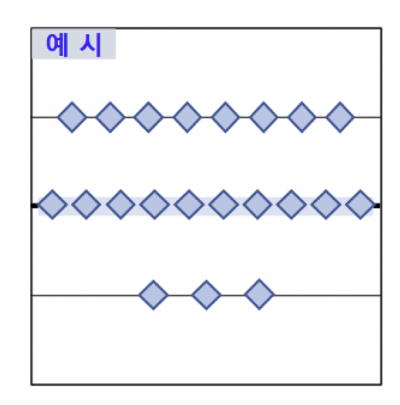 A total of 27 dots are plotted at each interest rate level, allowing the level and distribution of 6-month-ahead rate expectations to be seen at a glance.
Background and expected effects of the new interest rate outlook
The previous interest rate outlook was presented as a statement of possibilities rather than a forecast, in response to the question, "What are the Monetary Policy Board members' views on the base rate over the next three months?" As a result, the message tended to be somewhat unclear, and because the horizon was only three months, there was limited additional information compared with the current month's policy decision and some overlap, according to the Bank of Korea.
The new interest rate outlook, through three anonymously presented dots, can convey views on the rate path, including the baseline and upside and downside risks, more clearly. Director General Choi said, "By extending the horizon to six months and thereby providing, to some extent, the Monetary Policy Board members' views on the medium- to long-term yield curve, we expect it to support economic agents' decision-making and enhance the transmission of monetary policy."
The reason all seven Monetary Policy Board members, including the Governor, present their views is to better reveal the Board's collective outlook for the future policy rate.
How will the existing 'conditional three?month outlook' be used?
For the time being, the Bank of Korea plans to describe the existing three?month outlook in a qualitative manner. However, it explained that presenting both three?month and six?month rate outlooks could constrain policy flexibility, so after a transition period it intends to operate in a way that does not provide a separate three?month outlook. Instead, the market will be expected to infer the three?month rate on its own, based on the policy decision for the current month and the six?month outlook.
Director General Choi said, "Because we have been providing the three?month outlook up to now, rather than stopping it immediately, we intend, after the monetary policy decision meetings, to explain it qualitatively at the press briefings (for example, indicating majorities and minorities without specifying the number of members)," adding, "It is difficult to specify the transition period precisely, but we will proceed while monitoring when the market more fully accepts the formation of rate expectations based on the six?month outlook."
Was the introduction of the new outlook decided abruptly?
The Bank of Korea stressed that it has been preparing for more than three years since it began presenting Monetary Policy Board members' three?month rate outlooks in October 2022. Director General Choi said, "Internally, we have continuously discussed extending the horizon of the outlook and clarifying the presentation method through pilot tests. We have also been studying foreign cases for more than three years," adding, "Last year, we conducted surveys of economic agents and held a monetary policy conference to gather external opinions." He explained that the new framework reflects a comprehensive review of the pilot test results and feedback from the market and academia.
Why three dots per member, unlike the single dot used by the U.S. Fed?
The U.S. Federal Reserve's Federal Open Market Committee (FOMC) has 19 members providing projections, so even a single projection per member contains a great deal of information. By contrast, the Bank of Korea has only seven members, making it difficult to convey sufficient information with just one dot each. Director General Choi added, "We judged that clearly presenting the baseline outlook and upside and downside risks with three dots would provide richer information about the future policy path."
The U.S. is considering shrinking its dot plot; is Korea moving in the opposite direction?
The Bank of Korea believes it is too early to judge whether the Fed will scale back its dot plot in the future and that this needs to be watched further. It also noted that the two countries are not directly comparable, as the Bank of Korea has only now extended its horizon from three to six months.
Director General Choi said, "Given that Korea is a small open economy and therefore highly exposed to external uncertainty, we judged that presenting a forecast with a horizon of around six months is appropriate," adding, "It will be important for each country to improve its forward guidance in line with its own economic conditions."
Is there a possibility of extending the horizon to one year?
The Bank of Korea stated that, because the six?month horizon for the interest rate outlook has been introduced after more than three years of preparation, any further extension of the horizon will be discussed only after the effects of the new outlook have been evaluated over a sufficiently long period.
© The Asia Business Daily(www.asiae.co.kr). All rights reserved.


















