Democratic Party attacks, calling the failure of the Special Act a "betrayal"... Governor Kim says "adjusting the national-to-local tax ratio to 60 to 40 is a prerequisite"
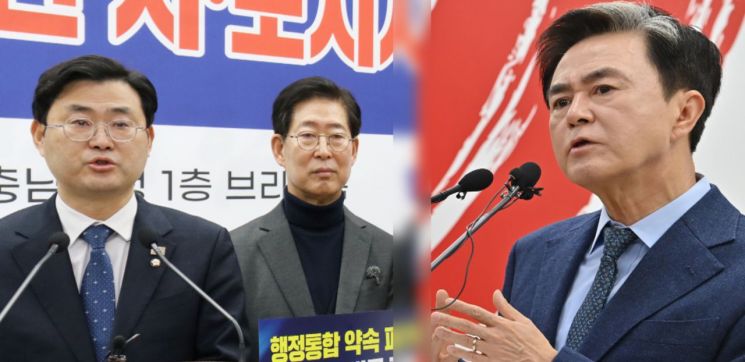
Immediately after the "Special Act on Administrative Integration of South Chungcheong Province and Daejeon" was put on hold at the National Assembly Legislation and Judiciary Committee on the 24th, South Chungcheong Province Governor Kim Taehum publicly proposed a redesign of the plan based on fiscal and authority transfers, saying, "Integration is about substance, not speed."
In response to the Democratic Party of Korea's attacks accusing him of "betrayal," he flatly refuted them, saying, "Talking about 'Maehyang (selling out one's hometown)' is political agitation."
With the administrative integration issue emerging rapidly ahead of the upcoming June 3 local elections, the Democratic Party of Korea South Chungcheong Provincial Chapter and Governor Kim held back-to-back press conferences and clashed in the briefing room at the South Chungcheong Provincial Government on the 25th.
The Democratic Party South Chungcheong Provincial Chapter (headed by Lee Jeongmoon) stated at a 10 a.m. press conference that day, "The handling of the Special Act on Administrative Integration of South Chungcheong Province and Daejeon has ultimately fallen through," adding, "This is not merely a delay in the political schedule, but a grave abdication of responsibility that tramples on the future of South Chungcheong Province and Daejeon."
It then called on the People Power Party to: ▲apologize for reneging on the promise of administrative integration, ▲clarify its position for or against the plan, and ▲present concrete alternatives to address local extinction.
In response, Governor Kim countered at an 11 a.m. press conference and through social media.
He criticized, "Members of the Democratic Party who talk about 'Maehyang (selling out one's hometown)' toward me are truly bad people," and added, "They said nothing for a year and a half while the framework was being drawn up, but then, at a single word from the president, they hastily cobbled together a hollow bill and demanded unconditional acceptance. Is that not what Maehyang really is?"
While expressing regret over the Legislation and Judiciary Committee's decision to put the bill on hold, saying, "In effect, administrative integration has reached the point of collapse," he nevertheless stressed the need to redirect the course of the integration debate.
Governor Kim argued, "For administrative integration, what matters is not speed but the transfer of finances and authority, in other words, substance," and insisted, "If we are to manage our own affairs after integration, the current 75-to-25 ratio of national to local taxes must be adjusted to around 60 to 40."
Targeting the Democratic Party's narrative of "being bypassed," he said, "Do not agitate and intimidate the residents of the province," and added, "Even if it is late, you must lay the proper foundation stone and design the structure correctly so that the house does not collapse."
As an alternative, Governor Kim proposed forming a "special committee with an equal number of ruling and opposition party members" within the National Assembly and establishing a "pan-governmental body" at the government level.
He declared, "I will not stop the clock on integration. However, it must move in the right direction."
With the Special Act on Administrative Integration of South Chungcheong Province and Daejeon having been put on hold at the National Assembly Legislation and Judiciary Committee on the 24th, there is growing expectation that, in the 9th nationwide local elections to be held on June 3, the current system of electing separate mayors and provincial governors, rather than integrated leadership, will be maintained.
© The Asia Business Daily(www.asiae.co.kr). All rights reserved.

















