"Even R&D Funds Will Be Diverted to Cancellations, Hindering Mid- to Long-Term Growth"
"Regulatory Reforms to Boost Management Vitality Must Be Accelerated," Business Community Urges
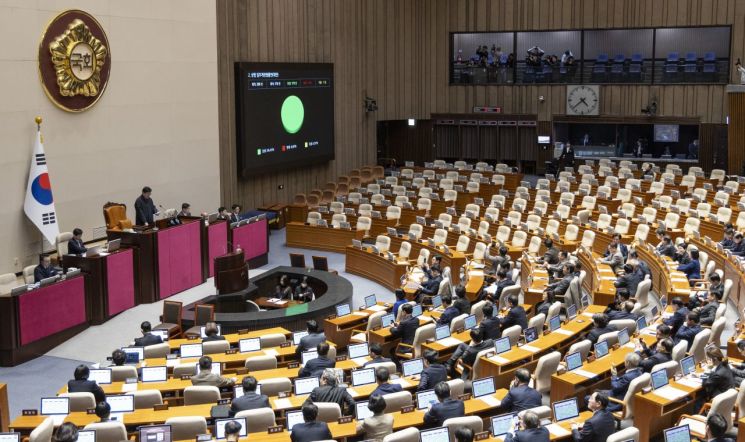
The so-called "third amendment to the Commercial Act," which mandates the cancellation of treasury shares held by companies, passed the National Assembly plenary session on the 25th. While some view it as an appropriate measure to resolve the so-called "Korea discount," others criticize it as an excessive infringement on corporate management autonomy. In this context, the business community is calling for follow-up legislation to minimize any side effects that may arise in the future.
The core of this amendment is that companies are now required to cancel any treasury shares they acquire within one year. For treasury shares already held, companies must dispose of or cancel them within a grace period of one year and six months.
The business community believes that, due to the passage of this amendment, the use of treasury shares as one of the key tools for defending management control will effectively be blocked. A senior industry official expressed concern, saying, "The cancellation of treasury shares should be an area of optimal management decision-making depending on the circumstances facing each company, but forcing this by law is an overly rigid measure." The official added, "There are cases where companies need to hold treasury shares to defend management control when necessary, and it is clear that such defensive tools will be weakened."
In particular, large conglomerates have so far used the so-called "treasury share magic" to strengthen the controlling shareholder's grip by allocating new shares to treasury shares during spin-offs. However, with this legislation, such scenarios are expected to become impossible.
Some companies have already taken preemptive steps by selling their treasury shares to friendly partners or swapping shares to convert them into "friendly stakes with voting rights."
There are also concerns that future-oriented management activities such as mergers and acquisitions (M&A) will be dampened. Another corporate official said, "Treasury shares are used in a variety of management activities, not only serving as a white knight, but also being sold on the market when needed to raise funds for mergers and acquisitions," and added, "If cancellation becomes mandatory, funds that should be used for research and development (R&D) investment or new businesses will be forcibly directed into one-off value-up cancellations, which will have side effects that undermine companies' mid- to long-term competitiveness."
While the business community agrees with the purpose of enhancing shareholder returns, it has called for detailed institutional refinements that do not undermine the vitality of corporate management. Lee Sangho, Head of the Economic Division at the Federation of Korean Industries, said, "To ensure that this amendment contributes to enhancing shareholder value and advancing the capital market, we hope that issues related to treasury shares acquired for specific purposes, such as in the course of M&A, will be supplemented through further discussions going forward."
He continued, "Since expanding corporate earnings is crucial for shareholder returns, we urge the National Assembly to accelerate regulatory improvements that can boost management vitality," and emphasized, "The business community will also continue efforts to strengthen communication with shareholders and to enhance market trust."
© The Asia Business Daily(www.asiae.co.kr). All rights reserved.

















