40MW Solar and Wind Power Cluster... Full-Scale Profit Sharing Begins
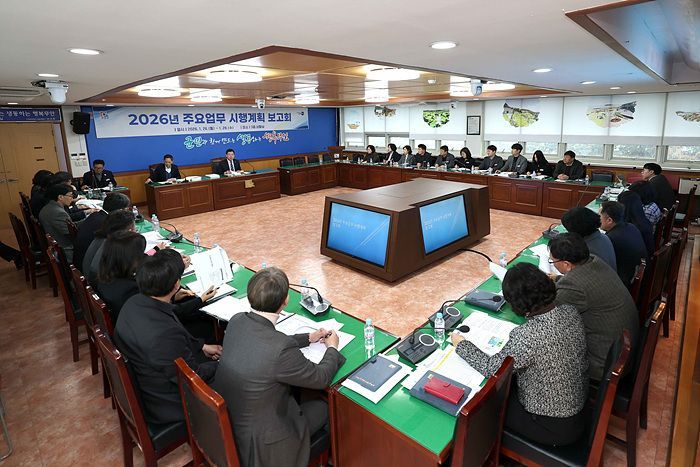 Muan-gun is discussing concrete measures to establish an energy self-sufficient city through a major business implementation plan briefing. Provided by Muan-gun.
Muan-gun in Jeollanam-do is accelerating its efforts to build an "energy self-sufficient city" by expanding the supply of new and renewable energy based on solar and wind power. The county plans to fully implement the "Muan-style profit-sharing scheme," which returns power generation profits to residents in the form of income and welfare, in order to usher in an era of energy welfare.
Muan-gun has shifted its policy direction in line with the global trend of responding to the climate crisis and the spread of RE100. It is moving beyond the simple expansion of power generation facilities toward a structure that links energy production with residents' income. The strategy is to mitigate the risk of regional extinction by sharing renewable energy profits with the local community in response to rural depopulation and population aging.
As of December last year, 2,026 solar power plants with a capacity of 1MW or less had been approved within the county, of which 1,147 plants (178MW) had begun commercial operation. In addition, 66 large-scale power plants with a capacity of more than 1MW (175MW) are in operation.
In the same year, through the new and renewable energy convergence support project, facilities were supplied to 471 sites (401 solar, 67 solar thermal, and 3 geothermal), delivering energy cost savings for residents. The county also launched a task force involving 10 departments across 3 sectors and began a feasibility study for a resident-participation model.
The county is pursuing the creation of a public-led new and renewable energy cluster with a capacity of 40MW or more as a core task. The plan is to build solar and onshore wind power facilities by utilizing public property and reclaimed land, and to use the power generation profits as financial resources for resident welfare.
Applying a solar utilization rate of 15.4%, a 40MW facility is estimated to produce approximately 54,000MWh of electricity per year. Based on the SMP (System Marginal Price) and REC (Renewable Energy Certificate) prices, annual electricity sales revenue is expected to reach between 9.3 billion and 10.2 billion won. Analysts say that a stable profit base can be secured even after deducting operating and other costs.
However, grid connection remains a variable. Depending on Korea Electric Power Corporation's transmission and substation expansion projects and the promotion of the "energy highway," the renewable energy acceptance capacity in the Honam region is expected to expand from 21GW in 2026 to 46GW in 2030. Reflecting these grid conditions, the county plans to push the project forward in stages.
Village-level participation models will be pursued in parallel. In 2026, the county will promote the pilot installation of three general-type and agrivoltaic solar power facilities and will subsidize 50% of the installation costs. It is also considering expanding agrivoltaic solar power through temporary-use permits for farmland.
In connection with the "Sunlight Income Village" project led by the Korea Energy Agency, the county will also expand resident-led power generation models. The central government aims to cover 2,500 villages nationwide between 2026 and 2030, and Jeollanam-do has set a target of securing 500 villages.
Energy welfare will also be expanded. In 2026, the convergence support project will be increased to 626 sites (475 solar, 138 solar thermal, and 13 geothermal) with a total investment of about 6 billion won, including national funding.
At the same time, the county will strengthen the energy safety net by providing support for coal briquette purchase (60 households), replacing aging LPG pipelines (135 households), supplying gas timer cocks (232 households), and replacing LED lighting (12 households).
A county official said, "We will go beyond simply expanding renewable energy and build a structure in which power generation profits are returned to residents' lives," adding, "We will complete the Muan-style energy transition model in which sunlight and wind are directly linked to income and welfare."
© The Asia Business Daily(www.asiae.co.kr). All rights reserved.

















