2025 Startup Trends: Number of New Startups Declines for Fifth Consecutive Year
Share of Technology-Based Startups Hits Record High at 19.5%
Due to sluggish domestic demand, the number of new startups last year fell 4.0% year-on-year, marking a decline for the fifth consecutive year. However, technology-based startups increased by 2.9%, helped by the wider adoption of generative artificial intelligence (AI). The share of technology-based startups was the highest since related statistics began to be compiled.
According to the "2025 Annual Startup Trends" released by the Ministry of SMEs and Startups on the 26th, the number of new startups last year totaled 1,135,561, down 47,344 (4.0%) from the previous year. The number of startups has continued to fall for five straight years, from 1.41 million in 2021 to 1.13 million last year.
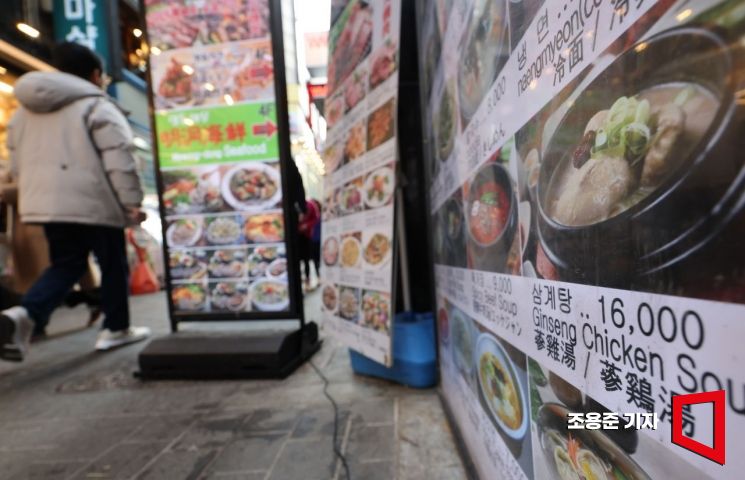 On the 14th, a menu board was posted in a restaurant district in Jongno, Seoul, as dining-out prices continued their soaring run at the start of the year. According to Statistics Korea's consumer price trends, last year's dining-out price inflation rose 6% year-on-year, marking the highest level in 30 years. Photo by Cho Yongjun
Slump in dining-out sector and intensifying competition... restaurant startups down 12%
The sectors that saw particularly sharp declines were electricity, gas, and steam supply (-29.2%), accommodation and food service (-11.8%), and real estate (-9.1%). Since the second half of 2024, Korea Electric Power Corporation has designated substations in areas where power-receiving capacity is saturated as grid management substations (substations that monitor and operate the power grid in real time), which led to a large drop in power generation startups. In particular, solar power generation startups fell 29.2% year-on-year.
As the dining-out industry slumped and competition among coffee shop chains intensified, restaurant startups decreased across the board. General Korean restaurants declined 12.0%, from 63,217 to 55,605, while coffee shops dropped 17.9%, from 18,887 to 15,504. According to the National Tax Service, the number of coffee beverage business operators decreased from 95,564 as of December 2024 to 93,356 at the end of last year.
In the accommodation and food service sector, the decline in individual startups (-12.0%) was much steeper than in corporate startups (-0.05%). Unlike in food services, accommodation startups increased 19.1%, which appears to reflect the impact of the requirement for Airbnb hosts to submit business registration certificates.
In addition, due to the sluggish construction market and weak investment returns on commercial real estate, real estate rental startups fell 9.1% year-on-year. Real estate rental and supply businesses and real estate-related service businesses decreased by 8.9% and 10.3%, respectively.
Startups rise in knowledge-intensive sectors such as finance, insurance, and ICT
Sectors with large increases in startup numbers were knowledge-intensive industries such as finance and insurance (25.9%), information and communications (17.5%), and professional, scientific, and technical services (5.0%). As investment capital flowed in, financial services startups rose 31.3% year-on-year, while insurance and pension-related startups jumped 61.0%.
As generative AI services for language and video, among others, became more widespread, related startups also increased. The number of businesses engaged in the production and distribution of video and audio recordings grew 24.4%. Generative AI models for images and video are being released one after another, and the share of generative AI users in Korea is also steadily rising. In professional, scientific, and technical services, the activation of online distribution led to a 26.1% increase in advertising agencies, while the spread of AI technologies contributed to a 5.9% rise in management consulting firms.
Last year, technology-based startups numbered 221,063, up 2.9% from the previous year. The share of technology-based startups in total startups reached 19.5%, an increase of 1.3 percentage points from a year earlier, marking the highest level since the statistics were first compiled.
Technology-based startup sectors include manufacturing and knowledge-based services (information and communications; professional, scientific, and technical; business facilities management; education services; health and social welfare; and creative, arts, and leisure). Technology-based startups have recently increased mainly in information and communications and professional, scientific, and technical service sectors that utilize AI.
An age-based analysis of startup founders shows that the number of startups declined year-on-year across all age groups. The under-30 age group recorded the largest decrease at 6.6%, while the decline among those aged 60 and older was 2.1%, smaller than in other age brackets.
© The Asia Business Daily(www.asiae.co.kr). All rights reserved.

















