Korea Southern Power and KIMS hold technology forum
Simultaneous realization of natural lighting and power generation
Market growth expected in line with ZEB policies
"Building Act regulations on building-type solar power must be eased"
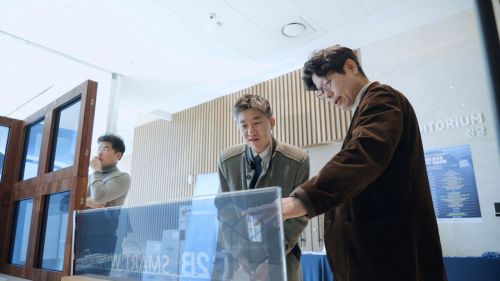 Attendees are viewing the exhibited smart window products at the Next-Generation Window-Type BIPV Technology Forum held at Korea Southern Power Co., Ltd.'s Busan headquarters on February 25, 2026. Korea Southern Power Co., Ltd.
The window-type BIPV (Building-Integrated Photovoltaics) technology, which integrates solar modules into building windows to generate electricity, is drawing attention as a future energy technology. Window-type BIPV is expected to serve as a way to expand renewable energy in the urban environment of Korea, where there are many buildings but insufficient space for installing solar power systems.
At the "Smart Window Industrial Technology Exchange: Next-Generation Window-Type BIPV Technology Forum" held on Feb. 25, 2026 at Korea Southern Power's Busan headquarters by Korea Southern Power and the Korea Institute of Materials Science, the Ministry of Climate, Energy and Environment stated, "To revitalize the solar power industry, we are promoting the early commercialization of tandem cells and diversifying their applications," adding, "Window-type BIPV accounts for a large share in the expansion of solar power applications."
BIPV is a technology that integrates building exterior materials with solar power generation modules so that the building itself serves as a solar power plant. It is distinct from building-attached photovoltaics (BAPV), in which conventional solar panels are installed separately on the exterior of a building. Its advantage is that it can produce energy while maintaining the building's exterior appearance.
Among these, window-type BIPV directly combines solar modules with glass windows, enabling both natural lighting and power generation at the same time. This represents an evolution from the conventional approach of installing solar modules only on exterior walls or rooftops.
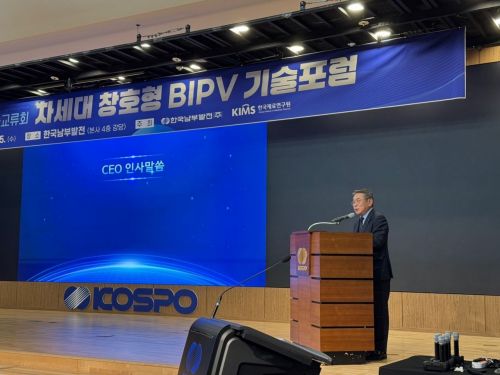 Kim Jundong, President of Korea Southern Power, is delivering remarks at the Next-Generation Window-Type BIPV Technology Forum held on the 25th. 2026.2.25 Korea Southern Power
The market for window-type BIPV is expected to expand in line with the government's recent Zero Energy Building (ZEB) policy. Private buildings with a total floor area of 1,000 square meters or more, and multi-family housing complexes with 30 or more units, are required to obtain at least Grade 5 zero-energy certification. In addition, public institutions must supply a certain proportion of their energy use from renewable energy sources for new or expanded buildings with a total floor area of 1,000 square meters or more.
At the technology forum, various window-type BIPV technologies under development in Korea were introduced, including the jointly conducted "Window Solar Film" project by Korea Southern Power and the Korea Institute of Materials Science.
Korea Southern Power and the Korea Institute of Materials Science are developing a film-type solar cell that applies smart window technology to organic solar cells. Lim Dongchan, principal researcher at the Korea Institute of Materials Science, explained, "We can achieve about 10% efficiency at 40% transmittance," and added, "Considering that it can replace existing building exterior materials while generating electricity, it can secure economic feasibility." Lim also noted, "Even now, various companies are inquiring about window-type BIPV technology."
Mecaro Energy is developing a perovskite-based transparent solar cell. Lee Gyuhyeon, head of division at Mecaro Energy, said, "Last year, our transparent solar cell 'Viewlight' received KS certification," and added, "We plan to mass-produce high-efficiency tandem solar cells by 2027 and enter the global BIPV market."
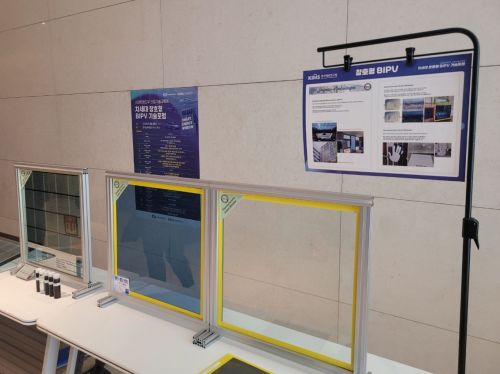 The Korea Institute of Materials Research is exhibiting a product under development at the Next-Generation Window-Type BIPV Technology Forum held on February 25, 2026. Photo by Heejong Kang
Companies attending the forum called for more active policy support from the government. Choi Byungin, CEO of G2B, said, "In Korea, there are no government support policies or sufficient standards for smart windows," and added, "Despite our excellent technological capabilities, initial cost barriers and the lack of incentives are blocking market entry."
Because BIPV replaces existing building exterior materials, meeting fire resistance standards under the Building Act remains a challenge. The Ministry of Land, Infrastructure and Transport currently requires quasi-noncombustible performance evaluations for building-type solar products (excluding window-type) under the existing Building Act. In response, companies are calling for these standards to be relaxed for BIPV.
Regarding this, an official from the Ministry of Climate, Energy and Environment explained, "We are in discussions with the Ministry of Land, Infrastructure and Transport on fire performance evaluations that take into account the characteristics of BIPV."
The Ministry of Climate, Energy and Environment is supporting the BIPV industry with a focus on research and development (R&D). Over the past six years, the government has provided 74.9 billion won for 13 projects to develop BIPV technologies, and this year it plans to provide 36.2 billion won in R&D funding for six projects, including the development of curtain-wall solar modules. In addition, in June last year, it built a demonstration center in Jincheon, North Chungcheong Province, where it plans to conduct KS certification testing and integrated performance evaluations.
Lee Wonju, policy chief of the Energy Transition Policy Office at the Ministry of Climate, Energy and Environment, said, "We will actively work to expand BIPV by improving systems related to building-type solar power, such as the Building Act and the KS certification system, and by promoting the wider deployment of building-type solar power systems."
© The Asia Business Daily(www.asiae.co.kr). All rights reserved.



















