Constitutional Complaint System, Crime of Distortion of the Law, and Increase in Supreme Court Justices
Seeking Response Measures Ahead of Plenary Passage
Official Position Expected After the Meeting Ends
On the 25th, ahead of the plenary session handling of the Democratic Party of Korea’s so-called “Three Judicial Reform Bills,” court presidents from across the country gathered in one place to prepare response measures.
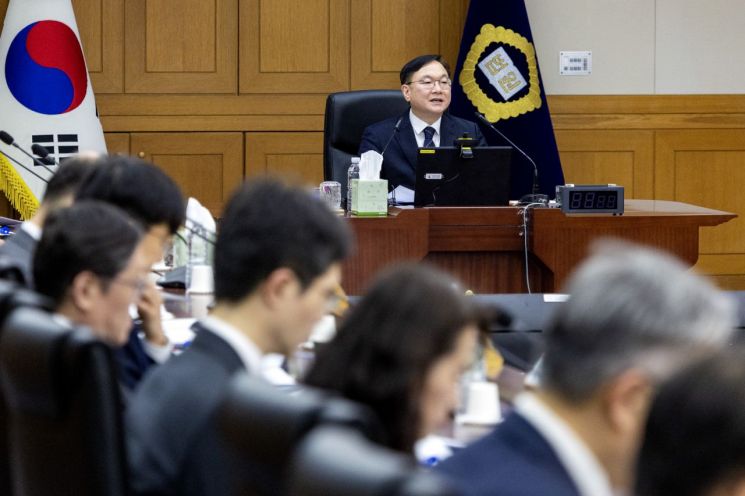 Park Youngjae, Director of the Court Administration, is speaking at the National Meeting of Court Presidents held at the Supreme Court in Seocho-gu, Seoul, on the 25th. Yonhap News
The Supreme Court has been holding the National Conference of Court Presidents at the Supreme Court building in Seocho-gu, Seoul, from 2:00 p.m. on this day. A total of 43 people, including Park Youngjae, Director of the Court Administration, and presidents of courts at each level, attended. Chief Justice Cho Hee-dae is not attending the meeting.
This meeting was convened urgently to collect opinions from judges belonging to courts at all levels on the “Three Judicial Reform Bills (the crime of distortion of the law, the introduction of a constitutional complaint against court decisions, and the increase in the number of Supreme Court justices),” which are about to be enacted under the leadership of the Democratic Party of Korea, and to discuss countermeasures.
Before the meeting, Director Park stated, “Even though the judiciary has made great efforts to ensure speedy and fair trials, we must all soberly recognize and reflect on the reality that there are still aspects that fall short of the expectations and standards of the public.”
The Court Administration plans to issue a press release containing the details of the discussions after the meeting concludes.
Regarding the Three Judicial Reform Bills, it was emphasized that “they all not only bring significant changes to the essential role and function of the courts in safeguarding the constitutional order and the rights of the people, but also contain provisions that can directly affect people who seek relief of their rights through the courts,” and that “in the deliberation process on these bills, it is necessary to reflect the views of the judiciary, which is directly responsible for trials.”
The judiciary has consistently stated the position that, because the judicial reform bills may be unconstitutional and are grave matters that could have a major impact on the judicial system and on the public, sufficient discussion is required. On the 23rd, Chief Justice Cho Hee-dae said, “These bills fundamentally change the framework of the judicial system that has continued for nearly 80 years since the establishment of the judiciary of the Republic of Korea,” adding, “This is an issue that could directly cause harm to the people.”
However, as the Democratic Party of Korea has declared its intention to push ahead with the legislation, the bills now only await passage at the plenary session of the National Assembly. The establishment of the new crime of distortion of the law (amendment to the Criminal Act), the introduction of a constitutional complaint against court decisions (amendment to the Constitutional Court Act), and the increase in the number of Supreme Court justices (amendment to the Court Organization Act), all of which have passed the Legislation and Judiciary Committee of the National Assembly, are scheduled to be dealt with one after another at the plenary sessions to be held through March 3.
© The Asia Business Daily(www.asiae.co.kr). All rights reserved.

















