The dollar weakened after U.S. President Donald Trump reaffirmed in his State of the Union address that he would maintain his tariff policy. Analysts said that the heightened possibility of tariff expansion highlighted policy risk, which in turn acted as a factor weakening the dollar.
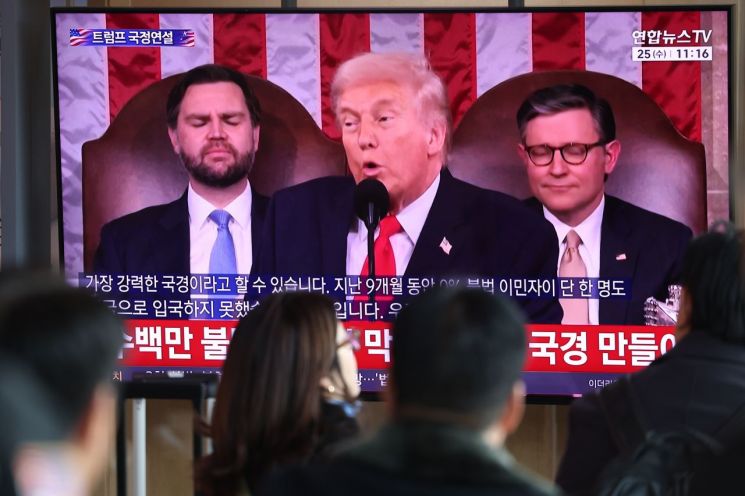
On the 24th (local time), President Trump criticized the U.S. Supreme Court for invalidating global reciprocal tariffs and said he would use other legal authorities to restore broad-based import tariffs. He expressed confidence that foreign governments would abide by trade agreements and claimed that tariff revenues would increase significantly and "substantially replace much of the modern income tax system."
Following President Trump’s remarks, the Bloomberg Dollar Spot Index fell as much as 0.2%. U.S. stock index futures gave back most of their gains, and U.S. Treasury prices slipped slightly, pushing the 10-year Treasury yield up 2 basis points to 4.05%.
Gareth Berry, a strategist at Macquarie, told Bloomberg, "The comment that tariffs could replace income taxes in the long run suggests the possibility that tariffs will be used even more aggressively going forward," adding, "Such concerns have in the past also acted as a burden on the dollar."
As the rally in technology stocks continued, Asian stock markets also rose in tandem. On the 25th, Korea’s KOSPI broke above the 6,000 level intraday and traded near 6,100, while Taiwan’s Taiex surpassed the 35,000 mark. Japan’s Nikkei 225 climbed more than 2% to reach the 58,000 level, and China’s Shanghai Composite Index also gained more than 1%, rising above 4,160.
The rebound in global equity markets is seen as being partly driven by a reduction in concerns related to artificial intelligence (AI). Anthropic announced plans to expand its partnerships, emphasizing the integration of its chatbot “Claude” into the existing work and services of corporate clients.
Bloomberg reported that this development has somewhat eased market fears that AI could rapidly overrun entire industries. Previously, the New York stock market had seen heightened volatility as worries about the impact of AI spread from software to sectors such as insurance brokerage, asset management, and cybersecurity. In other words, the so-called “AI Scare Trade” appears to have entered a phase of stabilization.
© The Asia Business Daily(www.asiae.co.kr). All rights reserved.


















