Development of "Biodegradable Coating" Fertilizer Technology
Enables Slow Nutrient Supply Aligned with Crop Growth Cycles
Reduces Fertilizer Use by 46.7% and Methane Emissions by 63.9%
The Rural Development Administration has developed a fertilizer manufacturing technology that coats the fertilizer surface with biodegradable resin so that it dissolves slowly in the soil. This technology reduces the number of fertilizer applications, thereby cutting fertilizer use and labor, and also helps reduce environmental pollution caused by the loss of fertilizer components.
On the 25th, the Rural Development Administration announced that, through industry and public-private cooperation, it had developed a biodegradable resin coating technology that addresses the shortcomings of existing controlled-release fertilizers.
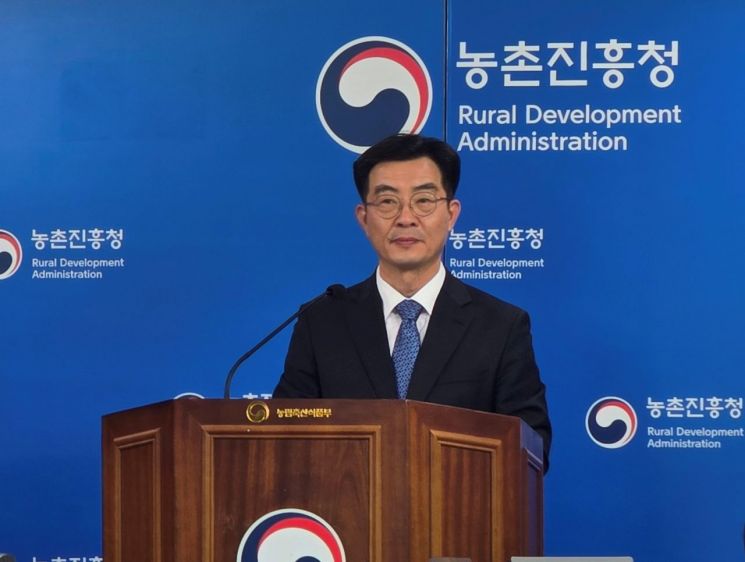 Sung Jehoon, director of the National Institute of Agricultural Sciences at the Rural Development Administration, explained on the 25th at the Government Complex Sejong about the 'biodegradable resin coating technology' that addresses the shortcomings of existing controlled-release fertilizers. Rural Development Administration
Seong Jehun, Director of the National Institute of Agricultural Science at the Rural Development Administration, explained, "Controlled-release fertilizer is a type of fertilizer whose dissolution rate is controlled by coating the fertilizer surface with plastic," and added, "Most existing controlled-release fertilizers are coated with non-degradable plastic, which causes problems because they do not break down easily after use. We have therefore developed a fertilizer-coating technology that maintains the advantages of controlled-release fertilizers while minimizing the problem of residual plastic in the agricultural environment after use."
The difficulty of controlling the period during which fertilizer components are released, due to the coating easily decomposing when biodegradable resin is used, was resolved by improving both the decomposition characteristics of the coating resin and the coating technology. When controlled-release fertilizer using this coating technology is applied to crops, the period during which the fertilizer components act in the soil can be controlled according to the crop cultivation period. In addition, the Rural Development Administration expects that the problem of residual plastic in the soil can also be minimized.
In fact, when controlled-release fertilizer using this coating technology was applied to a test paddy rice field, the amount of fertilizer used was reduced by 46.7% compared to conventional fertilizer, and emissions of methane, a greenhouse gas, were reduced by 63.9%. In addition, the coating resin decomposed by 90% over six months under composting conditions, confirming that it is an eco-friendly fertilizer that can minimize the problem of residual plastic in the soil. In Europe, the European Union (EU) Fertilising Products Regulation prohibits the use of non-degradable plastics in fertilizers starting in October 2028, and efforts are underway to achieve sustainable agriculture.
This year, the Rural Development Administration plans to conduct crop growth tests on chili peppers and Chinese cabbage at test cultivation sites, and in 2027 it plans to carry out on-site demonstrations of fertilizers for upland crops. Based on this, it intends to promote a new-technology pilot project in 2028.
Director Seong said, "If farmers use controlled-release fertilizers that apply biodegradable resin coating technology, they can reduce labor and fuel costs by cutting the amount of fertilizer used and the number of applications," and added, "Although the price is higher than that of existing controlled-release fertilizers, it helps resolve the problem of residual plastic in farmland and contributes to the development of sustainable agriculture, so in the long term it can be considered economically beneficial."
© The Asia Business Daily(www.asiae.co.kr). All rights reserved.

















