Ministry of the Interior and Safety to Declassify 1.74 Million Previously Confidential National Records
Includes Records on the Establishment of the National Cemetery for the Armed Forces, Mediation of Disputes over the Nakdong River Phenol Contamination Incident, and Forced Mobilization Rosters
Available for Viewing via the National Archives Portal
The National Cemetery for the Armed Forces, established to inter fallen Korean service members, is currently located on Hyeonchung-ro (Dongjak-dong) in Dongjak District, Seoul, but this site was not designated from the outset. After analyzing areas including Gyeongju, Daejeon, Daegu, Anyang, and Seoul starting in 1951, Ui-dong in Gangbuk District, Seoul, was reportedly the leading candidate site for the National Cemetery for the Armed Forces. However, Dongjak-dong was ultimately selected during subsequent reviews. The advantages cited were that there was no risk of flood damage, it was close enough to downtown Seoul to offer a view of the city, and there would be no harm to nearby residents caused by construction. Other areas in and around Seoul that were reviewed at the time, in addition to Ui-dong, included Wausan, Hawolgok-dong, Hannam-dong, Joseon Shrine, Jangchungdan, Itaewon, Seobinggo, as well as Yeomchang-ri in Gimpo and Onsu-ri and Oryu-dong in Bupyeong.
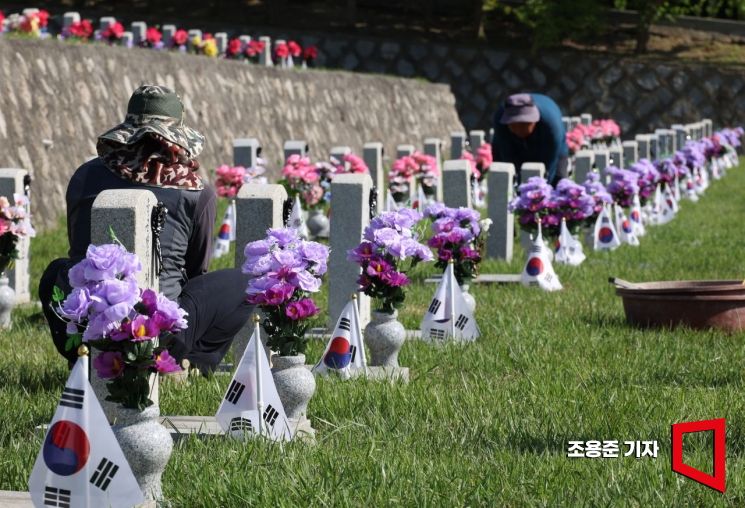 On the 31st, one day before Patriots and Veterans Month, officials at the Seoul National Cemetery in Dongjak District, Seoul, are sprucing up the cemetery grounds by laying flowers and replacing headstones. Photo by Jo Yongjun
On the 25th, the Ministry of the Interior and Safety announced that it will make public or partially public 1.74 million records that had previously been kept confidential, including the records on the establishment of the National Cemetery for the Armed Forces. The aim is to guarantee the public's right to know and to make these records available as research materials to uncover the truth about historical events. As a result of this measure, the disclosure rate for records has risen by 1.4 percentage points, from 66.9% to 68.3%.
Confidential records are required to be disclosed after deliberation by the Records Disclosure Review Committee in accordance with Article 35 of the Public Records Management Act. Major records newly converted to public status include those on: ▲the establishment of the National Cemetery for the Armed Forces, ▲mediation of disputes over the Nakdong River phenol contamination incident, ▲forced mobilization rosters, and ▲the Government-General of Korea’s correctional and educational affairs, among other key historical events.
Among these, the records on the establishment of the National Cemetery for the Armed Forces consist of 48 documents produced by the Ministry of National Defense (1953-1954) concerning the selection of candidate sites for what is now the Seoul National Cemetery, as well as budget, facility construction, and other matters related to its establishment. The document titled "Progress Report on the Establishment of the National Cemetery for the Armed Forces" details the process in which Ui-dong in Seoul was reviewed as the leading candidate site before Dongjak-dong was finally selected.
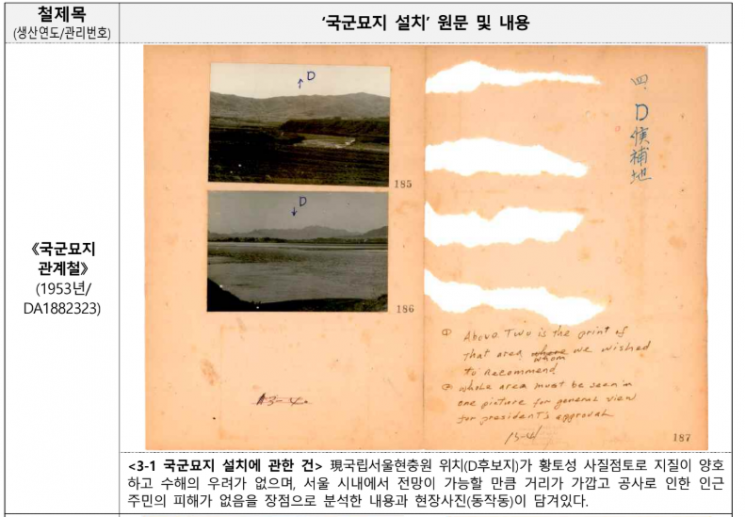
The document titled "Request for On-Site Inspection of the National Cemetery for the Armed Forces by the President" clearly reflects the urgency, in the immediate aftermath of the Korean War, of burying the service members who lost their lives in the war, as well as the shortage of the construction budget, including land acquisition costs, relocation support funds, and construction expenses.
The records on "Mediation of Disputes over the Nakdong River Phenol Contamination Incident" comprise 40 documents produced (1992-1993) by the Central Environmental Dispute Mediation Committee of the then-Environment Agency in connection with the contamination of the Nakdong River caused by a phenol spill in 1991. These records contain the dispute mediation process, including the collection of opinions and review of materials from various sectors regarding phenol-related damage, examination of key issues raised by victims, results of epidemiological investigations on pregnant women, and reports on the review of causal relationships.
Forced mobilization rosters and records of the Government-General of Korea, which had previously been kept confidential for reasons of personal data protection, are also being released to facilitate academic research on the Japanese colonial period and to clarify past history.
The forced mobilization rosters consist of 16,009 records, including: ▲"Emigration to the South Seas," produced (1939-1940) by the Government-General of Korea; ▲"Military Service Wartime Rosters," produced by Japan’s Ministry of the Army; ▲rosters of Koreans contained in the "Prisoner of War Cards (Furyo Meihyo: the Japanese term for prisoner-of-war rosters)" produced by the Allied Forces during World War II; and ▲the "Register of Decisions on the Payment of Compensation for Japanese Civilian Claims" produced (1971-1972) by the Ministry of Finance of the Republic of Korea. These can be found under "Rosters of Forced Mobilization under Japanese Rule" on the National Archives Portal.
The records of the Government-General of Korea comprise 19,786 documents, including correctional records related to civil and criminal litigation such as written judgments and criminal case files, as well as educational records such as school life records and academic records. Since 2022, these have been continuously released each year for individuals over 90 years of age.
Meanwhile, the records concerning the establishment of the National Cemetery for the Armed Forces and the mediation of disputes over the Nakdong River phenol contamination incident can be viewed in their original form through the National Archives Portal.
Other records can be viewed in their original form by searching the catalog or by submitting an information disclosure request to the National Archives of Korea.
Minister Yoon Hojung said, "We will continue to work to ensure that national archival information can be used closer to the public by proactively identifying and preemptively releasing records on major policies, systems, and events that attract significant public interest."
© The Asia Business Daily(www.asiae.co.kr). All rights reserved.


















