The government has decided to shut down the Daejeon headquarters of the National Information Resources Service (NIRS), which caused a large-scale computer system failure due to a fire, by 2030. This measure accompanies the effort to raise the safety standards of data centers in the government and public sector to the level of the private sector. To prevent cyber security incidents, a new system will also be introduced under which white-hat hackers will not be punished even if they identify and report security vulnerabilities of companies and institutions.
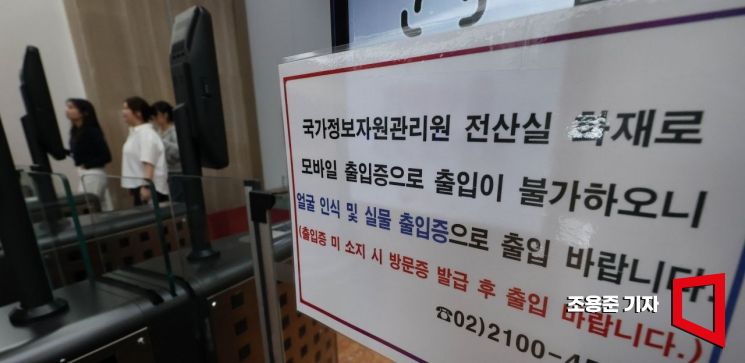 Amid a fire at the National Information Resources Service that has effectively paralyzed the government's computer network, a notice stating "No entry with mobile pass due to the National Information Resources Service fire" was posted on an entrance to the Government Complex Seoul in Jongno-gu on the 29th. 2025.9.29 Photo by Cho Yongjun
The National Artificial Intelligence Strategy Committee (the Committee) announced that it held its 2nd plenary meeting at Seoul Square in Jung-gu, Seoul, on the 25th and deliberated and approved five agenda items, including the "Republic of Korea AI Action Plan."
The Committee deliberated and approved the "Direction for Promoting AI Government Infrastructure Governance and Innovation" to fundamentally redesign the national information management system. First, it decided to shut down the NIRS Daejeon Center, which has reached its limits in disaster response capability and capacity, by 2030. In September last year, a fire broke out during the relocation work of lithium-ion batteries at the NIRS Daejeon Center, paralyzing the government's administrative systems. This year, disaster recovery systems will first be built for 134 systems out of 693 systems at the NIRS Daejeon Center, and a leading project will be promoted to establish a private cloud-based disaster recovery system, focusing on three core systems: dBrain, the Postal Information System, and the Safety Stepping Stone system.
The direction for building the disaster recovery system has also been set. Recovery target standards by system type will be established in consideration of the impact on citizens' daily lives, and data will be transferred according to its importance: confidential data will be transferred to government and public data centers, while private-sector and public data will be transferred to private clouds. In addition, under the Deputy Prime Minister and Minister of Science and Technology, a new dedicated organization, the "AI Government Infrastructure Governance and Innovation Promotion Task Force," has been established jointly by the relevant ministries to oversee AI government infrastructure. The Task Force will review the appropriateness of building and operating public information systems and will also prepare plans for redesigning mid- to long-term governance.
A system will also be introduced to shift the existing information security paradigm from ex-post response to ex-ante prevention. By deliberating and approving the "Roadmap for Introducing the System for Reporting, Addressing, and Disclosing Security Vulnerabilities," the Committee decided that even if white-hat hackers continuously report security vulnerabilities of companies and institutions, the reported institutions will take measures to address the vulnerabilities and disclose them transparently. Initial participation by white-hat hackers will be encouraged by activating a reward program for reports. The Committee explained that the system is being introduced because new security threats using AI are spreading and to overcome the current national security situation.
In addition, the Committee deliberated and approved the final version of the "Republic of Korea AI Action Plan," which was reported to the Cabinet Meeting on the 10th. The final version, consisting of a total of 99 implementation tasks and 326 policy recommendations, includes such measures as building an AI expressway, establishing an essential AI education system for elementary, middle, and high schools, and formulating the Manufacturing AI 2030 Strategy.
© The Asia Business Daily(www.asiae.co.kr). All rights reserved.

















