Last year, the youth mandatory employment compliance rate at public institutions rose slightly to the mid-80% range, continuing its recovery trend. The number of newly hired young people also recovered to the 20,000 range, indicating that youth employment in the public sector has entered a rebound phase.
On February 25, the Ministry of Employment and Labor announced that it had convened the Special Committee on Youth Employment Promotion and deliberated and approved the “2025 Results of the Mandatory Youth Employment System at Public Institutions.” According to the results, both the compliance rate with the youth employment mandate at public institutions and the scale of new hiring improved from the previous year, showing a recovery trend in youth recruitment in the public sector.
According to the government, 391 out of 462 public institutions subject to the mandatory youth employment system last year fulfilled their obligations, resulting in a compliance rate of 84.6%. This is an increase of 1.3 percentage points from 83.3% in 2024. Compared with the 2023 compliance rate of 78.4%, the rate has risen for two consecutive years, indicating that the level of implementation under the system is gradually recovering.
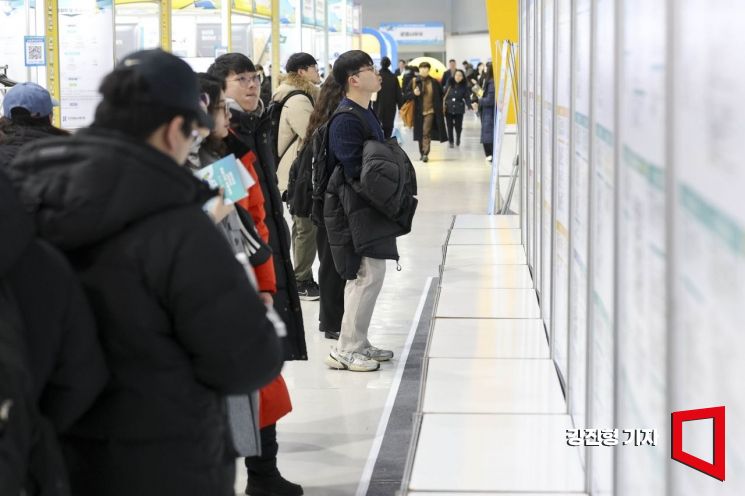 Job seekers attending the "2026 Public Institution Job Fair" at the aT Center in Seocho-gu, Seoul, on the 27th are looking at a recruitment bulletin board. Jan. 27, 2026. Photo by Kang Jinhyung
The scale of new youth hiring also expanded. The number of young people newly hired by public institutions last year came to 25,435, a sharp increase from 18,842 in 2024 and 18,175 in 2023. This is analyzed as a shift to an upward trend, breaking away from the pattern of hiring contraction that continued after COVID-19. In particular, the hiring scale was the highest in the past six years since 2019.
The mandatory youth employment system requires public institutions and local public enterprises to newly hire young people at a rate of at least 3% of their total workforce each year. Since its introduction in 2004, it has been operated as a key policy tool to expand opportunities for young people to enter the public sector.
However, not all institutions fulfilled their obligations. Last year, 71 institutions failed to meet the mandate, citing reasons such as insufficient vacancies, business downsizing, and reduced hiring capacity due to management efficiency measures. Considering that 76 institutions failed to comply in 2024, the number of non-compliant institutions has decreased, but disparities in system implementation still remain.
The government plans to induce compliance at non-compliant institutions through institutional measures such as publishing their names and reflecting the results in management evaluations. For institutions that repeatedly fail to fulfill their obligations, it will strengthen oversight by holding joint inspection meetings with relevant ministries and requiring them to submit improvement plans.
The government also stressed that the employment environment for young people remains challenging. Youth unemployment and the number of people preparing for employment are still at significant levels, leading to the view that the public sector must play a leading role in creating quality jobs. Accordingly, the government plans to push ahead in parallel with policies such as tailored support for each stage of the job search, expansion of work experience opportunities, and the hosting of joint public-private recruitment fairs.
Minister of Employment and Labor Kim Younghoon said, “Public institutions must first play a responsible role in expanding job opportunities for young people,” adding, “We will closely monitor compliance with the mandatory youth employment system and strengthen policy support so that it leads to a tangible expansion of hiring.”
© The Asia Business Daily(www.asiae.co.kr). All rights reserved.
![Clutching a Stolen Dior Bag, Saying "I Hate Being Poor but Real"... The Grotesque Con of a "Human Knockoff" [Slate]](https://cwcontent.asiae.co.kr/asiaresize/183/2026021902243444107_1771435474.jpg)















