Wonju Mayor Won Kangsu Holds Press Briefing on Key Pending Issues
Influx of Residents in Their 30s Solidifies Wonju’s Role as Gangwon’s "Population Dam"
Population Up 1,030 Last Year... Unstoppable Drive Toward a "500,000-Strong Megacity"
KDI Designates Wonju as a "Non-Capital-Area Hub City to Ease Concentration in the Seoul Metropolitan Area"
As fears of "local extinction" spread across the country, Wonju in Gangwon Special Self-Governing Province is drawing attention as it alone continues to post population growth. While neighboring local governments are suffering from population outflows, Wonju has instead played the role of a "population dam" that absorbs residents, proving itself to be the engine of regional growth.
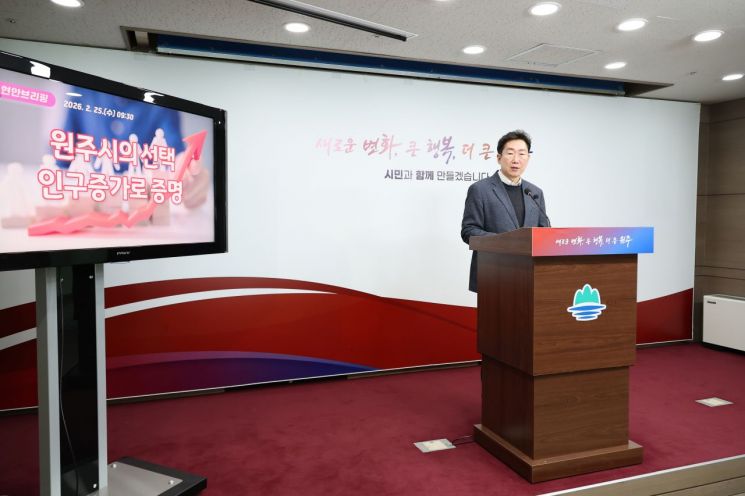
At a press briefing, Wonju Mayor Won Kangsu announced that as of the end of 2025, the total population of Gangwon Special Self-Governing Province stood at 1,508,500, down sharply by 9,266 from the previous year, and that most cities and counties in the province are facing a crisis due to population decline, but Wonju alone has seen an increase. Wonju’s population rose from 362,164 in 2024 to 363,194 in 2025, an increase of 1,030.
The growth trend has become even steeper this year. In January alone, the population increased by as many as 302 people. The number of newborns rose compared to the same month a year earlier, while the number of deaths decreased, easing the pace of natural decline. In addition, there was a clear pattern of "social increase," with 353 more people moving into Wonju from other regions than leaving. Above all, the continued inflow of people in their 30s, who are at the core of economic activity, is brightening the city’s future.
Analysts say these results are largely due to the successful restructuring of the industrial base in pursuit of "Economic City Wonju."
The city has simultaneously expanded four industrial complexes, including the Buron General Industrial Complex, resolving the chronic shortage of sites, and is accelerating the development of future high-tech industries such as a semiconductor cluster and AI-converged digital healthcare.
At the same time, it has strengthened win-win cooperation with local companies to create quality jobs, while also working to improve living conditions for all generations through initiatives such as the Youth Dream Fulfillment Voucher program, the Children’s Imagination Playground, and the construction of a municipal art museum.
Recently, the Korea Development Institute (KDI), in its regional balanced development strategy report, designated Wonju as a non-capital-area hub city to ease overconcentration in the Seoul metropolitan area, alongside the six metropolitan cities and Sejong City. This is seen as recognition that Wonju, beyond being just another local city, has the productivity and potential to serve as the largest economic hub in the central region.
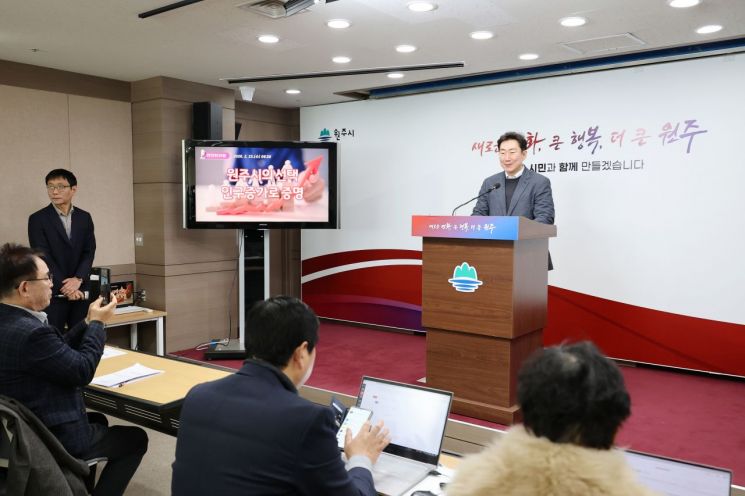
Going forward, Wonju plans to use the expansion of the wide-area transportation network as a springboard - including completion of the double-track railway between Yeoju and Wonju in 2028 and the early opening of the GTX-D line in 2030 - to steadily push ahead with initiatives such as an additional designation as a High-tech Medical Complex, attracting a second round of relocations of public institutions, and developing mini new towns tailored to retirees.
Mayor Won Kangsu said, "Population growth is an objective indicator that proves Wonju’s municipal policy direction has been correct," adding, "We will not be complacent with our current achievements, but will continue to drive innovations that citizens can truly feel and usher in the era of a 500,000-strong megacity."
© The Asia Business Daily(www.asiae.co.kr). All rights reserved.
![Clutching a Stolen Dior Bag, Saying "I Hate Being Poor but Real"... The Grotesque Con of a "Human Knockoff" [Slate]](https://cwcontent.asiae.co.kr/asiaresize/183/2026021902243444107_1771435474.jpg)

















