2025 Survey on Return-to-Farming and Return-to-Rural Areas
A survey found that the average annual income of households in their fifth year of returning to farming, who move from cities to rural areas and make farming their main occupation, was 33 million won, more than 30% higher than in their first year of returning to farming. For those returning to rural areas, who live in rural regions but have non-agricultural work as their main occupation, the average annual income was 42.15 million won.
The Ministry of Agriculture, Food and Rural Affairs announced these findings from the "2025 Survey on Return-to-Farming and Return-to-Rural Areas" on the 25th. This fact-finding survey was conducted through face-to-face interviews from September to November last year with 6,000 households that had returned to farming or rural areas over the past five years (2020-2024).
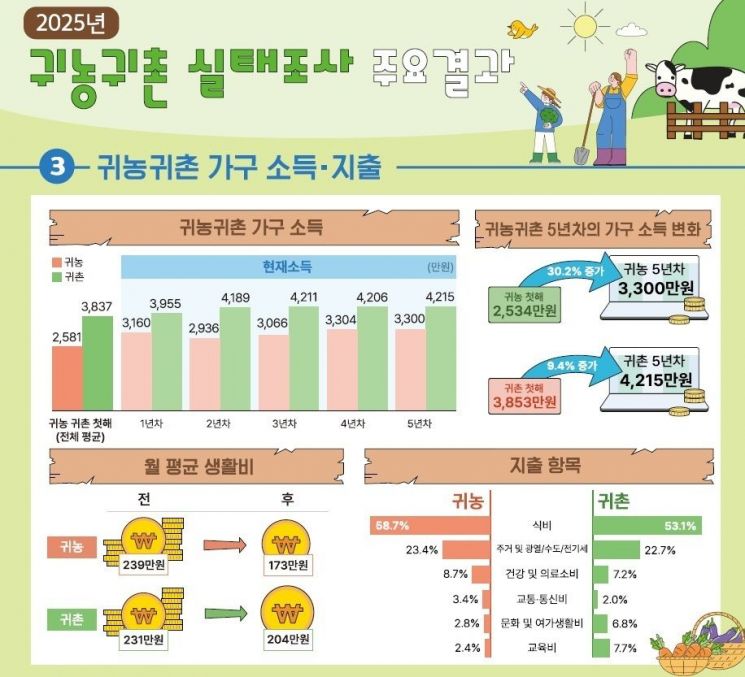
According to the survey, the average annual household income in the fifth year after returning to farming and returning to rural areas was 33 million won and 42.15 million won, respectively. Compared with the first-year household incomes of 25.34 million won and 38.53 million won, these figures represent increases of 30.2% and 9.4%, respectively. Although the average annual household income of return-to-farming households in their fifth year was 65.2% of that of the average farm household (50.6 million won in 2024), their agricultural income was 15.39 million won, which is actually 60.6% higher than that of the average farm household (9.58 million won). The ministry cited "small cultivation scale and short farming experience" as the reasons for the relatively low income levels of return-to-farming households.
The average monthly living expenses of return-to-farming and return-to-rural households were 1.73 million won and 2.04 million won, respectively, down 25.1% and 11.7% from 2.39 million won and 2.31 million won before they returned to farming or rural areas. The average preparation period for returning to farming was 27.4 months, and for returning to rural areas it was 15.5 months. During this preparation period, they engaged in activities such as searching for settlement areas, housing and farmland, securing funds, and participating in return-to-farming and return-to-rural education programs. The younger the age group, the shorter the preparation period tended to be, but participation in education was higher, indicating that they prepared for returning to farming more efficiently. It was also found that participation in return-to-farming education was proportional to the scale of farming.
Among return-to-farming cases, the "U-type," in which people born in rural areas move back to rural regions where they have existing ties after living in cities, accounted for the majority at 73.0%. For return-to-rural cases, the "I-type," in which people originally from cities move to rural areas, was the most common at 48.7%.
The main reasons for returning to farming were the natural environment (33.3%), succession of the family business (21.7%), and the vision and growth potential of agriculture (13.5%), in that order. For returning to rural areas, the top reasons were employment in non-agricultural industries (14.3%), the natural environment (13.8%), and emotional relaxation (13.3%). However, among young people in their 30s and under, the vision and growth potential of agriculture ranked as the top reason for returning to farming for seven consecutive years, at 27.3%. The share of young people returning to farming because they see a future in agriculture, including family business succession, has consistently remained in the 50-60% range.
Return-to-farming and return-to-rural households cited the provision of information on farmland, housing, and jobs as the government policy they needed most. Seven out of ten such households said they were satisfied with their return-to-farming or return-to-rural life. In addition, 71.4% of return-to-farming households and 51.4% of return-to-rural households responded that they had "good relationships" with local residents, and most of them (97.0% of return-to-farming households and 86.3% of return-to-rural households) said they planned to continue living in their current place of residence.
Yoon Wonseup, Director-General for Agricultural Policy at the Ministry of Agriculture, Food and Rural Affairs, said, "The government will further strengthen return-to-farming and return-to-rural education tailored to the characteristics of those who wish to return, focusing on the Return-to-Farming and Return-to-Rural Integrated Center, including programs such as agricultural job exploration and experiential training, long-term education for young people returning to farming, and online education on returning to farming and rural areas." He added, "Through the return-to-farming and return-to-rural integrated portal 'Greendaero,' we plan to provide broader and more diverse information in a customized manner, thereby further enhancing convenience for users preparing to return to farming or rural areas."
© The Asia Business Daily(www.asiae.co.kr). All rights reserved.
![Clutching a Stolen Dior Bag, Saying "I Hate Being Poor but Real"... The Grotesque Con of a "Human Knockoff" [Slate]](https://cwcontent.asiae.co.kr/asiaresize/183/2026021902243444107_1771435474.jpg)
















