HIPDC Finalizes Implementation Plan for the 2nd Comprehensive National Health Insurance Plan
Expanded Reimbursement for Immuno-oncology Drug Imfinzi Injection
Strengthening Intensive, Patient-tailored Rehabilitation... Comprehensive Re-evaluation of 7,760 Medical Procedures
The annual cost of medication for patients with bile duct cancer, who have long had few treatment options, is expected to be significantly reduced from about 120 million won per year to around 6 million won. While strengthening compensation for essential medical services, the government will streamline National Health Insurance expenditures by reducing unnecessary or excessive use of medical services.
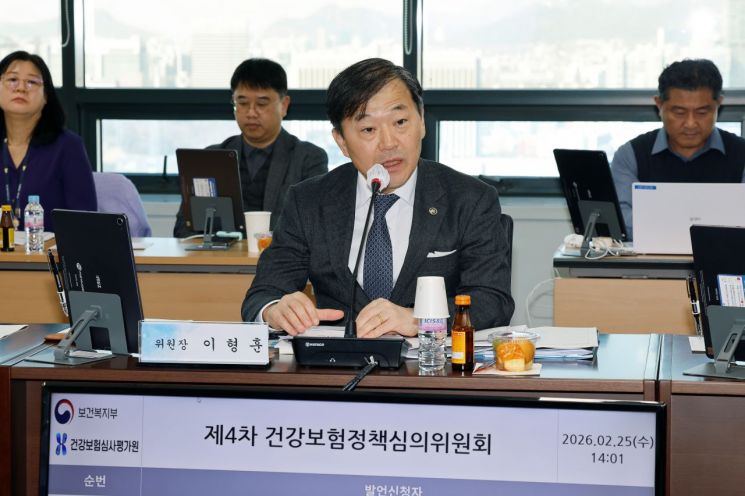 Lee Hyunghun, Second Vice Minister of Health and Welfare, speaks at the 4th Health Insurance Policy Committee held on the 25th. Photo by Ministry of Health and Welfare
The Ministry of Health and Welfare announced that on the 25th it held the "4th Health Insurance Policy Deliberation Committee (HIPDC) meeting of 2026" to discuss the following agenda items: revisions to the drug reimbursement list and reimbursement ceiling price table; an interim report on the pilot project for reimbursement rates for rehabilitation medical institutions; plans to promote the re-evaluation and reclassification of medical procedures; and the 2026 implementation plan for the 2nd Comprehensive National Health Insurance Plan.
First, starting next month, the National Health Insurance coverage for the immuno-oncology drug Imfinzi Injection (ingredient: durvalumab) will be expanded from the existing indication of non-small cell lung cancer to include bile duct cancer. There have been no newly listed therapeutic drugs for bile duct cancer over the past 10 years, which has caused considerable suffering for patients. With this expansion of reimbursement, immunotherapy has been included among reimbursable treatments, providing a new treatment option.
Accordingly, if patients meet the reimbursement criteria, the annual drug cost per patient, which had reached about 118.93 million won, will be drastically reduced to around 5.95 million won when a 5% coinsurance rate is applied. The Ministry expects this to broaden treatment options for bile duct cancer patients, extend their survival, and alleviate their financial burden.
The pilot project for reimbursement rates for rehabilitation medical institutions, which is intended to minimize disability and support early return to daily life through intensive rehabilitation after an acute onset or surgery, will also be strengthened. The government has designated 71 institutions (13,390 beds) as 3rd-phase rehabilitation medical institutions and will apply pilot reimbursement rates for intensive, patient-tailored rehabilitation treatment starting in March.
Recovery-phase patients with conditions such as stroke, spinal cord injury, and hip fracture will be able to receive customized treatment based on multidisciplinary teams, and providers will be compensated under a new bundled service unit system (15-minute units). In addition, about 520 billion to 580 billion won will be invested through 2027 to support seamless connection to home-visit rehabilitation and community care after discharge.
Along with expanding rehabilitation medical institutions, a performance-based differential reimbursement scheme will be introduced to enhance recovery-phase rehabilitation. Under this scheme, reimbursement will vary depending on outcomes such as level of functional recovery, management of residual disabilities, and linkage to home-visit rehabilitation and community-integrated care.
Post-management of approximately 7,760 medical procedures listed under National Health Insurance will also become more stringent. The Ministry will establish a "Task Force for Re-evaluation and Reclassification of Medical Procedures" and will adjust reimbursement levels or exclude from coverage those technologies whose safety or effectiveness has changed.
Conversely, in areas such as pediatric and highly complex surgeries, where the level of difficulty is high but reimbursement has been insufficient, the system will be overhauled through reclassification to ensure appropriate compensation. The aim is to provide patients with safe and effective medical technologies and to ensure that medical institutions receive appropriate reimbursement.
Focusing on regional, essential, and public healthcare in line with national policy tasks
Meanwhile, this year’s implementation plan for the finalized 2nd Comprehensive National Health Insurance Plan (2024-2028) focuses on strengthening regional, essential, and public healthcare and securing fiscal sustainability, in line with the current administration’s national policy tasks.
The main components include expansion of cooperative programs for maternity and pediatric care; achieving balanced reimbursement rates for essential medical services by 2030; new designation and support for comprehensive secondary general hospitals under a bundled-payment model; inclusion of caregiving services at long-term care hospitals in the benefits package; and reform of the property-based insurance contribution system into a proportional-rate scheme. In particular, to curb overtreatment, the government plans to tighten the criteria for differentiated coinsurance on outpatient visits by raising the coinsurance rate to 90% for patients whose annual number of outpatient visits exceeds 300 starting in the second half of the year, thereby encouraging more rational use of outpatient services.
The Ministry of Health and Welfare stated, "Through the third-year implementation plan of the 2nd Comprehensive National Health Insurance Plan, we will strengthen regional, essential, and public healthcare so that necessary medical services can be provided in a timely manner, and we will faithfully achieve the goal of building a sustainable National Health Insurance system through innovation," adding, "We will pursue this more substantively in connection with the government’s key policy tasks."
© The Asia Business Daily(www.asiae.co.kr). All rights reserved.

















