CSIS Releases Chinese Military Purge Database
Many of Xi Jinping’s Handpicked Officers Also Fall from Power
"Given the Considerable Number of Vacancies... Large-Scale Military Operations Against Taiwan Will Be Difficult"
Over the four years since 2022, about 100 senior officers of the Chinese military have disappeared from public view. This comes as Chinese authorities have recently turned the anti-corruption spotlight on the military’s second-in-command, Zhang Youxia, Vice Chairman of the Party Central Military Commission, and Liu Zhenli, Chief of the Joint Staff Department. With a significant number of posts now vacant, some analysts forecast that it may be difficult for China to carry out military operations against Taiwan at all.
On the 24th (local time), the Center for Strategic and International Studies (CSIS) released its “CSIS Chinese Military Purge Database,” stating that since 2022, 36 generals in the People’s Liberation Army have been officially purged, and an additional 65 senior officers are either unaccounted for or are believed to have possibly been purged. This figure corresponds to roughly half of the Chinese military’s top leadership.
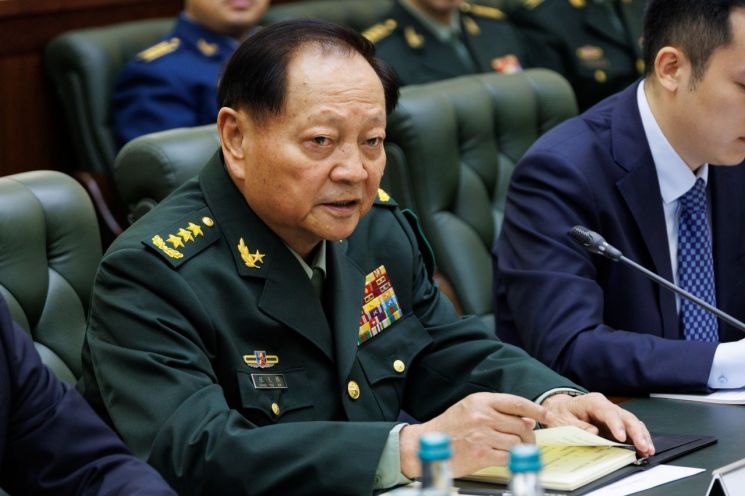 Recently ousted second-ranking Chinese military official Zhang Yuxia, Vice Chairman of the Party Central Military Commission. TASS Yonhap News
This tally includes 11 individuals who were purged after retirement, but most of the purges appear to have targeted serving officials. Of the 47 members of the leadership who held the rank of general in 2022 or were promoted to general after 2022, 41 are considered to be possibly purged.
The wave of downfalls began in 2022, when one senior military officer disappeared. In 2023, the number of officers who were dismissed or vanished from public events rose to 14, and a further 11 were removed in 2024. Last year, purges surged, with about 62 people ousted, many of them in the second half of the year. This year, about 11 officers have failed to attend meetings they had routinely taken part in until now. The New York Times (NYT) noted that this suggests some of them may be entangled in serious problems, adding that additional figures connected to the fallen Vice Chairman Zhang may currently be under investigation.
Among the senior generals who were dismissed or disappeared from public view were figures handpicked by Chinese President Xi Jinping. According to CSIS, of the 35 senior generals whom President Xi personally promoted after 2020, 32 appear to have come under investigation. Of these, 29 have either been purged or are considered possibly purged. Only three generals have remained outside the scope of investigation: one died due to health issues, and the other two were promoted in December last year.
Vice Chairman Zhang, who previously fell from power, belongs to the “princeling” group, the children of revolutionary elders, and is also part of President Xi’s “Shanxi clique,” his network from Shanxi Province. He Weidong, former Vice Chairman of the Central Military Commission, who was ousted last year on corruption charges, was one of Xi’s close confidants.
M. Taylor Fravel, a Chinese military expert and professor at the Massachusetts Institute of Technology, said, “The purge of Vice Chairman Zhang is only the completion of phase one, and one can expect even greater turmoil to come.” Fravel pointed out that officers typically need to serve three to five years in their current rank before becoming eligible for promotion, and that the purge has greatly reduced the pool of talent that combines both loyalty and experience.
CSIS noted that investigations into senior generals usually take several months to as long as a year, and that, given this, more serving officers may fall from power in the coming months. John Culver, a former CIA official and nonresident senior fellow at the Brookings Institution, said, “Each senior officer has dozens, and in some cases hundreds, of junior officers attached to them. The ripple effects of this will last at least two to three years.”
The NYT assessed that, despite the large-scale purge, the pace of the Chinese military’s modernization has not slowed. However, it pointed out that some operations could be disrupted. Bonnie Lin, senior adviser at CSIS, explained that gaps in the corps of seasoned commanders may have led China to scale back the military exercises it conducted near Taiwan last year. “Given the considerable number of vacancies,” Lin said, “it will be extremely difficult for China to launch a large-scale military operation against Taiwan in the short term.”
© The Asia Business Daily(www.asiae.co.kr). All rights reserved.
![Clutching a Stolen Dior Bag, Saying "I Hate Being Poor but Real"... The Grotesque Con of a "Human Knockoff" [Slate]](https://cwcontent.asiae.co.kr/asiaresize/183/2026021902243444107_1771435474.jpg)
















