Survey Results Released
As companies face a sharp increase in tax burdens ahead of the first global minimum tax filings this year, a recent survey found that their preparations remain insufficient. While more than 8 out of 10 tax and accounting officers at domestic companies responded that it is necessary to use artificial intelligence (AI), the actual adoption rate of AI or automation technologies among respondents from companies subject to the global minimum tax is stuck at around 6%.
On the 25th, EY Korea released the results of a survey conducted among participants of the recently held "2026 EY Korea Tax Law Amendments Seminar." A total of 252 tax and accounting officers from domestic companies took part in the survey.
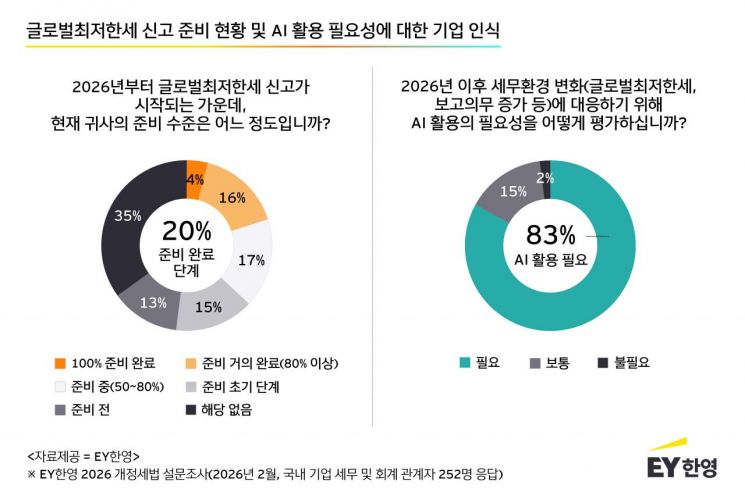
The global minimum tax, implemented in 2024, is an international tax regime that applies a minimum effective tax rate of 15% to the income of multinational enterprises. Despite the first filing deadline approaching in 2026, the level of practical preparation by companies was found to be insufficient. Only 20% of respondents from companies said they had completed (100%) or almost completed (at least 80%) their preparations for the global minimum tax. Even among companies with assets of 2 trillion won or more, only 54% of respondents said they were at the completion stage of preparation.
The issues that companies are most concerned about in relation to global minimum tax filings were, in order, tax calculation errors caused by complex calculation methods (29%), the timely collection of necessary data (24%), and ensuring the accuracy of data from overseas subsidiaries (23%).
Similar challenges were identified with respect to tax law amendments in general. When asked about difficulties related to tax law changes, 33% of respondents pointed to "the complexity of applying tax laws, including global minimum tax calculations, and the resulting increase in tax compliance costs," making it the most frequently cited issue. This was followed by insufficient internal data processing and automation capabilities to cope with tax law amendments (31%). In addition to institutional complexity, the burden of data management is also increasing.
Accordingly, the types of support needed by tax officers are also diverse. Demand was relatively evenly distributed across government and regulatory guidelines and interpretations (49%), training and seminars by tax experts (46%), practice-oriented application guidance based on case studies (46%), and calculation automation tools or systems (42%). With the introduction of new regimes such as the global minimum tax, the need for practical support is also expanding.
Due to the burden of data collection, the potential for errors, and complex calculation structures, companies are turning their attention to AI as a practical alternative. A total of 83% of respondents said that "AI utilization is necessary" in tax work to respond to the rapidly changing tax environment, including the implementation of the global minimum tax and increased reporting obligations. In contrast, only 2% responded that AI is not necessary.
In particular, the compliance task where AI-based automation technologies are expected to be most helpful is data collection and consistency verification, cited by 69% of respondents. Other areas mentioned included the automation of tax return preparation (53%) and the prediction and management of risk points in advance (43%).
Although there is broad agreement on the need to introduce AI, actual on-the-ground application is still at an early stage. Among companies subject to the global minimum tax, only 6% of respondents said they are using AI or automation technologies (for automated data collection, verification, calculation, and risk analysis), and only 13% said they are preparing to introduce such technologies. Among respondents from companies with assets of 2 trillion won or more, 33% said they are either using AI or preparing to introduce it, indicating that adoption is starting in earnest, particularly among large corporations.
Ko Kyungtae, Head of Tax at EY Korea, said, "There are limits to manual processing because not only is the volume and variety of data that must be collected for the global minimum tax enormous, but that data must also be meticulously collected and verified, then used in line with the relevant filing type," adding, "AI-based automation can be a practical alternative that minimizes calculation errors and enhances data reliability. However, from a risk management perspective, it is important to adopt a systematic approach that combines technology implementation with expert review and advisory support."
© The Asia Business Daily(www.asiae.co.kr). All rights reserved.
![Clutching a Stolen Dior Bag, Saying "I Hate Being Poor but Real"... The Grotesque Con of a "Human Knockoff" [Slate]](https://cwcontent.asiae.co.kr/asiaresize/183/2026021902243444107_1771435474.jpg)
















