Marriage and childbirth among the "echo boom generation" gather momentum
Fertility rate for women in their late 30s hits an all-time high
A faint but noticeable warmth has begun to appear in South Korea's demographic report card. The total fertility rate in 2025 came in at 0.80 children per woman, marking a rebound for the second consecutive year. In particular, women in their late 30s, who recorded the highest fertility rate since statistics began, drove the increase in births, which reached its largest scale in 15 years. However, the so-called "death cross," in which the number of deaths outstrips the number of births, has continued for six straight years.
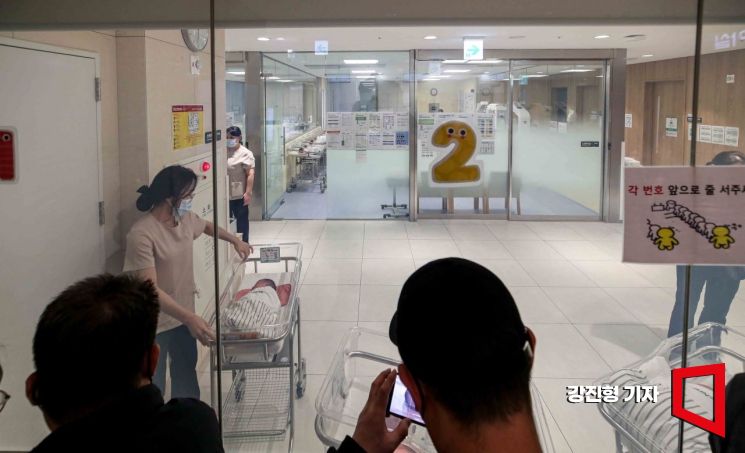 Amid Statistics Korea's announcement that last year's number of births was 238,300, an increase of 8,300 from a year earlier, on Feb. 27 parents and family members of newborns in front of the neonatal ward at Ain Hospital in Michuhol-gu, Incheon looked at the babies through the window. Feb. 27, 2025. Photo by Kang Jinhyung
Fourth-largest increase in births on record... Share of "older mothers" in their late 30s hits all-time high
On the 25th, the National Data Office released the provisional report titled "2025 Population Trends Survey: Birth and Death Statistics," containing these findings. The number of births last year was 254,500, an increase of 16,100 (6.8%) from a year earlier. This is the fourth-highest growth rate since birth statistics began in 1970, and in terms of the absolute increase in births, it is the largest in 15 years since 2010.
As a result, the total fertility rate reached 0.80, extending its rebound for a second year and recovering the 0.8 level for the first time in four years. The total fertility rate had been declining continuously since 2016, hitting an all-time low of 0.72 in 2023, before turning upward for the first time in nine years to 0.75 in 2024. On this, Park Hyunjung, Director of Population Trends at the National Data Office, explained, "Behind the rebound are the sharp increase in the number of marriages after the COVID-19 endemic phase and the growth in the population in their early 30s, which is the main childbearing age group."
The analysis is that the recent sustained increase in marriages, combined with the entry into prime marriage and childbearing age (the 30s) of the "second echo boom generation" born in the early to mid-1990s to parents of the "second baby boom generation," has powered the fertility rebound. In this cohort, each age group numbers in the 700,000s, making it larger than those born in the late 1980s, whose cohorts are in the 600,000s. In addition, according to the "Survey on Perceptions of Marriage, Childbirth, and Childrearing" released last year by the Low Fertility and Aging Society Committee, 70.8% of respondents answered that "you should have children," nearly 10 percentage points higher than in 2024 (61.1%).
Compared with other countries, South Korea tends to have a relatively high age at marriage and childbirth. Last year, the fertility rate for women in their late 30s (ages 35 to 39) was 52 births per 1,000 people, a sharp increase of 13% (6.0 births) from the previous year. The fertility rate for women in their late 30s is the highest on record since statistics began. The share of births to older mothers (age 35 or older) among all births also reached 37.3%, the highest level ever recorded. The National Data Office explained that the fact that the fertility rate for women in their late 30s has risen above the level seen when the total fertility rate exceeded 2.0 is largely due to the aging of marriage and childbirth compared with the past.
Yeonggwang in South Jeolla ranks No. 1 in fertility for 7 straight years... Population "death cross" continues for 6 years
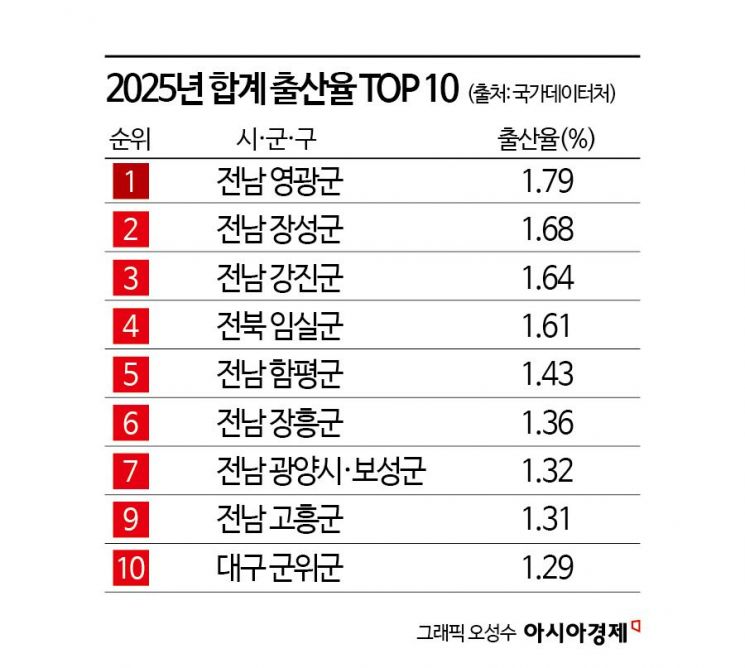
By region, among the 17 metropolitan cities and provinces, South Jeolla Province recorded the highest total fertility rate at 1.10. At the city, county, and district level, Yeonggwang County in South Jeolla posted a total fertility rate of 1.79, ranking first for the seventh consecutive year. Not only Yeonggwang County but also Jangseong County (1.68, second place) and Gangjin County (1.64, third place) were among the top 10 jurisdictions nationwide in terms of fertility, and 8 of those top 10 were basic local governments in South Jeolla Province. The only two areas in the top 10 not located in South Jeolla were Imsil County in North Jeolla Province (1.61, fourth place) and Gunwi County in Daegu (1.29, tenth place).
An official at the National Data Office said, "The reason South Jeolla's fertility rate is the highest in the country appears to be the impact of policies that actively encourage childbirth," adding, "The number of women of childbearing age is small, but their tendency to have children is strong, which also contributes to the high fertility rate." In Yeonggwang County, South Jeolla, the local government is implementing pro-birth policies that combine generous cash support, such as a 5 million won marriage incentive and up to 35 million won in childrearing subsidies for large families, with housing and job programs, and other cities and counties in South Jeolla are pursuing similar policies.
However, from a macro perspective, the shadow of low fertility still looms heavily. Last year, the number of deaths was 363,400, up 1.3% from a year earlier, and the natural population change, calculated by subtracting deaths from births, was minus 108,931, indicating that population decline due to natural decrease has continued for six consecutive years. In particular, the number of deaths among those aged 90 or older increased by 4,800 from the previous year, and the crude death rate, meaning the number of deaths per 1,000 people, stood at 7.1, up 0.1 from the year before. As the structure in which deaths outnumber births has become entrenched, 16 of the 17 metropolitan cities and provinces, all except Sejong City, experienced natural population decline.
© The Asia Business Daily(www.asiae.co.kr). All rights reserved.


















