2.1 trillion won in support tied to finance, tax cuts, and lower electricity tariffs
‘Redesign, not simple production cuts’... Full-capacity operations and shift to high value-added products in full swing
Follow-up restructuring to accelerate
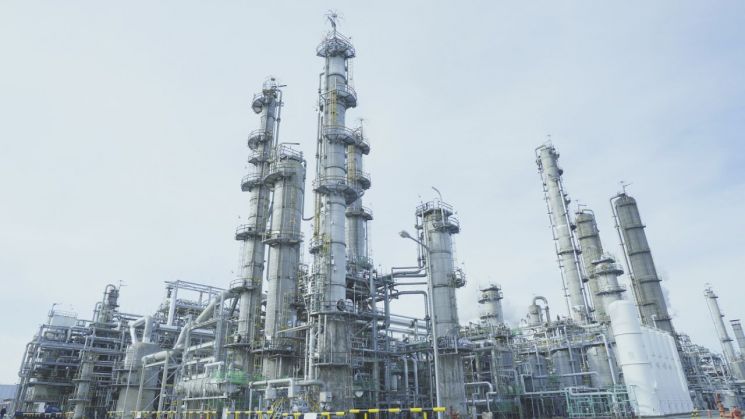
The petrochemical industry, which is facing a structural crisis due to deepening oversupply, weakening cost competitiveness, and a lack of high value-added products, has entered a full-fledged restructuring phase. The government has approved the "Petrochemical Industry Business Restructuring Project No. 1," centered on the shutdown of Lotte Chemical's 1.1 million-ton Daesan NCC (naphtha cracking center), and decided to roll out a comprehensive package worth more than 2.1 trillion won that bundles improvements in finance, taxation, costs, and licensing. This is the first implementation case following the restructuring roadmap announced last year.
The Ministry of Trade, Industry and Energy announced on the 25th that it had finally approved the business restructuring plan submitted by HD Hyundai Oilbank, HD Hyundai Chemical, and Lotte Chemical at the Economic Ministers' Meeting and the Ministers' Meeting on Strengthening Industrial Competitiveness, presided over by Koo Yuncheol, Deputy Prime Minister for Economy and Minister of Economy and Finance. The government defined this move as "the first case of preemptive and voluntary restructuring in response to an industry-wide structural crisis, rather than ex post restructuring of individual companies."
Selective reduction of 1.1 million tons... Restructuring focused on 'competitiveness' rather than 'volume'
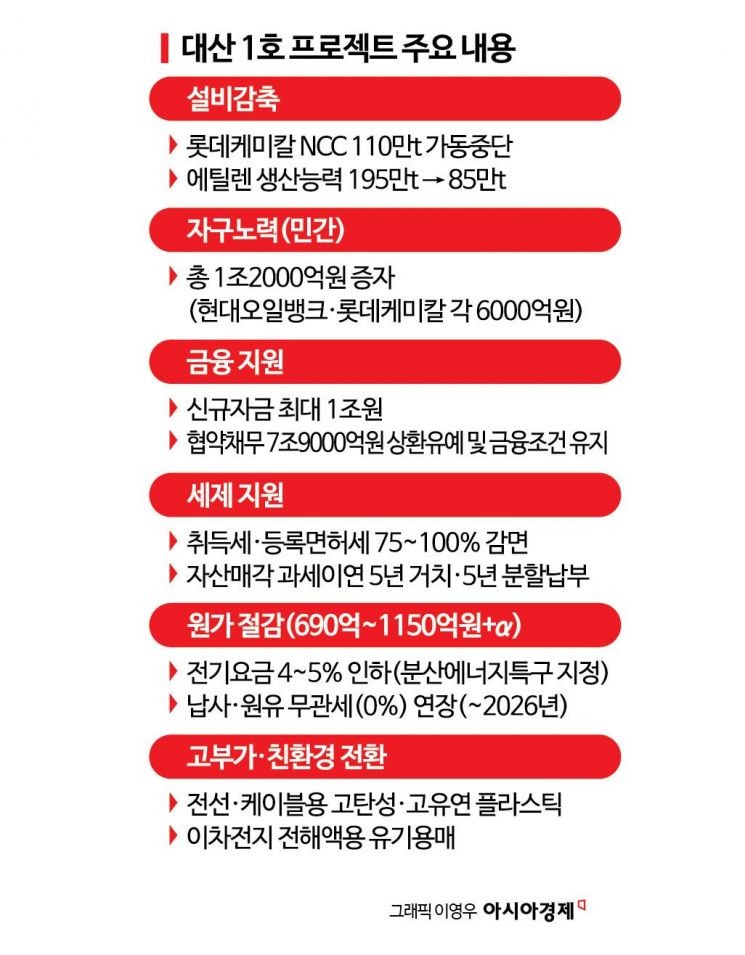
The core of this first project is not simple production cuts. Lotte Chemical's Daesan plant will be split and merged with Hyundai Chemical to establish an integrated entity, and one NCC facility with a capacity of 1.1 million tons will be shut down for three years. Ethylene production capacity within the Daesan Industrial Complex will be reduced from 1.95 million tons to 850,000 tons. However, the strategy is to raise the operating rate of the remaining facilities from the current level of around 80% to 100% to lower the fixed-cost burden and restore unit cost competitiveness.
The government is placing more emphasis on "which facilities are reduced" than on "how much is reduced." An official from the Ministry of Trade, Industry and Energy explained, "The benchmark for restructuring is competitiveness, not volume," adding, "The principle is to reduce low-efficiency facilities, switch to high-efficiency facilities, and thereby increase profitability." Regarding why the facility being shut down is Lotte's NCC, the official said, "After evaluating overlapping facilities and efficiency on a project-by-project basis, we decided to shut down the facility that was relatively less competitive."
Downstream facility reductions are expected to proceed in stages, focusing on commodity and loss-making products. However, given that product supply and demand conditions are fluid, specific volumes and facilities will be finalized during the implementation process. On the relationship with the industry's voluntarily proposed reduction target of 2.7 million to 3.7 million tons, the government drew a clear line, saying, "That figure is not a government target, and a simple additive approach is not appropriate."
The integrated entity is focused not on simple restructuring but on shifting its business portfolio. It will expand the share of high value-added products such as high-elasticity lightweight materials for wires and cables and organic solvents for secondary battery electrolytes, while simultaneously pursuing an eco-friendly transition that reduces carbon emissions by up to 50% through the introduction of bio naphtha and ethane. By vertically integrating refining and petrochemicals to operate feedstock procurement, production, and sales in an integrated manner, the company also plans to enhance operational efficiency.
1.2 trillion won in self-rescue efforts matched with 2 trillion won... Policy finance as a 'buffer'
Another feature of this restructuring model is the structure in which policy finance is matched to companies' self-rescue efforts. HD Hyundai Oilbank and Lotte Chemical will each inject 600 billion won in new capital, for a total of 1.2 trillion won. In response, the creditors have prepared a plan to provide up to 1 trillion won in new funds and to convert up to 1 trillion won of existing loans into perpetual bonds. Including the deferral of repayment and maintenance of financial terms on about 7.9 trillion won of existing agreement debt, the financial safety mechanism is described as being up to 9.9 trillion won in scale.
The government described this as "a structure in which companies and creditors place their bets together." It explained that the support scale is determined by assessing the size of self-rescue efforts and the sustainability of the business plan, making this a model that secures time for structural transition rather than merely providing temporary liquidity support. It also made clear that if self-rescue efforts are large, support can be expanded, and conversely, if they are small, support can be reduced.
Tax and cost support are also included. Acquisition tax and registration and license tax will be reduced by 75% to 100%, the deferral of corporate tax will be expanded, and the ceiling on the deduction of carried-forward losses will be raised. Daesan will be designated as a distributed energy special zone, with electricity tariffs cut by 4% to 5% compared with Korea Electric Power Corporation (KEPCO) rates, and regulations on overlapping heat (steam) supply will be eased. This will be accompanied by expanding the scope for direct imports of LNG for fuel use and extending the application of zero tariffs on naphtha and crude oil. The cost reduction effect is estimated at between 69 billion and 115 billion won over three years.
However, discussions are continuing over the extent of the electricity tariff reductions. In response to criticism that there is a gap between the level requested by companies and the reduction applied under the special zone scheme, the government said it is consulting with relevant ministries on the potential introduction of additional systems such as time-of-use tariffs and regionally differentiated tariffs. Issues of fairness with other sectors, such as steel, are also being discussed.
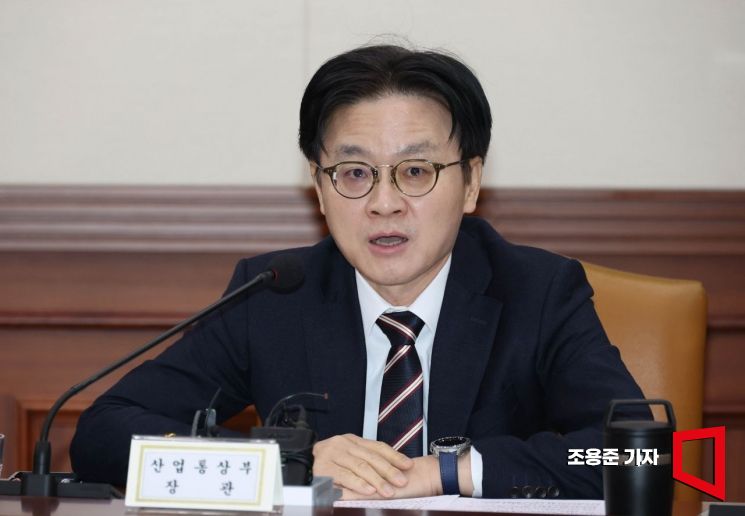 Kim Jeonggwan, Minister of Trade, Industry and Energy, is attending and speaking at the Economic Ministers' Meeting and the Ministers' Meeting on Strengthening Industrial Competitiveness held at the Government Complex Seoul in Jongno-gu, Seoul on February 25, 2026. Photo by Cho Yongjun
Restructuring projects No. 2 and No. 3 to gain rapid momentum
With the approval of Project No. 1, follow-up restructuring plans are also expected to gain speed. A total of five business restructuring plans were submitted to the Ministry of Trade, Industry and Energy at the end of last year, and excluding the Daesan Project No. 1 approved this time, four plans are about to submit their detailed proposals. In the Yeosu Industrial Complex, Yeochun NCC is preparing a detailed plan, and the possibility of a joint venture between LG Chem and GS Caltex is also being mentioned. In Ulsan, SK Geocentric, Daehan Chemical, and S-Oil are engaged in related discussions.
The industry believes that uncertainty has been largely resolved as the structure of government support has become more concrete. The support structure that combines repayment deferrals and maintenance of financial conditions with capital reinforcement is being evaluated as having served as a "buffer" for companies with heavy financial burdens. Accordingly, there are expectations that detailed restructuring plans will be submitted one after another.
However, the fundamental causes of the crisis in the petrochemical industry have not been resolved. There are concerns that if global demand remains sluggish and oversupply driven by large-scale capacity additions in China continues, the effects of improving financial structures may be limited. Critics also point out that if fundamental structural improvement and a shift toward high value-added products do not translate into tangible results, this could end up being only a one-off measure.
Eom Chanwang, Vice Chairman of the Korea Chemical Industry Council, said, "The structural crisis can only be overcome when private-sector self-rescue efforts go hand in hand with effective government support," adding, "We hope this approval will serve as a priming water that spreads restructuring across the industry."
Minister of Trade, Industry and Energy Kim Jeonggwan said, "The Daesan Project No. 1 is the first implementation outcome produced through cooperation between the government and industry," adding, "We will swiftly push ahead with follow-up business restructuring to restore the competitiveness of the petrochemical industry."
© The Asia Business Daily(www.asiae.co.kr). All rights reserved.
![Clutching a Stolen Dior Bag, Saying "I Hate Being Poor but Real"... The Grotesque Con of a "Human Knockoff" [Slate]](https://cwcontent.asiae.co.kr/asiaresize/183/2026021902243444107_1771435474.jpg)

















